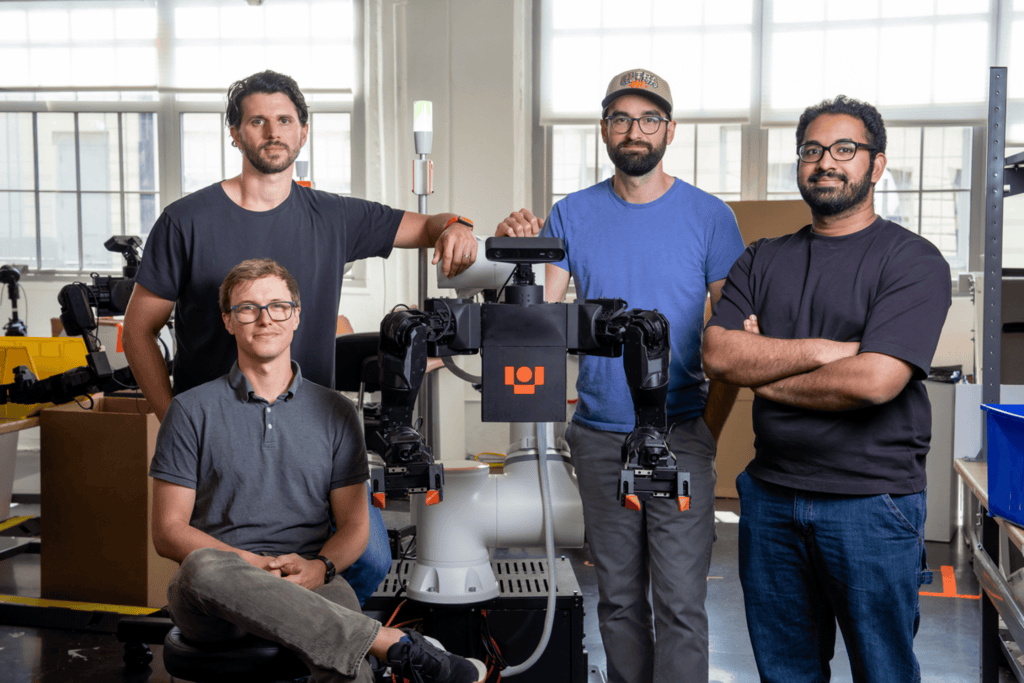
Finance editor Jeff John Roberts here. The explosive growth of the robotics industry in recent years is reflected in new technology feats, but also by the proliferation of new business and distribution models. Ultra, a startup that leases its devices to warehouses under a monthly “robots as a service” model, is a case in point. On Friday, the Brooklyn-based company announced it had raised $62 million, while also deepening a partnership with the buzzy “robot brains” AI firm Physical Intelligence.
Ultra’s funding came in two rounds: a $50 million Series A led by Framework Ventures with participation from Y Combinator, and an earlier $12 million seed round led by the latter and Next View.
In an interview with Term Sheet, Ultra CEO and co-founder Jon Miller Schwartz made a point we’re hearing a lot these days: Namely, he says humanoid robots get the lion’s share of attention, but that it is other forms of robots that are having the most impact in the real world. This phenomenon is hardly a new one: Recall how, in the 1980s, fictional robots like C3PO and Terminator’s T-800 captured the popular imagination, even as people gave little notice to new robotic arms doing actual work in auto factories.
Today, humanoid robots have made their way from the movie screen into real life, but they are prone to falling over, and their makers are struggling to deploy them in everyday situations. Ultra’s robots, on the other hand, can be found in warehouses across the country and according to the company, the devices have packed more than half a million orders for shipping.
Unlike many Silicon Valley engineers, Schwartz studied mechanical engineering, which means he and his team spend their days doing hands-on stuff with metal parts, cables and motors. That includes going to so-called 3PL (third party logistics) sites, and installing Ultra’s robots that specialize in packing goods for transit.
Ultra’s contraptions are part of a growing robot empire taking over the country’s warehouse and logistics operations. Notable players in the space include France-based
Exotec, whose robots specialize in climbing vertical racks to retrieve things and, of course, Amazon and its
fleet of devices working alongside humans in hubs across the U.S. There is also Uber founder Travis Kalanick, who is also firmly in the non-humanoid robot, and who recently stepped
back into the public eye with a plan to complete what he started at the ride-sharing firm. Kalanick’s new company, Atoms, is a massive logistics and AI play that he says will one day use one robot to cook your burrito and another to bring it to your door.
While Ultra is riding a wave, its early success has come in part from its shrewd as-a-service business model. Schwartz says the company has booked significant revenue (he didn’t disclose how much) because Ultra doesn’t require customers to lay out large amounts of capital to use its robots. Instead, clients pay an up-front integration fee for Ultra to install the robots, and then an ongoing monthly fee for ongoing hardware and software support. The model has gotten so much traction that Schwartz says Ultra has been able to raise prices.
There is a second intriguing part of Ultra’s business model, which is its decision to employ what some call the “body and brains” approach to robots. That means Ultra builds and installs the robots, but relies on Physical Intelligence to supply the AI that allows them to learn and improve rapidly in response to any given customer’s set-up. Numerous other robot makers are also using software from PI, which is valued at $5.6 billion, and was founded by a team from Google DeepMind who published a landmark paper on robotic intelligence.
The tie-up between Ultra and Physical Intelligence thus reflects a clever division of labor and distribution play—one that lets the former focus on its core robot-building competency, while PI gets out-of-the-lab data to better train its models. As for when we’ll see this sort of scaling on the humanoid robot side of things? Schwartz says give it five years.
See you Monday,
Jeff John Robertsjeff.roberts@fortune.com @jeffjohnroberts
Submit a deal for the Term Sheet newsletter
here.
Joey Abrams curated the deals section of today’s newsletter.