And, promising radiation results in lung and prostate cancers.
 

Health Rounds

Health Rounds

By Nancy Lapid, Health Science Editor

Hello Health Rounds readers! It's Nobel Prize season and today we feature promising early results of a novel technique for treating blindness that made Nobel laureates of three scientists this week. We also report on two studies comparing treatment options presented at the American Society for Radiation Oncology meeting.

Among our breaking news stories: US states label abortion drugs a 'public nuisance'; US FDA promises abortion drug safety review by March; pharma lobby sues Trump administration over Medicare drug price cuts; AI companies run virtual drug trials; and Canada to exclude mental illness as sole reason for euthanasia.

On the US influenza front: North Carolina reports its first flu death of the season; New York governor plans to seek federal help to tackle measles outbreak; and Pennsylvania measles cases rise to 1,078.

Around the world: Kenya Ebola case exposes gaps in border screenings; Russia says checks following Siberian plague lab death are complete; China has nominated health official Song Li as WHO head; and North Korea's Kim Yo Jong rejects South Korean medical aid, calls it a provocation.


Industry Updates

  • Boston Scientific sues J&J for patent infringement over heart tool.
  • US FDA flags four deaths in Newron schizophrenia drug studies.
  • Nvidia-backed Iambic Therapeutics launches IPO.
  • Viatris bets on non-opioid pain drugs with $1.65 billion Pacira deal.
  • Argenx discontinues Vyvgart study in Sjögren's disease.
  • Boots’ new owners bring needed retail tonic.
  • Glaukos eye disease treatment shows lasting benefits.
  • Zealand, Roche obesity drug helps patients lose up to 9.2% weight.
  • US FDA expands use of Novartis drug for chronic skin condition.
  • Pfizer to cut around 330 jobs in Italy, unions say
  • Halozyme wins court order to block Merck's Keytruda in select European markets.
  • Danaher to launch AI-powered autonomous research lab.


US and German scientists win Nobel medicine prize for work on light and brain

TT News Agency/Pontus Lundahl/via REUTERS

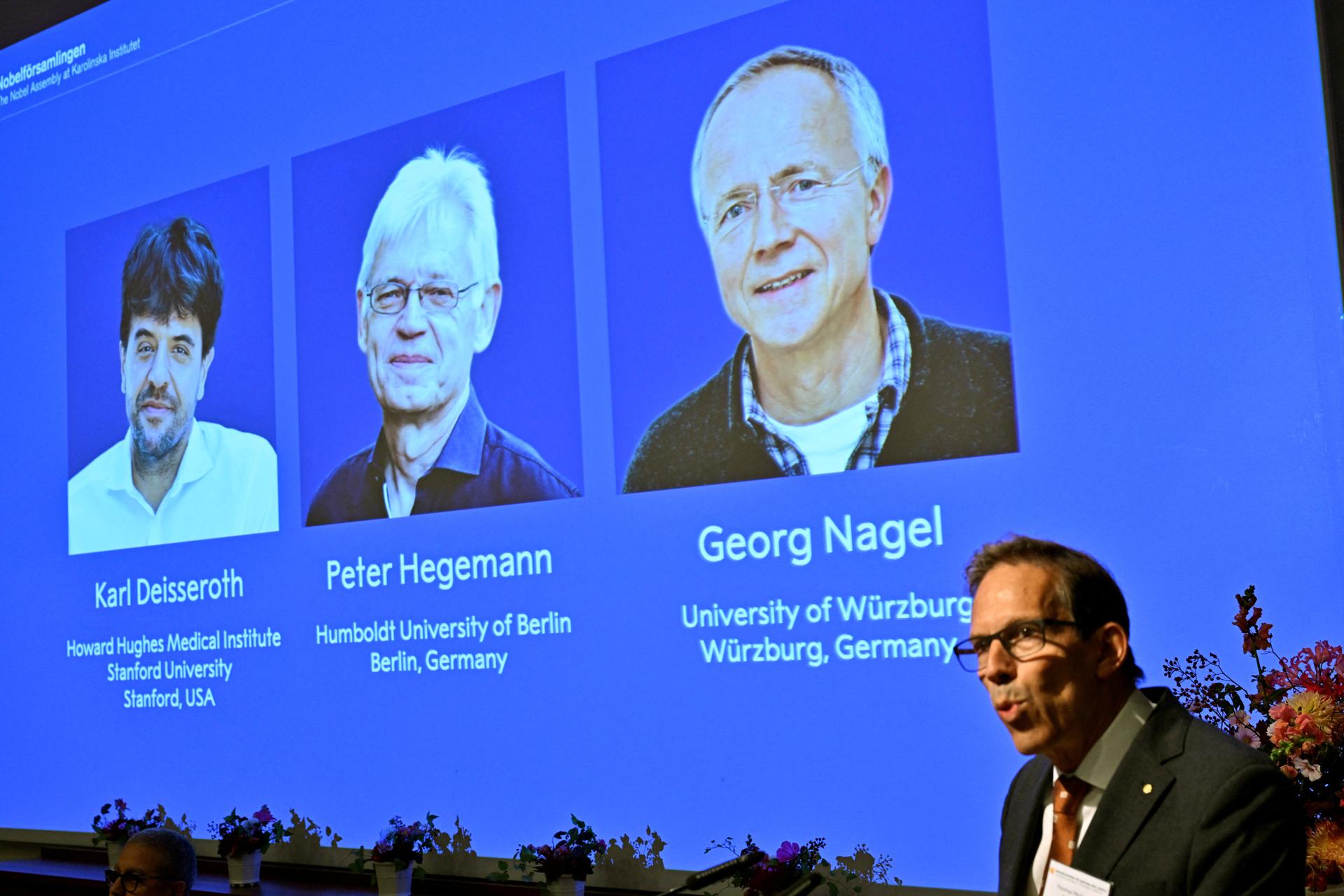
American Karl Deisseroth and Germans Peter Hegemann and Georg Nagel won the 2026 Nobel Prize in Physiology or Medicine on Monday for developing optogenetics, a technique that uses light to control individual nerve cells in the brain. Read more here.


Study Rounds

Nobel-winning therapy shows early promise in blind patients


Patients with blindness due to retinitis pigmentosa who received a treatment based on research that won the 2026 Nobel Prize in Physiology or Medicine had their ability to detect objects restored in a small trial that demonstrated the potential of the novel approach.

So-called optogenetic therapy uses light to control brain cells. In the current study, researchers combined gene therapy that made surviving retinal ganglion cells sensitive to light with delivery of light to stimulate these cells.

The 10 trial participants each received an injection into one eye carrying genetic instructions for ChrimsonR, a light-sensitive protein from GenSight Biologics.

Patients then wore goggles that captured visual information, converted it into patterns of light at wavelengths that activated ChrimsonR in the modified retinal cells, and sent the patterns of light back to the eye.

Seven patients became more sensitive to light, with six achieving clinically meaningful improvements, such as being able to detect when an object was present, determine where it was located and reach toward it accurately.

One severe adverse event occurred immediately after injection and resolved within minutes, researchers reported in The New England Journal of Medicine.

While larger studies are needed to definitively prove the usefulness of ChrimsonR and the goggles, the findings show that even at a very advanced stage of blindness, surviving retinal ganglion cells can be made responsive to light and transmit visual information to the brain, the researchers said.

"Even in people with profound vision loss, the visual system retains a remarkable capacity to process new information," study leader Dr. José-Alain Sahel of the University of Pittsburgh said in a statement.


Read more about this week's Nobel Prize announcements on Reuters.com

  • Francis Halzen wins Nobel physics prize for Antarctic 'ghost particle' hunt
  • Nobel chemistry prize goes to pair who solved mystery of 'mirror image' molecules
  • Genre-defying Canadian poet Anne Carson wins 2026 Nobel Prize in Literature
 

Radiation effective as surgery for localized prostate cancer

Radiotherapy kept localized prostate cancer under control just as well as surgery, with fewer side effects, researchers reported at the recent American Society for Radiation Oncology (ASTRO) meeting in Boston.

After a median of eight years of following patients, survival without recurrence was statistically similar. Of those who received five sessions of stereotactic body radiation therapy delivered over two weeks, 91% were alive without cancer recurrence versus 84% after surgery.

SBRT delivers the radiation directly to the prostate while limiting exposure to nearby healthy tissue.

The trial involved 123 patients, most with low- or intermediate-risk cancers who were monitored for reappearance of a tumor or a rise in prostate-specific antigen levels, a potential indicator of prostate cancer.

The trial’s original goal was to compare quality of life after the interventions. Efforts to enroll nearly twice as many participants were thwarted by the COVID pandemic, leaving the study with too few patients to answer that questi