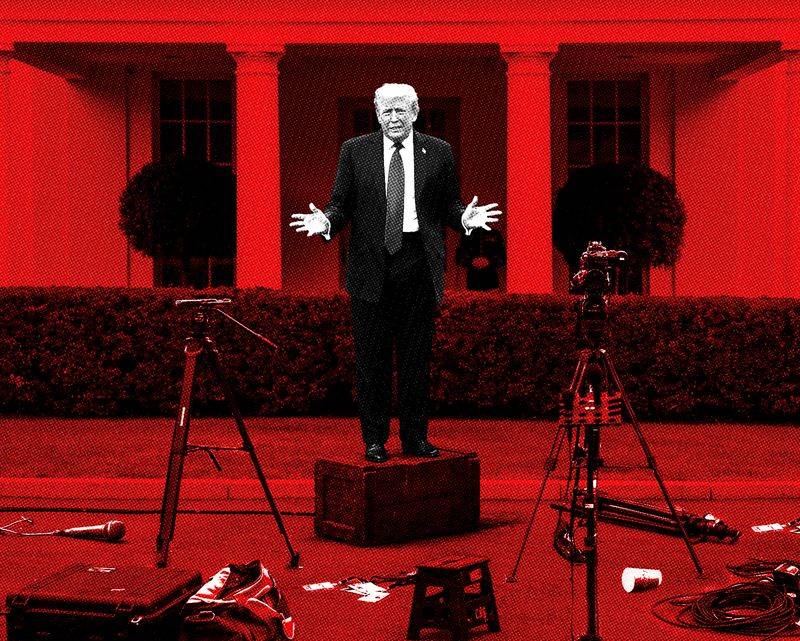
On Pebble Beach, the strip of broadcast booths that line the driveway leading up to the West Wing of the White House, you typically find some of television’s biggest stars, standing erect atop little wooden boxes, the glow of the camera light dancing off their thick coats of makeup, readying themselves to deliver a hit with the most famous building in the world as their backdrop.
This week, many of those booths sat empty, rain lashing the hunter green tarps that covered them, as President Donald Trump’s ban of three news outlets from the White House metastasized into a broader boycott by the press. It was unseasonably quiet inside the cramped press rooms of the White House, which are typically bustling with journalists awaiting the next hit or the daily briefing, though the latter hasn’t happened with much regularity as of late.
On Wednesday, two bored members of the press corps sat in the briefing room and debated the timing of the court hearing on the challenge to Trump’s ban. A young press aide walked into the room and complained about her cell reception. “Why do I never have service in my office?” she asked no one in particular. “It must be China.” Raghubir Goyal, an eccentric veteran of the briefing room who serves as White House correspondent for India Globe, a newspaper that appears to no longer exist, stood at the press secretary’s dusty podium and filmed selfie videos.
Earlier this year, Trump barred reporters from “upper press”—the rooms down the hall from the Oval Office that house senior communications aides—which has made the West Wing a considerably less valuable place for reporters to be. “You can’t go into upper press and talk to someone with authority,” says one White House reporter who now prefers to make calls from his members club.
Trump announced the decision to ban the three outlets—CNN, MS Now, and Politico—abruptly, without warning some of his top staffers. A White House official, declining to be named, tells Vanity Fair: “Nobody close to the president was surprised at his action to hold the fake news accountable.” Susie Wiles was miles away from Washington when it was decreed on Truth Social, and those left at the White House on Friday afternoon scrambled to figure out how to implement the president’s order. Some aides advised against the revocations, I’m told, warning it would have unintended consequences for Trump’s coverage. He ignored them. (Vanity Fair has reached out to the White House for comment.)
The hastiness helps to explain why the administration’s defenses of the order varied so exotically. It’s “a ban on the free press,” Trump said in the Oval Office. “We are banning them, yes, we are.” Clear enough. No, wait, here’s the vice president: “He’s not banning media outlets.” JD Vance went on to blame the ban that is not a ban on biased coverage. “About 92% of the stories that they have on the president of the United States, on the administration, are negative,” he reasoned. The White House, in its own statement, said Trump was banning outlets “friendly to the Radical Left.” Then, in a court filing, Trump’s Justice Department argued the trouble was not bias but that reporting from these outlets posed a threat to national security.
To make its case, the Department of Justice has cited examples of reporting it said were demonstrative of this threat. One, a Politico report from June, was based on information from a “senior administration official.” It was quickly reported by the media newsletter Status that the anonymous source for the story was Vice President JD Vance.
US District Judge Timothy Kelly, who was appointed to the bench by Trump, was understandably confused by these explanations. “Nothing in the record that predates this suit suggests that the revocation of Plaintiffs’ hard passes was motivated by national security concerns,” he said, granting a temporary restraining order Thursday morning that returns press passes to the targeted outlets for at least two weeks. “Certainly, that is not what President Trump said when he announced that he was ‘banning’ Plaintiffs from the White House—instead, he focused on the alleged lack of truthfulness and negativity of Plaintiffs’ reporting.” (Condé Nast, Vanity Fair’s publisher, joined an amicus brief in support of the plaintiffs.)
By midday on Thursday, the White House restored access and the reporters who had been banned made their triumphant returns to the asphalt shores of Pebble Beach.
Trump has been down this road enough times to have anticipated defeat. Earlier in the week, before Judge Kelly heard arguments, Trump predicted the ban would be struck down—and promised to appeal.
What Trump didn’t anticipate when he launched this fresh war, I'm told, is that the networks would fight back. The outlets that make up the television pool—a group of five that includes Fox News—stood in solidarity with CNN and boycotted coverage of the White House rather than sub another outlet in for the network and continue broadcasting the president to their audiences.
“Before the networks issued statements standing with CNN, Trump was conveying to his team that he didn’t think the outlets had the balls to stand up together and do something about it,” a source says. “He was calling the media’s bluff. He was banking on someone else swooping in and taking CNN’s place. And that’s obviously not what happened.”
“The guy was buying the whole news industry with a return phone call,” Jimmy Breslin once said of the relationship between Trump and the press. “The news people provided Trump with the currency of his life, publicity, and he believed it was real and the news people believed him right back.”
That was back in 1991, when Trump muscled his way into New York’s ravenous tabloids and dreary business pages by offering what they needed most: a saucy quote, available on demand. Trump soon traded up for television—The View, Good Morning America, and eventually Fox News, the perch from which he would launch his political career—by the sheer force of his gab. “The next time Iran attacks this country, go in and grab one of their big oil installations,” he told a wide-eyed Barbara Walters in 1987. “I have tremendous respect for the Japanese people,” he told Oprah Winfrey in 1988. Ivanka Trump had “always been very voluptuous,” he told Howard Stern in 2006. “Cher is kind of a loser,” he told Greta Van Susteren in 2015.
It was, for decades, a fruitful symbiosis. Like the tabloids of the 1980s who couldn’t resist a yarn from the brash real estate developer from Queens, the cable news networks enjoyed their boom times when Trump stormed the White House in 2016. Ratings soared and stars were minted through ’round-the-clock coverage of the car crash no one could look away from. Trump, while he routinely assailed the “fake news media” as a matter of campaign strategy, still took calls from reporters and sat for interviews.
The president has declared the occasional war on the media since, but his ban of three top outlets from the White House presents a new kind of rupture. Battered for months by bad headlines over the war with Iran and rising prices at home, which have sent his approval rating to unprecedented lows, he’s pushing the boundaries of a trusted old formula. Yet here he may have gone too far. The boycott by the press in response meant pooled video coverage of the president was suspended throughout the week, leaving Trump, for the first time in his political career, without a boom mic to shout into.
The result was a series of moments...Read the rest of the story by clicking here.