|
|
|
|
Good morning. We attended Canada’s largest artificial intelligence and technology event, which showcased the strength of the domestic AI ecosystem. One theme at the event was how our country is trying to chart its own path in AI development as the U.S. and China vie for supremacy. Will it work? |
|
|
|
|
|
|
|
|
|
|
|
|
|
|
|
|
Oversight: Health Canada suspended the licence of the Grifols plasma collection site in Winnipeg where a young donor experienced heart problems that led to her death last year. |
|
|
|
|
|
|
|
|
|
|
On defence: Bell Canada partnered with Cohere to develop an AI model that can provide the context organizations need to conduct cybersecurity investigations. |
|
|
|
|
|
|
|
|
|
|
|
|
|
|
|
The All In 2026 AI conference in Montreal was held on Sept. 16 and 17. Christinne Muschi/The Canadian Press
|
|
|
|
|
|
|
|
|
|
|
|
|
|
|
|
|
AI is a bubble. I don’t mean in the financial sense (okay, maybe) but in the ideological sense. |
|
|
|
|
Last week, I went to Montreal for All In, a two-day AI industry extravaganza with thousands of lanyard-wearing evangelists ready to promote their companies’ latest AI-powered workflow solutions. Federal AI Minister Evan Solomon was there, along with executives from Cohere, Nvidia and OpenAI. |
|
|
|
|
There was some caution in the air – especially in light of calls from Anthropic and other AI labs to pace development – but overall, the mood was optimistic. |
|
|
|
|
|
|
|
|
That was not the case outside the downtown convention centre, where protesters clogged the streets early Wednesday evening as police officers in riot gear stood watch. The protesters carried signs decrying AI as “fascist” and unfurled a banner reading “All Out.” Cohere CEO Aidan Gomez eyed the protests warily as he walked past, headed to a private event featuring chess superstar Magnus Carlsen. Overnight, vandals had smashed windows
at the building housing Mila, Quebec’s non-profit AI research hub, and spray-painted messages such as “burn the data centres” on its walls. |
|
|
|
|
When I casually asked people at All In about the protests, I received a mix of genuine befuddlement, blame pointed at the media for fixating on the negatives, and a sense that the public just doesn’t understand the potential of AI and fears change. The public anxiety is no surprise, though, especially when some of the developers of this technology profess it will destroy jobs and potentially humanity someday. |
|
|
|
|
What I’ve been interested in is how Canada will respond to these opportunities and anxieties. |
|
|
|
|
So much of what happens with AI development is beyond our direct control, given the biggest companies are in the U.S. and our relationship with that country is not the greatest these days. As much as we like to say Canada invented AI, the country is behind. But what emerged at All In is how Canada is trying to chart a different path, which I wrote about recently. |
|
|
|
|
|
|
|
|
|
AI Minister Evan Solomon, from left, and German digital transformation minister Karsten Wildberger listen to Canadian computer scientist Yoshua Bengio speak at All In. ANDREJ IVANOV/AFP/Getty Images
|
|
|
|
|
One example is the Canadian and German governments partnering to provide up to $300-million to non-profit LawZero.
Founder Yoshua Bengio is one of the Canadians credited with helping invent modern AI, and someone who has become deeply concerned about the possibility that superintelligent systems could go rogue or outsmart us. He is betting that LawZero can create AI that does not exhibit the alarming behaviours we’re seeing today, and develop a guardrail to keep other systems in check. |
|
|
|
|
What might be underappreciated is just how much of a moonshot LawZero is. Bengio plans to do away with some of the fundamentals that have led to huge advances in AI, but ones that he believes are responsible for harmful traits. In the long run, his system has to be smarter than the most capable commercial AI models, meaning LawZero will need a lot more than $300-million dollars. That’s why he’s in talks with other governments for funding, too. |
|
|
|
|
“Betting against Yoshua is not a good idea,” Hugo Larochelle told me, Mila’s scientific director who completed his PhD under Bengio. In his view, LawZero can make important contributions to AI safety even if it doesn’t end up replacing today’s systems entirely. “The more we invest in a number of directions, the better prepared we’ll be,” he said. |
|
|
|
|
If not, we’ll have a lot more than broken windows to worry about. |
|
|
|
|
|
|
|
|
|
|
|
|
|
|
|
|
|
|
|
|
|
|
|
|
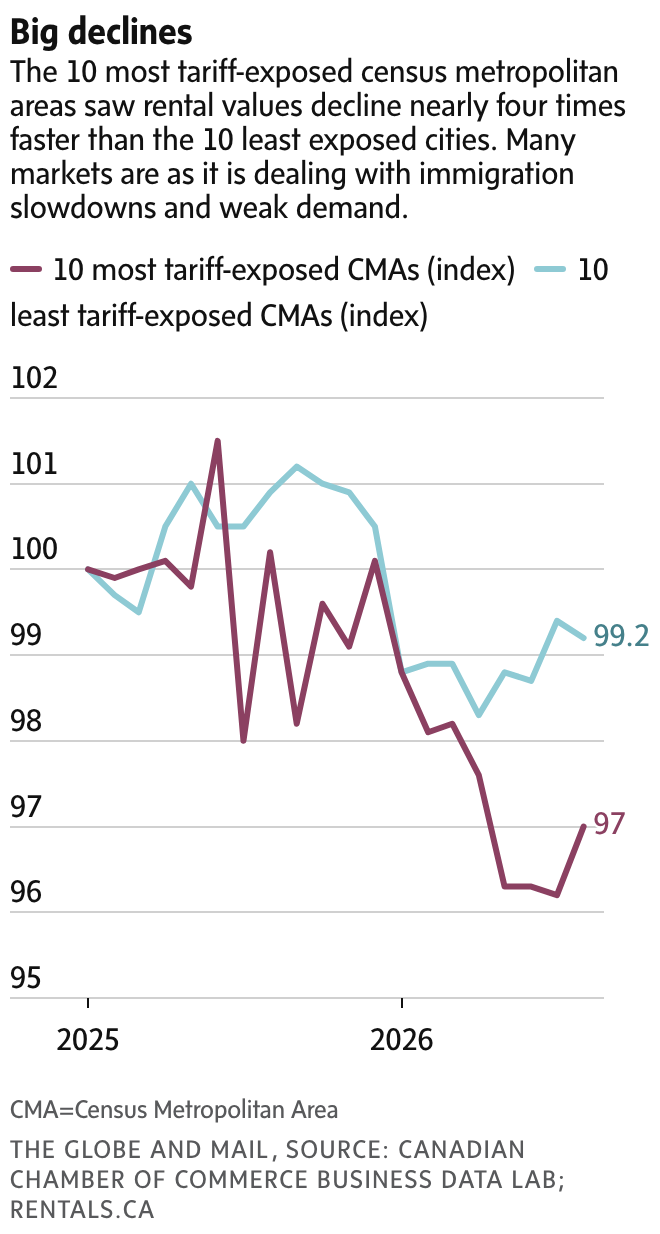
Rental rates are dropping much faster in cities that are the most exposed to U.S. tariffs, such as Oshawa and Kitchener-Waterloo, Ont., compared with the communities least affected by the trade war, Salmaan Farooqui reports. |
|
|
|
|
|
|
|
|
|
|
|
|
|
|
|
|
|
|