
|
 |


We’ve speculated that Trump’s “ban” on CNN, MS NOW, and Politico was not a policy that had been thought out in advance, but rather something the President launched off the cuff on Truth Social. It looks more and more like that’s the case. It’s not just that Trump TV was launched that same day with little more than a camera and bad audio. Shortly before midnight Tuesday, the government filed its response to the journalists’ motion for a temporary restraining order (TRO) against the ban. But the government lawyers were left without a good argument after Trump acted so abruptly. The response reads as little more than an after-the-fact effort to justify and smooth over what Trump did.
It doesn’t seem like it’s going to work.
Judge Kelly didn’t rule from the bench following the hearing today. He said he would rule as soon as possible. That’s not surprising. He will likely want to write an opinion that takes into account the arguments the parties made in court today, knowing full well this is going on appeal and Trump has made clear he’s prepared to take the fight to the Supreme Court. That’s because there’s precedent that stands in the way of what Trump wants, Sherrill v. Knight, which we discussed Saturday night, before the plaintiffs had even filed their lawsuit. It’s controlling case law that says once the government opens up space to the press, it can’t arbitrarily exclude journalists or cut them out because it doesn’t like their views.
That’s the law. Donald Trump’s lawyers know that, and a serious conversation in the White House before he banned the media outlets would have exposed the legal flaw in his plan. His lawyers had only one option—to ask that Sherrill be overturned. They didn’t need Judge Kelly to point out, as he did at the start of the hearing today, that he’s not the judge who can do that. Sherrill, a Court of Appeals decision, can only be overruled by the D.C. Circuit sitting en banc (all active judges on the court, not just a three-judge panel) or by the Supreme Court. Trump’s lawyers are raising the issue now, as they must to preserve it, but their argument for reversing it is only half-hearted.
Here’s what Trump’s lawyers were reduced to arguing about Sherrill in their brief: “That decision is wrong and should be overruled. But even under Sherrill, the President’s actions must be sustained because the President has ‘compelling interest[s]’ in enforcing minimum standards for bona fide journalists and safeguarding national security information. At the very least, the Government may control reporters’ access to restricted presidential areas, such as the Oval Office, even for viewpoint-discriminatory reasons.”
So first, there’s no real argument here that Sherrill is wrong. The most that the court gets from the government is the bit about minimum standards. What the government apparently means by that is “Nothing about Sherrill is inconsistent with the President’s judgment that reporters who publish classified and sensitive information fail to meet the Sherill [sic] standard.” (Pro tip for government lawyers: Proofread your brief and spell the name of the case you want the court to reverse correctly throughout.)
The Pentagon Papers case established the rule that the government cannot prevent a journalist from publishing classified information unless it shows the publication will do direct, immediate, and grave harm to national security. It stands to reason that the government cannot punish what it cannot prevent. The government argues that “reporters who publish classified and sensitive information” are not entitled to the access Sherrill grants, but that argument is a failure on its face. Everything they point to is core, First Amendment-protected activity.
Example: Politico is accused of publishing a piece that was a less-than-flattering assessment of Trump’s recent midterm GOP convention in Texas. Direct, immediate, and grave harm to national security? Not happening as a result of that story.
Example: Oliver Darcy scooped that another item the government relied on in a Politico story was information gleaned during a call with the Vice President on background, so apparently the White House thought it was fine to share that information with the press.
Example: “In August 2026, MSNOW claimed that the Iran conflict had ‘significantly depleted’ the US military’s munitions supply.” That’s true. They did it based on a document that was published in the Federal Register, hardly a national security breach.
The government, embarrassingly, tries to suggest that the press, doing its job, is a danger to national security. What they’re really a danger to is, of course, the President’s ability to get away with grotesque misconduct, whether it's his son’s Russian oligarch-paid post-wedding party, or his most recent efforts to suppress the vote.
Judge Kelly asked Ted Boutrous, the plaintiffs’ lawyer, whether the White House could revoke a journalist’s press credentials for publishing classified information that the administration believed endangered national security. Boutrous said that would amount to unconstitutional “viewpoint discrimination” and threaten aggressive national security reporting.
Boutrous encapsulated his case by saying President Trump is basically “our lead witness” because he keeps making plain why the ban happened: he doesn’t like the outlets’ coverage.
As we’ve discussed, the plaintiffs offered the court two grounds for rejecting Trump’s ban. First, they argue that it violates the Due Process Clause of the Fifth Amendment. Second, they argue that it violates the First Amendment in two separate but related ways: by retaliating against the media plaintiffs and by discriminating against them based on viewpoint. There is an important technical legal point here: The plaintiffs don’t have to prevail on all of these arguments. To establish that the ban is likely unconstitutional, they need to prevail on only one.
Due process is the cleaner path to getting there. The violation is plain: The media outlets did not get notice in advance of Trump’s Truth Social post and had no opportunity to be heard before it went into effect. The government was reduced to arguing that it sent out letters days after the fact and was giving the outlets until Friday to respond. But that’s laughable. Due process requires notice and an opportunity to be heard before the adverse action is taken. As Judge Kelly said in the hearing today, “I don’t know how a letter that they got after the pass was revoked could provide them with the kind of — the standard that they’d have to conform their conduct to.”
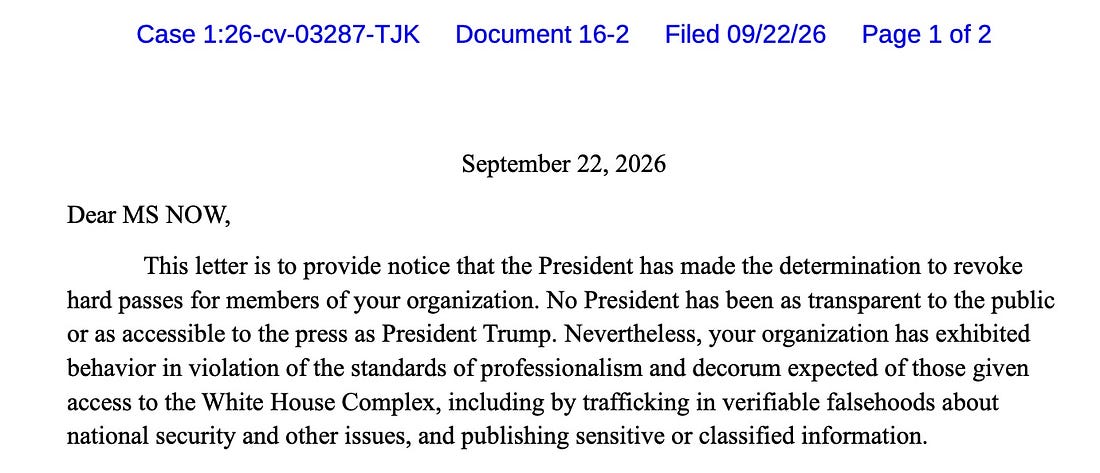
Side point: The letters themselves are just…off. Boutrous said today that he “didn’t think they were real” at first. Here’s the MSNOW letter, with no letterhead. It has no signature either. Tell me the President acted without any advance preparation, without coming out and saying it.
 |
This situation is reminiscent of when Trump went after Jim Acosta by taking away his hard pass because he was “rude.” This same judge found that the due process violation alone was enough to temporarily block the White House’s action against Acosta, without even reaching his First Amendment claim. After he made that decision, “Presidential press secretary Sarah Huckabee Sanders said…that Acosta's press pass would be restored and the White House would ‘develop rules and processes to ensure fair and orderly press conferences in the future.’”
Apparently, Trump didn’t learn the lesson, and his increasing unwillingness to back down has forced his lawyers into a dubious position. The required due process had to come before the press credentials were revoked, not after. His lawyers can’t change the fact that that didn’t happen. And the judge could rule, as he did in Acosta’s case, that the plaintiffs have made a sufficient showing to warrant a TRO on due process grounds alone, without ever reaching the First Amendment.
But here’s the catch: If the judge restores the plaintiffs’ hard passes, the White House could turn around and revoke them again, taking the approach Sanders laid out in 2018. It could establish standards, give the plaintiffs notice and an opportunity to respond, and then yank their passes again. The plaintiffs could still challenge whether that process was genuine or adequate, but the First Amendment issue would then be squarely on the table. If the court doesn’t consider it now, the plaintiffs could end up in a cycle of having their White House access restored, only to have it revoked again, seriously disrupting the work they do for the American people.
Trump, as Boutrous pointed out, is the plaintiffs’ best witness on the First Amendment issues. Trump doesn’t like their criticism of him and doesn’t think he should have to tolerate it. That’s why he banned them. That’s a clear-cut First Amendment violation. Days later, his lawyers offered the half-hearted “national security” argument that doesn’t hold water. It walks like a duck and quacks like a duck, and the press shouldn’t be burdened, especially just weeks out from a key election, with having to fight over and over for the right to do their constitutionally protected jobs, in the face of a president who acknowledged, when he banned them, that it was because of what they had to say about his administration. It’s just like the Acosta case, where Boutrous, also the lawyer then, rejected the White House’s assessment of his client’s questions of Trump as rude, saying "'Rudeness' is really a code word for 'I don't like you being an aggressive reporter.'"
In other words, we’re back where we were at the start: This is a case about whether the press can criticize the president. The Constitution says yes.
Trump’s lawyers try to sidestep the First Amendment argument by reframing the issue as one of access to the White House. In their