




Xi Jinping touches down in the United States today for the first time in more than a decade. A lot has changed since Xi’s 2015 bilateral with then-President Barack Obama, and he and Donald Trump will have plenty to talk about: Taiwan, AI, trade, and China’s rare-earth mineral supply. But we’re sure our extremely smart and cunning president will keep him in line. Happy Wednesday.
|

Join Mark Hertling and Ben Parker for Command Post today at 10:30 a.m. EDT live on Substack and YouTube.
 |
Are You Ready to Grumble?
by Brendan Hartnett
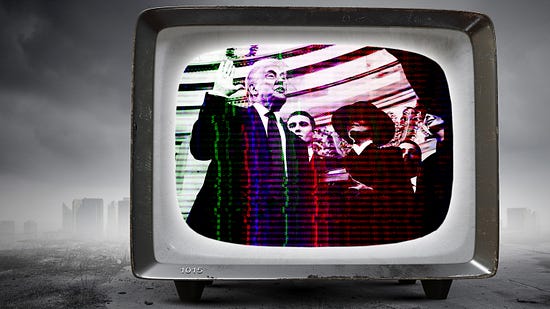
[Editor’s note: Brendan Hartnett watched six hours of Trump TV soon after it debuted. His diary of the experience—and his review of the confounding “entertainment” product—is in The Bulwark this morning. Read the whole thing here. An excerpt appears below.]
In the course of my normal work, I have watched hundreds of Trump’s speeches, interviews, and rallies—along with countless events featuring Trump White House personnel. Whatever one thinks about Trump, he is an entertainer, and I do admit to frequently laughing during his events—most of the time at him, though occasionally with him. However, despite the White House’s content-free hypeposting on X about the new channel, the premiere of Trump TV arrived without humor. Or, really, any entertainment, or even basic interest. Want to know what it’s like to struggle to remember the sound you make when you laugh? Come along with me to see what happens when you hook yourself up to Trump TV. . . .
8:24 p.m. — I’m frankly perplexed by the decision to broadcast this speech now. When he delivered it, Trump was at his peak. MAGA appeared to have won the culture war. Trump seemed well on his way to establishing a formidable multiracial working class coalition. But, viewed in September 2026, the speech doesn’t come across as an emblem of the good times. It’s really just a reminder of all the things Trump promised and failed to deliver:
“Never again will the immense power of the state be weaponized to persecute political opponents. . . . Under my leadership, we will restore fair, equal, and impartial justice under the constitutional rule of law.”
“I will also sign an executive order to immediately stop all government censorship and bring free speech back to America.”
“I will direct all members of my cabinet to marshal the vast powers at their disposal to defeat what was record inflation and rapidly bring down costs and prices. The inflation crisis was caused by massive overspending and escalating energy prices. . . . We will bring prices down, fill our strategic reserves up again right to the top, and export American energy all over the world.”
“We will measure our success not only by the battles we win but also by the wars that we end—and perhaps most importantly, the wars we never get into.”
“Our power will stop all wars and bring a new spirit of unity to a world that has been angry, violent, and totally unpredictable.”
“And we will pursue our manifest destiny into the stars, launching American astronauts to plant the Stars and Stripes on the planet Mars.”
That last line gave me my first laugh. . . .
9:49 p.m. — The military exercise from last year is still on, and 2,692 people are still watching. Surely a good chunk of these people have fallen asleep with this playing in the background. Will any old people die while watching this, slumped over in a La-Z-Boy while Trump TV plays in the background?
Have you ever envied them, the dead? . . .
11:28 p.m. — We’re off to Switzerland for Trump’s 2026 speech in Davos. I remember watching this live. It’s a long speech. I’m so f[—]d.
Friendship Ended With [CANADA]. Now [BELARUS] Is My Best Friend.
by Andrew Egger
Donald Trump spoke to the UN General Assembly yesterday. By his standards, it was a short and even a restrained speech. He wrapped it up in about 45 minutes and didn’t bring up the UN building’s terrazzo floors once. It was also deeply evil—the now-standard manifesto for international institutions to be dismantled and for strong countries to do what they wish while weak countries suffer what they must.
“It was a war, but it’s perhaps the biggest deal ever made,” Trump said of decapitating Venezuela’s government and seizing its oil reserves. “To the victor belong the spoils. . . . We will use our unmatched military might to secure the vital national interests of the United States.”
It was the usual Trump sickness. To be honest, I’m a little tired of talking about it. It’s bad; we all know it’s bad; you don’t need me to tell you why it’s bad.¹ Instead, if you’ll humor me, I want to talk a bit about potash.
Potash, potassium salts, is used to make potassium fertilizer, one of several fertilizers crucial to America’s farm economy. The United States has meager potash reserves. Happily, there are massive deposits of it just over our northern border, up in Saskatchewan. America typically imports nearly 8 million tons of Canadian potash a year. That’s 80 percent of what we use. Canada has the fertilizer; we have the climate and soil for the crops; we buy their potash and sell them (and other countries) our soybeans and corn. Canada and America’s long cooperation have allowed this trade to grow into an enormous and incredibly efficient economic machine, driving down costs for everybody. Everybody wins.
Now, however, that setup is threatened. Donald Trump doesn’t believe that international trade is ever a win-win. If we’re buying from other countries more than they’re buying from us, they’re ripping us off, full stop. As a result, he’s declared a trade war on Canada. The potash industry hasn’t been hit by direct tariffs yet, but American farmers are understandably freaked out that it will.
Not to worry, though! Trump has a plan. “The United States is working on a massive Deal with respect to the purchase of Potash from Belarus,” he wrote on Truth Social this week. “The pricing would be for substantially less than we are currently paying to Canada, very good news for our Farmers and Ranchers.”
What a relief! There are only many problems.
For one, Belarus doesn’t have the potash to spare. “Even if we wanted to supply [potash] to other, Western markets, we simply do not have those volumes—everything is contracted for this year,” dictator Alexander Lukashenko said Monday when asked about Trump’s post.
For another, we wouldn’t have any way to get it. Belarus is landlocked, and the country is under EU sanctions thanks to its human rights abuses and participation in Russia’s war on Ukraine; getting its potash out to us would require America to convince the EU to let it ship through Lithuanian ports—or to convince Russia to let it ship through Russian ones. The State Department has been wheedling the EU on this very point this year, but so far no dice.
Lastly and most obviously, getting our hands on Belarusian potash wouldn’t offer cost improvements even if we could. Getting our potash down from Saskatchewan is easy; they throw it on trains that run straight down into the upper Midwest. Getting it from Belarus (again, even if we could) would be far more logistically complex: trains from Belarus to the Baltic Sea, bulk carriers out across the Atlantic and into the Gulf of Mexico, river barges up the Mississippi to the farm belt. Global shipping has gotten very cheap, but still: Every step costs money, particularly when there’s energy shortages going on.
I hope I’ve made my point. The whole idea of Belarusian potash replacing Canadian potash in our supply chains is Trump’s unique economic ignorance on full display—his total contempt for any international trade that doesn’t result from some international boardroom deal that he himself signed.² The potash trade is just one example, but Trump has been trying hard to run the whole economy this way—even before he really got himself into trouble in Iran. Any supply chain