
|
 |
Here are the facts:
In 2021, 34,594 people subscribed to Popular Information after organically seeing our reporting on Google, Facebook, and Twitter (now X).
We are two-thirds of the way through 2026, and just 1153 people have subscribed to Popular Information from those same platforms.
Our work is better than it was five years ago. (We were recently awarded the David Nyhan Prize for Public Policy Journalism by Harvard’s Shorenstein Center.)
But the billionaires who control Google, Facebook, and X have made the decision to choke off traffic to independent outlets like Popular Information. They are not interested in building an audience for stories like the one you are about to read.
This means that in order to survive, we need to decouple our success from the whims of tech oligarchs. That will require investing in new ways to spread the word about our journalism.
To do this, we need your help. If just a small percentage of free subscribers like you upgrade to a paid subscription ($50/year or $6/month), we can expand our reach and magnify our impact.
Thank you for your readership and consideration.
— Judd
Democrats capitulate to MAGA media mogul
California Attorney General Rob Bonta (D) and 11 other states drop their lawsuit to block David Ellison’s Paramount from acquiring Warner Bros. — and get little in return.
| |||||||||||||||


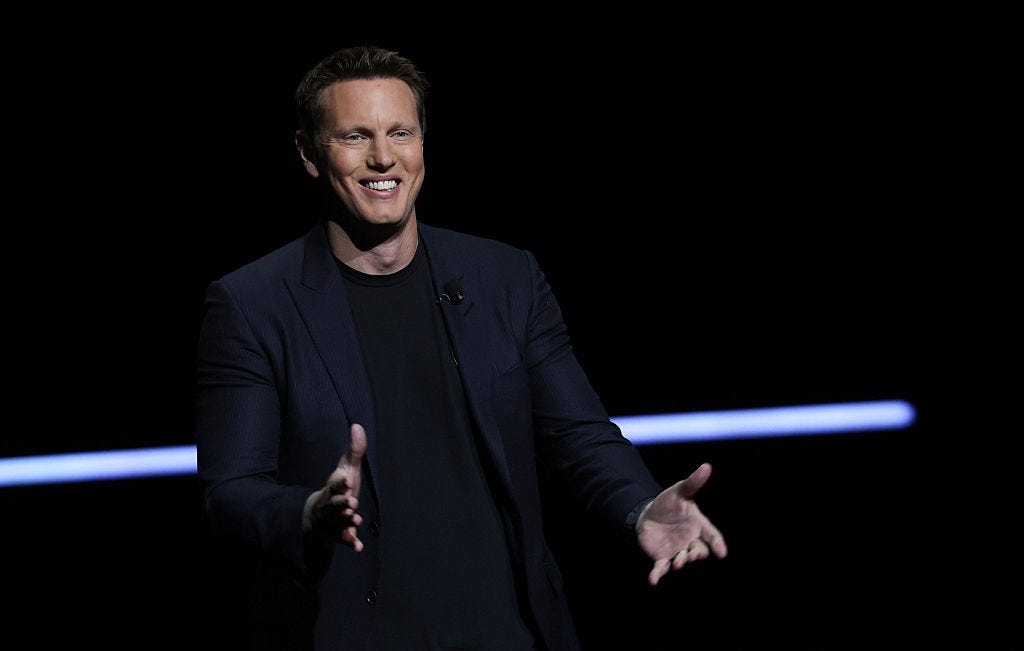 |
Paramount, controlled by Trump-supporting media mogul David Ellison, is attempting a $110 billion takeover of Warner Bros. The combined company would own two of the largest movie studios (Paramount Pictures and Warner Bros. Pictures), two of the largest streaming platforms (Paramount+ and HBO Max), and a slew of broadcast and cable TV networks (CBS, CNN, MTV, Nickelodeon, Comedy Central, Showtime, HBO, TNT, TBS, truTV, Animal Planet, Cartoon Network, and Food Network).
On July 13, after the Department of Justice declined to challenge the transaction on antitrust grounds, a group of 12 Democratic attorneys general, led by California Attorney General Rob Bonta, filed suit. Their complaint argued that the proposed merger “would extinguish competition between Paramount and Warner Bros. and inflict substantial harm on movie theatres, basic cable distributors, and, ultimately, audiences nationwide.”
In short order, Bonta and the other attorneys general had Paramount over a barrel. On July 20, a federal judge granted a request for a temporary restraining order (TRO) blocking the merger. The court’s order did not require the states to post a bond, which is sometimes required to cover potential losses to the defendant if the lawsuit is ultimately unsuccessful.
Paramount, eager to avoid an even more damaging preliminary injunction, agreed on July 24 not to proceed with the merger until five days after a ruling on the merits of the suit or June 1, 2027. This created a big problem for Paramount because it had agreed as part of its offer to Warner Bros. to pay $7 million per day if the deal did not close by October 1, 2026.
On August 17, Paramount reversed course and attempted to amend its stipulation to require the states to post a $1.88 billion bond to cover the $7 million daily ticking fee and other costs. A hearing was scheduled for September 24 on that issue. There was no indication, however, that Paramount’s gambit would be successful. The same judge had already granted a TRO without requiring a bond and Paramount voluntarily stipulated to delay the closing pending a ruling on the merits without a bond.
Paramount paired its more aggressive legal strategy with threats to leave California if the lawsuit continued. This bullying tactic convinced several prominent Democratic officials in California, including Governor Gavin Newsom and Los Angeles Mayor Karen Bass, to call on Bonta to settle.
On Monday, days away from a hearing that likely would have left Paramount in an even weaker negotiating position, Bonta and the other attorneys general agreed to drop the lawsuit. A real settlement would have included an agreement from Paramount to divest important assets — some of its cable TV assets like CNN or its 49% interest in a third movie studio, Miramax. But the deal, formalized in a consent decree, did not require any divestiture.
The consent decree, moreover, does not include any real concessions by Paramount.
A prime example of the vacuousness of the settlement is the requirement for an “Editorial Independence Board.” The consent decree requires the new combined entity to create this group within 180 days of the merger closing. The Editorial Independence Board will be responsible for “establishing and monitoring adherence to ethical journalism as defined by journalism industry best practices and to editorial independence.”
That sounds great, but the details of how the Editorial Independence Board functions are less encouraging. First, the five members of the Editorial Independence Board are all selected by the combined entity’s board of directors. The board of directors is fully controlled by David Ellison and his father Larry Ellison, a MAGA billionaire. The Ellison family will control 77.5% of voting shares in the new company. In other words, an Ellison-controlled board will select five people to determine whether the Ellisons are interfering with the editorial independence of the company.
Even if the Editorial Independence Board were independent of the Ellisons, it has no power. It is tasked with “[e]stablishing a set of guiding editorial principles based on CBS News and CNN’s Standards & Practices policies and principles… of accuracy, independence, fairness, and journalistic integrity.” The Editorial Independence Board will then be responsible for “resolving any disputes between CBS News employees, CNN employees, and management of the Combined Entity regarding alleged violations of the News Editorial Principles.” There is no explanation as to how the Editorial Independence Board will resolve such disputes.
David Ellison will control the resources of the combined entity. That means he controls what kind of reporting at CBS News and CNN will be funded and what will be promoted. Since he took over CBS News in August 2025, the network’s news coverage has shifted to the right. David Ellison reportedly told Trump administration officials that “he’d make sweeping changes to CNN“ as part of his campaign to win Trump’s support for the merger.
It is not surprising that the concept of an “Editorial Independence Board” was first floated by Ari Emanuel, a business partner of David Ellison who supported the merger, last month.
Other major sections of the consent decree are similarly toothless.
Paramount’s empty pledge to release 30 movies per year
As part of the settlement, Paramount committed to distributing at least 30 films per year across both studios for five years. For the first two years, Paramount is required to distribute 30 films, of which at least 20 must be wide-release films. For the following three years, the company must release at least 32 films. At least four of the films released each year must be independent films and at least 20% must be blockbusters.
If Paramount does not meet this requirement, after a six-month cure period, “