| | OpenAI releases its most powerful model, a Federal Reserve governor advocates holding interest rates͏ ͏ ͏ ͏ ͏ ͏ |
| |  | Flagship |  |
| |
|
The World Today |  - OpenAI’s latest model
- Nvidia buys Hugging Face
- HUMAIN’s global VC fund
- Markets rally, yields fall
- Ukraine deal momentum
- Beijing bets on sports
- Historic NBA punishment
- GLP-1s for anti-aging
- Rethinking recycling
- Reading isn’t dead, yet
 Revisiting Gloria Steinem’s ‘powerfully personal yet universally appealing’ memoir. |
|
OpenAI launches its most advanced model |
 Jonathan Drake/Reuters Jonathan Drake/ReutersOpenAI began a phased release of its newest model Thursday, which the company said surpasses Anthropic’s most advanced models and meaningfully approximates “artificial general intelligence.” GPT-6 Astra is the startup’s first to cross the “critical” cybersecurity capability threshold, OpenAI said, and will be initially limited to businesses to allow them to address vulnerabilities. The move echoes Anthropic’s restricted release of Mythos, whose capabilities prompted regulatory scrutiny: The Pentagon affirmed its ban of Mythos Thursday. OpenAI is striving to regain the initiative in the AI race against a backdrop of growing anxiety from experts, tech leaders, and the public over the risks of frontier AI. Two US lawmakers on Thursday introduced the first, largely symbolic legislation to pause AI development. |
|
Nvidia to buy Hugging Face |
|
Saudi Arabia ramps up AI bet |
 Hamad I Mohammed/Reuters Hamad I Mohammed/ReutersSaudi Arabia’s state-controlled AI firm will unveil a venture capital fund this year expected to be significantly larger than a planned $10 billion vehicle, HUMAIN’s chief executive told Semafor, as it looks to position the kingdom at the forefront of the technology. Since launching 18 months ago, HUMAIN has received an early boost in backing Elon Musk’s xAI before its merger with SpaceX, and is racing ahead with a rapid data center buildout — aided by a $3 billion partnership with Blackstone — reflecting the scale of Saudi’s bet on AI to diversify away from oil sales. The ramped up investments contrast with some of the kingdom’s other ambitious projects, like the vastly-scaled back megacity NEOM and the moribund LIV Golf. |
|
US Fed’s Waller floats Sept. rate hold |
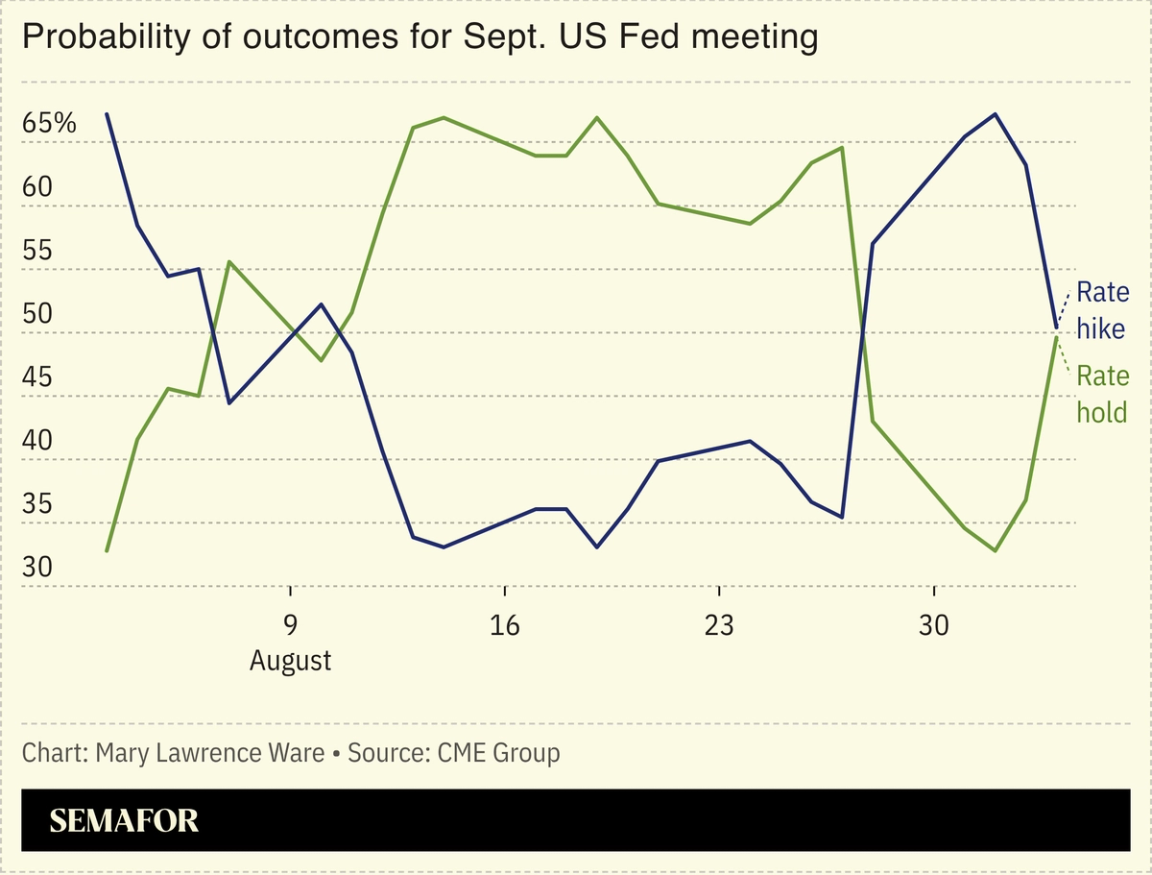 Markets rallied and global bond yields dipped Thursday after a US Federal Reserve governor advocated holding interest rates steady if inflation continues to cool. “Give disinflation a chance,” Christopher Waller said, citing “slow but continued progress” toward the Fed’s goal of 2% inflation. The market odds of a September hike fell to 50% days after Fed Chair Kevin Warsh’s hawkish Jackson Hole speech prompted traders to price in a rate increase. Both Waller and the New York Fed President John Williams suggested tariffs and war-related energy spikes’ inflationary effects were temporary and fading, but “there’s no clear signs right now” whether existing policy will bring inflation down to target, Williams said. |
|
Russia, Ukraine eye diplomacy effort |
 Vladislav Culiomza/Reuters Vladislav Culiomza/ReutersRussia’s Vladimir Putin suggested Thursday that a settlement to end the war was possible, while Ukraine predicted a “new dynamic” in peace efforts, marking a notable shift in rhetoric that could open a window for diplomatic progress. Ukrainian President Volodymyr Zelenskyy said he expected US envoys to hold talks in Moscow and Kyiv in coming days, suggesting Washington, which diverted its focus to the Iran conflict, is renewing efforts to end the Russia-Ukraine war as both sides wage an increasingly deadly aerial campaign. Zelenskyy is also contending with domestic political turmoil involving high-profile firings, graft scandals, and strife within government agencies — discord that burst into the open Thursday after rival Ukrainian intelligence units exchanged fire on the streets of Kyiv. |
|
China announces $1T sports push |
 Tingshu Wang/Reuters Tingshu Wang/ReutersChina plans to spend at least $1 trillion in the next five years to become a “sports powerhouse,” officials announced Thursday, as Beijing bets that more outdoor sporting events can stimulate sluggish domestic consumption. Along with widespread renovation of sporting facilities, the push aims to root out the corruption and “toxic fan culture” limiting public enjoyment of sporting events. China also hopes to encourage more citizens to exercise, thereby making an aging populace more active and reducing strain on the health system. A persistent weakness in China’s growth model, consumer spending weakened in July; Beijing rolled out new loan interest subsidies to try to spur demand — though ING analysts suggested their impact would be “relatively marginal.” |
|
NBA offers case study to regulators |
 William Liang-Imagn Images via Reuters William Liang-Imagn Images via ReutersThe NBA’s heavy-handed punishment of a franchise and its billionaire owner points to the changing media landscape and offers a case study for regulators seeking to crack down on powerful rule-breakers. The Los Angeles Clippers received huge financial and roster-building penalties while owner Steve Ballmer will be banned for a year for salary cap circumvention, a scandal originally revealed by Pablo Torre, who left ESPN to build his own show, now part of The New York Times’ network. The NBA may also offer a lesson in corporate regulation, by “status-stripping” executives as a form of punishment, Semafor’s Business editor wrote: “We’re living in an age of creative enforcement … More of it should actually sting.” |
|
GLP-1s slowed aging in mice |
 Lee Smith/Reuters Lee Smith/ReutersThe GLP-1 weight loss drug semaglutide, aka Ozempic, extended life in mice, adding to a small but noteworthy pile of evidence that such treatments could have anti-aging properties. Elderly female mice (males were not tested) given the drug lived 12% longer than controls, and did better on tests including coordination and muscle function. The mice on semaglutide ate 24% less, and calorie restriction has been shown to extend lifespan in many species; the extension may be a product of that, although the treated mice also showed memory benefits beyond those seen by calorie-restricted mice. Earlier research has shown similar GLP-1 longevity benefits. Researchers are now planning early trials in humans, Nature reported. |
|
What to do with your trash? |
 Krista Niles/Reuters Krista Niles/ReutersSending garbage to landfill rather than recycling is “one of the cleanest, cheapest, and most environmentally sensible things” we can do with trash, two urbanist writers argued. Modern landfills are sealed and safe, Alex Chalmers and Rob Wiblin wrote in Works in Progress. By contrast, plastic recycling is energy-intensive and difficult, while making single-use plastic items is usually cheap and the raw materials are abundant. (Metals, which recycle more easily and are harder to access, are unambiguously worth recycling, they noted.) Ocean plastic waste is “a huge environmental problem” but almost entirely comes from a few developing Asian countries; richer countries have near-universal refuse collection, so “whichever bin you choose,” your plastics won’t end up in the sea. |
|
|


