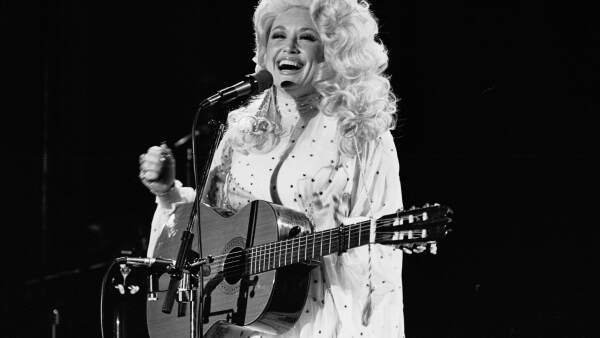
Until her passing on Tuesday, Dolly Parton may have been the only living person truly worthy of that old-fashioned designation, "America's Sweetheart." Her immense musical talent guaranteed her top-tier standing in country music and propelled her into a level of mainstream success that only a handful of her peers would match. Her charm, depth, beauty, sense of humor and radiant goodness made her a star across seven turbulent decades.
Richard E. Aaron/Redferns
Parton was our favorite aunt, our imaginary president. She was also the composer of a career's worth of indelible hits that emblematized America's cultural life, and particularly the changing experiences of women, in ways that place her in an elite category: a songwriter whose greatest works, considered together, are their own version of the American songbook.
She didn't write her first charting country single, 1967's "Dumb Blonde" (that was Curly Putnam), but it set the tone for her amiable, uncompromising version of women's liberation. This was one aspect of Parton, the adventurer whose insistent self-respect would carry her beyond any limitations others tried to impose on her. The other, the keeper of home truths, surfaced in 1971's "Coat of Many Colors," an expertly embroidered portrait of Appalachian rural life that also stands as one of the most powerful reminders of poor people's dignity to ever grace the airwaves.
Parton's legend was secured in 1973, when she released "Jolene," a song that transcended its moment by perfectly capturing the primal intensity of insecure romantic desire. "Jolene" is a murder ballad whose victims all survive, a cry of revenge in the face of betrayal that puts a woman in charge and unexpectedly creates a bond between two rivals. In fact, it was one of the less dramatic songs Parton wrote in her gothic mode, a style that allowed her to expose many of the burdens women endure under patriarchy; her early songs that never made it to the Top 40 dared to broach topics like emotional abuse, stillbirth, forced institutionalization, a birthmother's grief and a pregnant, abandoned lover's suicide. Her deep knowledge of the dark lent substance to the songs that expressed her belief in transcendence.
The masterpiece that she released the following year showed her rising upward with unrivaled grace. Parton wrote “I Will Always Love You” as a forgiving farewell to Porter Wagoner, the duet partner who had helped launch her career but also tried to restrict her when her genius took her beyond their partnership. It was a hit for her in 1974 and again in 1983, as part of the soundtrack to The Best Little Whorehouse in Texas.
The song reached its full potential, of course, in the hands of Whitney Houston, whose sublime 1992 version exposed the damage done by arbitrary divisions between Black and white radio formats, crossing into every corner of pop to become the definitive expression of the era's blockbuster-besotted grandeur. "I Will Always Love You" is the musical equivalent of Star Wars, an epic that encompasses many epochs. Houston could soar within it because Parton imbued the song with a musical and sentimental purity that made room for the enormity of her expressiveness.
Read Ann Powers' full remembrance of Dolly Parton here. You can listen to Dolly Parton's life story, in her own words, through interview clips from NPR's archive.
Check out more great reads from the NPR network you may have missed:
➡️ A California court battle over viral AI "Italian brainrot" characters could set a significant precedent for the ownership of AI-created content. Do Big Studios, the creator of the hit game Steal a Brainrot, argues that AI-generated characters should be considered public domain since current U.S. law mandates human authorship for copyright protection. Mementum Lab, the original AI prompters, says that these characters are protected works, claiming that human creativity was involved in writing the text prompts and selecting the final images. Many millions of dollars in revenue are potentially at stake in this AI art case.
➡️ National Guard members have been a constant presence on the streets of Washington, D.C., for more than a year. As President Trump's largest and longest domestic military deployment enters its second year, three guard members who have served many months working this duty share their personal thoughts with NPR. In their candid reflections, they discuss their worries about the new norms the deployment is establishing and the financial cost behind it.
➡️ The federal government is distributing more than $160 billion in tariff refunds to corporations after a Supreme Court ruling struck down extensive international tariffs. But regular shoppers may not benefit from this refund. While some retailers claim they will use the money to lower prices, others argue that new tariffs have already been introduced to replace the old ones, effectively absorbing the impact of the refunds before they reach everyday consumers. Now, frustrated shoppers are taking matters into their own hands by launching class-action lawsuits against major companies like Costco and Nintendo, hoping to compel them to share the financial gains.
➡️ This month, NPR's Newsmakers podcast sat down with Congressman Ro Khanna, who says he is considering running for president in 2028. Catch up with this story and more here.
Newsletter continues after sponsor message
Pod Club
Exploding Kittens
Thanks for tuning in last week to the Short Waveepisode about the split-second decision that saved atmospheric scientist Perry Samson's life when he got caught inside a tornado. NPR listener Miriam Cornelin said Samson’s experience reminded her of her time working in Nepal in 2015. She was finishing up brunch at her friend's farm on the edge of the Kathmandu valley when the neighbor's rooster was crowing incessantly. “A few minutes later, we were somewhat terrorized when the Earth started bucking and shaking, and roofs of the surrounding houses started to fall off! It was a 7.9 earthquake, and I lived to tell the tale,” Cornelin said.
Today, we’re listening to an episode from Planet Money as they pitch their game, Sell Me a Sasquatch, to big box retailers. The hosts provide a behind-the-scenes look at how products end up on big-box store shelves, and find out the fate of their board game. Listen to the episode or read the transcript.
Love podcasts? For handpicked episode recommendations every week, check out Pod Club — a newsletter written FOR podcast fans BY podcast fans. Subscribe here!
And, on this week's episode of The Sunday Story from Up First, country singer and rapper Shaboozey joins host Ayesha Rascoe to discuss his latest album The Outlaw Cherie Lee & Other Western Tales and the Black roots of country music.
Thing from thing
NPR
It's time for the Sunday Puzzle! For this week’s on-air challenge, NPR Puzzlemaster Will Shortz will name some things. For each clue, you will provide something that the thing has that starts with the same first two letters as what the thing does. For example, if you are given the clue “TRee,” the answer would be “TRunk.” This is because a tree has a trunk, and both "tree" and "trunk" start with “TR.” Test your skills here. Check the page later to hear the answers, or catch them live on Weekend Edition at 8:41 a.m. ET.
This week's online challenge comes from Ben Bass, of Chicago. Think of a state capital and say it out loud. Change one vowel sound in it to name something many schoolkids study. What things are these? Submit your answer here, and you could win a chance to play next Sunday's on-air puzzle.
You received this message because you're subscribed to Up First emails. This email was sent by National Public Radio, Inc., 1111 North Capitol Street NE, Washington, DC 20002