What matters in U.S. and global markets today

Start the day with Reuters on the stories moving U.S. and global markets. Subscribe for $1/week.


Morning Bid U.S.

Morning Bid U.S.

A Reuters Open Interest newsletter

What matters in U.S. and global markets today


By Mike Dolan, Editor-at-Large, Finance & Markets

Economic warfare of one sort or another tops the agenda as the new week kicks off. The collapse of U.S.-Canada trade talks late Friday saw Washington impose 50% tariffs on about $20 billion of Canada’s imports, while Treasury Secretary Scott Bessent announced an “economic D-Day” is coming in Iran.

I'll get into that and more below.

But first, listen to the latest episode of the Morning Bid daily podcast. We discuss the wider implications of the Canada-U.S. trade war, the Iran sanctions threat and the week ahead. Subscribe to hear Reuters journalists discuss the biggest news in markets and finance seven days a week.

Subscribe to hear Reuters journalists discuss the biggest news in markets and finance.


Data refreshes every time you open this email. For more U.S. market news, click here. Please send any feedback to morningbid@thomsonreuters.com.


Today's Market Minute

  • The U.S. threatened Iran with what it called "the greatest financial offensive ever marshalled" as it prepared to roll out economic sanctions on Monday that target Iran's trade partners.
  • China's Alibaba shares slumped in Monday Hong Kong trade after it launched a $10.2 billion share sale at a sharp discount to fund its AI ambitions, with investors focused on stock dilution and execution risks.
  • Shein aims to raise up to $1.8 billion in a Hong Kong IPO that values the fast-fashion retailer roughly 70% below its private-market peak four years ago, with a slower growth outlook set to weigh on investor demand.
  • U.S. oil refineries have been operating near maximum capacity for the longest sustained period in over a quarter century, scrambling to capture windfall profits, but history suggests this could lead to serious problems, explains ROI Energy Columnist Ron Bousso.
  • U.S. LNG producers have shipped out record volumes of the super-chilled fuel so far in 2026, but rising global natural gas prices may soon curb demand from cost-sensitive buyers, argues ROI Energy Transition Columnist Gavin Maguire.
 

Washington's wars

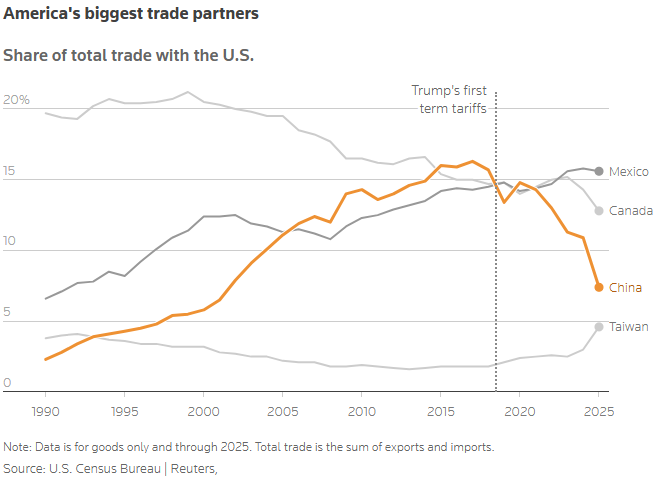
Canadian Prime Minister claims his negotiators were "attacked" at the last minute by the U.S. and would retaliate "dollar for dollar". With Canada accounting for about 12% of U.S. trade, the implications for the U.S.-Mexico-Canada trade agreement (USMCA) are now a big question, as is the impact on U.S. prices from higher levies on goods such as cement, furniture and clothing. Canada’s dollar, which had strengthened significantly last week against a softening greenback, fell back first thing Monday.

Oil prices fell back about 1% too overnight as energy markets await the details of the Trump administration's "economic warfare" sanctions against Iran. These measures are expected to squeeze Iran’s economy by targeting other countries that trade with it. The big ones are China, Russia and India.

The slight pullback in oil prices kept a lid on restive U.S. Treasury yields. The main focus of the rates market this week, however, is clearly the Federal Reserve’s Jackson Hole symposium, culminating in new Chair Kevin Warsh’s keynote speech on Friday. Warsh is likely to speak more about his proposed Fed reforms rather than offer any guidance on the September policy meeting.

Before then, the Fed’s favored PCE inflation gauge for July is released on Wednesday. And that report comes on the same day as the big corporate event of the week, Nvidia’s quarterly results. The chip giant's profits are expected to have doubled over the year, with spending plans ahead forecast to top $100 billion.

Options markets are braced for a 5% stock swing in either direction based on Nvidia's numbers, but the biggest takeaway as always will be what these results signal about the durability of the gigantic AI infrastructure build-out.

And, finally, the financing of that AI push is very much in focus on Monday, with China's tech giant Alibaba slumping 10% in Hong Kong trading after it launched a $10.2 billion share sale to fund its AI ambitions - the latest in a long line of debt and equity financing for AI around the world.


Today's key chart  


Graphics are produced by Reuters.

Trade tariffs and economic sanctions dominated the start of the week. U.S.-Canada trade talks collapsed on Friday, ushering in 50% U.S. tariffs on some $20 billion of Canadian imports, along with Canadian pledges to retaliate "dollar for dollar." Meantime, the U.S. Treasury plans to detail its 'economic D-Day' against Iran later on Monday, moves likely to sanction countries that still do business with Tehran, possibly including China, Russia and India.

Although both Canada and China are falling as a share of total U.S. trade, Canada's share is now almost twice that of China's.


Today's events to watch

  • U.S. Treasury details new economic sanctions against Iran
  • Chicago Fed's national economic activity index for July