





 |
THIS TUESDAY’S GUBERNATORIAL PRIMARY in Wisconsin may seem like the latest chapter of an internecine fight among Democrats over the philosophical direction of the party. And it is that.
But there’s much more on the line as well: The fallout from the Wisconsin election could extend nationally, by making it possible for Trump-allied Republicans to screw with the presidential election results in ways they tried, but failed, to do in 2020.
On the line is the Democratic Party of Wisconsin’s decade-and-a-half-long effort to claw its way back to a unified state government, as well as the opportunity to add more safe Democratic House seats to the next congressional map. Beyond that, however, is another hugely consequential prize: the capacity to ensure that the state’s 2028 presidential election results will be properly certified. Wisconsin’s governor will play a critical role in that, much as the current outgoing governor—Democrat Tony Evers—did when Donald Trump contested the state in 2020. There are real fears in Democratic circles that Wisconsin Democratic voters aren’t quite appreciating these stakes as they head to the polls this go-around.
“The critical importance of defeating Tom Tiffany for the future of American democracy is hard to overstate,” said Ben Wikler, the former state party chair, referring to the expected GOP nominee for governor.
Wikler’s fears aren’t imaginary. Tiffany, a House Republican who is cruising to the nomination, has a lengthy history of embracing Trump’s election lies. He voted to overturn the results of the 2020 election, peddled lies that “hundreds of thousands of illegal votes” were cast in Wisconsin, and signed on to Texas Attorney General Ken Paxton’s lawsuit seeking to bar Wisconsin and other swing states from voting in the Electoral College. More recently, he’s suggested that those convicted in the January 6th riot could possibly be owed restitution and he’s continued to back an FBI probe into Wisconsin’s 2020 election workers. He remains unwilling to definitively state that Trump lost the 2020 race.
“It is very clear that Tom Tiffany has a real issue when it comes to democracy,” said Devin Remiker, the current chair of the state Democrats. “Under Governor Tom Tiffany, I don’t know if we would be able to count on him doing the right thing and ensuring that that certification was properly done if he didn’t like the outcome.” And it’s not just the presidential election that may be at risk, Remiker notes: In Wisconsin the governor’s signature is necessary to certify even U.S. Senate elections—so it’s conceivable that Tiffany might interfere with the results of the 2028 Senate election.¹
The potential for an electoral-count crisis in the 2028 presidential election looms over several critical states as candidates connected to Donald Trump’s undying lie about the stolen 2020 election are running for governorships. Rep. Andy Biggs, who tried to overturn the 2020 results, is the GOP nominee for governor in Arizona, another critical presidential state.² And the Republican gubernatorial nominee in Pennsylvania, State Treasurer Stacy Garrity, has publicly called into question the results of the 2020 election.
But unlike in Wisconsin, where Evers decided not to run for a third term, Biggs and Garrity are both up against popular Democratic incumbents. And while national Democrats are fretting about election-denying GOP governors possibly having a hand in presidential election certification in a swing state, it’s not clear to local Democrats if that prospect is factoring into voters’ calculations.
“I don’t know if people are fully grasping the stakes,” said Joe Zepecki, a Milwaukee-based Democratic strategist. “Tiffany is not someone who just went along with the lies in 2020 to keep Trump’s favor. He has continued to push these conspiracies through 2026.”
If you find value in this kind of journalism, stick with us through the midterms and beyond—grab a Bulwark+ membership.
ALSO ON THE LINE in this fall’s Wisconsin election: The possibility of another round of congressional map-drawing in early 2027.
The nationwide clash over redrawing congressional districts over the last year saw red states make their maps redder and blue states make their maps bluer (with a handful of states’ redrawn maps rejected by the courts). Wisconsin Democrats entered 2026 optimistic about their chances of flipping the state Assembly and state Senate as well as keeping the governorship—which would allow them to redraw maps ahead of 2028 that could net additional safe Democratic House seats. (Wisconsin’s U.S. House delegation currently has six Republicans and two Democrats.) Losing the governor’s chair would imperil that, even if the party were to flip the state houses. And if Republicans were to win a trifecta of their own—controlling the governorship and both houses of the state legislature as they did from 2011 to 2018—they could just as easily redraw congressional lines that wipe Democratic House seats off the map.
“Wisconsin might be the single state with the biggest possible swing in what happens with House maps based on what happens in the midterms,” said Wikler.
Given those stakes, a panic has set in among some Democrats that the party appears to be on the verge of nominating Francesca Hong, a DSA candidate—someone who has called for canceling Thanksgiving, abolishing the Senate, and eliminating police funding entirely—as its gubernatorial nominee.
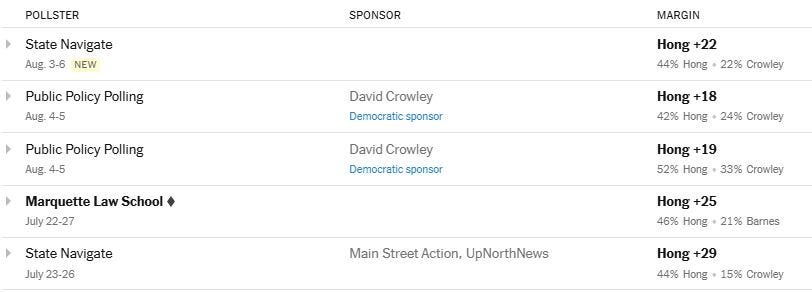
Hong’s defenders argue that she’s not the risk that her critics insist she is. They say she can marshal populist support to counter any losses she may suffer among the moderate suburban voters who might not find her socialist-tinted policies to their comfort or liking. They point to the swelling of support for Hong in the primary as evidence that she can succeed in the general election, should she get there—as the polls strongly suggest she will:
 |
But Hong’s success is also owed, in part, to the screwups of the establishment and the moderate wing of the party. A few months ago, Democrats believed that a competitive primary field for governor was a good thing and that the strongest candidate would ultimately emerge from it. The likely beneficiary, they believed, would be Lt. Gov. Sara Rodriguez—especially after Milwaukee County Executive David Crowley ended his campaign and endorsed her.
But Rodriguez stunned Wisconsin Democrats when she announced she was