| | In this edition, activist investors go back to basics, and HPE’s CEO dismisses state efforts to brea͏ ͏ ͏ ͏ ͏ ͏ |
| |  | Business |  |
| |
|
 - Dimon succession watch
- Banks nail stress tests
- HPE CEO on Juniper
- Daily Wire’s blue-chip boost
- State capitalism ‘queasiness’
|
|
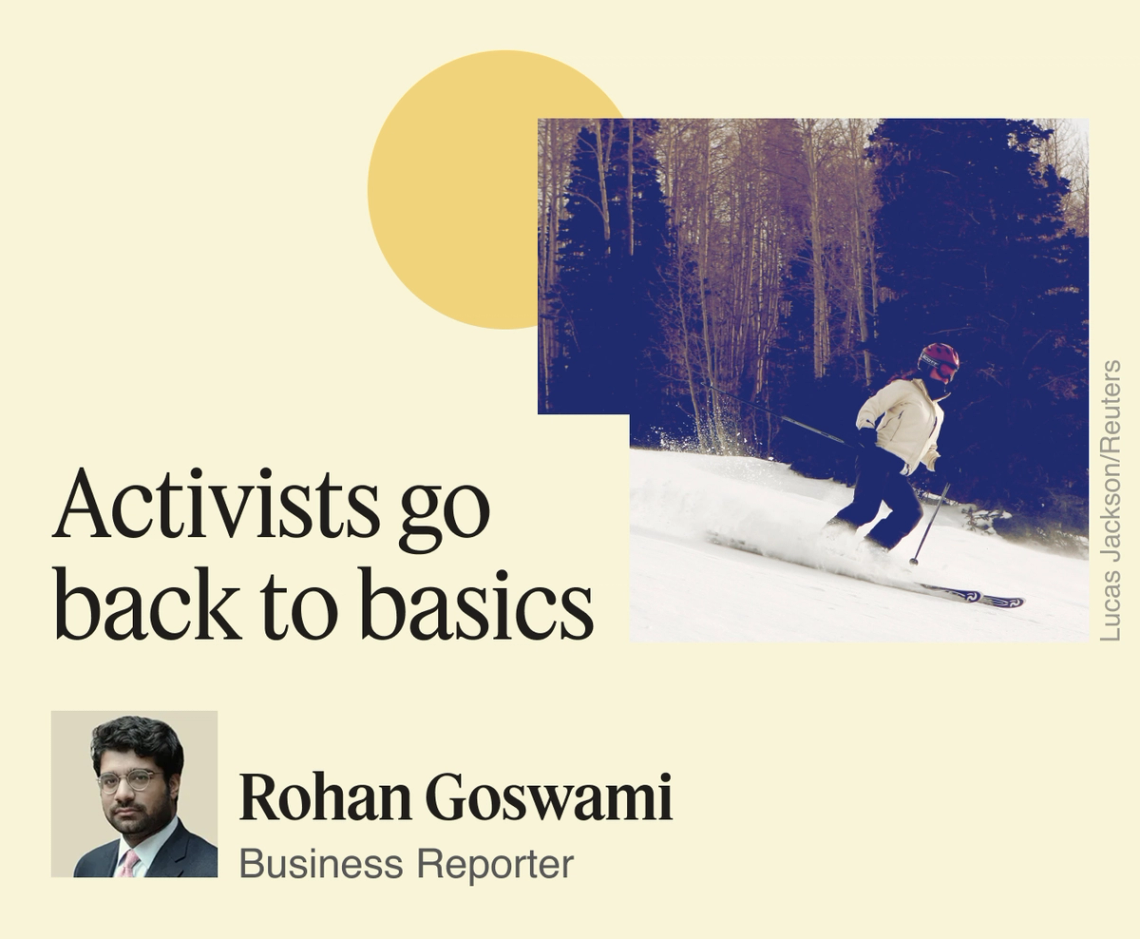 Activists are a little lost. The end of near zero-interest rates and the wacky dislocation of AI has scuttled the impact of tried-and-true activist plays like levered buybacks and cost-cutting campaigns. But this AI era is actually the perfect time for the right breed of activists: those with real plans on how to tear up business models and remake them for this particular moment of upheaval. The low-hanging fruit is gone. Take SaaS companies: a whole crop of companies like Adobe and Salesforce trying to protect against a wave of vibe-coding startups eating their lunch. It’s the perfect time for an outsider to come in with a better way. And there’s precedent here: activist ValueAct pushed Adobe in 2011 to move from a license-based model to that SaaS model, a shift that led to a 2,220% rise in shares over 10 years. There’s also a group of unsexy companies that are flying under the radar as everyone else focuses on AI: Chemicals, industrials, real estate, even forestry. They offer a chance for a back-to-basics approach targeting companies with finite assets that are underutilized, underperforming, or underappreciated. Dislocation from tariffs, onshoring, war, oil, and supply shocks present opportunities for dissident shareholders to show laggards the way. The lessons aren’t all that different from the great breadstick campaign of 2014, when Starboard’s Jeff Smith’s play at Olive Garden parent Darden literally ripped the company for undersalting its pasta water in an effort to save money on pots and pans. The company was saving a few bucks but ruining its product. (That campaign — and presentation — remains required reading for baby bankers and lawyers.) It would be a breath of fresh air for investors and the reporters covering the space. Activist plays have become a lot more boring lately — as Liz Hoffman and I joke, most of them can now be distilled down to “we’d like the stock price to go up, please.” Getting there also got boring — cut staff, pull back on advertising, maybe spin off a business or lever up and give the money to shareholders. They certainly seem busier than ever — Lazard data shows a 20% year-over-year jump in activity — but other than Elliott’s push at BP, they’ve been unusually quiet. There’s some hope, as we reported last week: Oasis’ plan to mount a proxy fight at Vail Resorts, which is essentially a REIT play that unlocks the value of a finite asset (mountains!), pushes for a dramatic business-model shift (sell those mountains), and gets someone to run the rest of the business more efficiently. As other investors zig towards AI, the smart activists will zag down the mountain. |
|
 Jamie Dimon in 2025. Jonathan Alcorn/Reuters. Jamie Dimon in 2025. Jonathan Alcorn/Reuters.Jamie Dimon elevated two new CEO candidates as a third leaves the bank. Is the clock actually ticking this time? For those trying to read the tea leaves in JPMorgan’s latest executive reshuffle, which will see Marianne Lake exit and two executives, Troy Rohrbaugh and Doug Petno, promoted to co-presidents, don’t stare too hard. Lake, most recently the CEO of JPMorgan’s consumer bank, is at least the eighth JPMorgan executive since 2013 to be promoted into a CEO-succession seat only to leave as Dimon continues his 20-year run atop America’s biggest and best-run bank. Dimon has occasionally sharpened his rolling five-year time frame for retirement but not advanced it. Last year, the bank elevated Jennifer Piepszak to COO, making her Dimon’s obvious successor — for about 15 minutes, before a bank spokesman clarified that Piepszak “does not want to be considered for the CEO position at this time.” The recent unveiling of JPMorgan’s new headquarters, a $3 billion monument to capitalism in midtown Manhattan that might have served as a send-off for Dimon, came and went. Dimon will soon pass another retirement signpost: a retention bonus of 1.5 million shares he received in 2021, which required him to remain CEO for five years, vests next month. And if it really is down to Petno and Rohrbaugh, any bake-off will likely take a while: It took Ted Pick two-and-a-half years to win a three-way succession race at Morgan Stanley, and David Solomon 18 months in the two-man bid to replace Lloyd Blankfein at Goldman Sachs. |
|
Banks sail through stress tests |
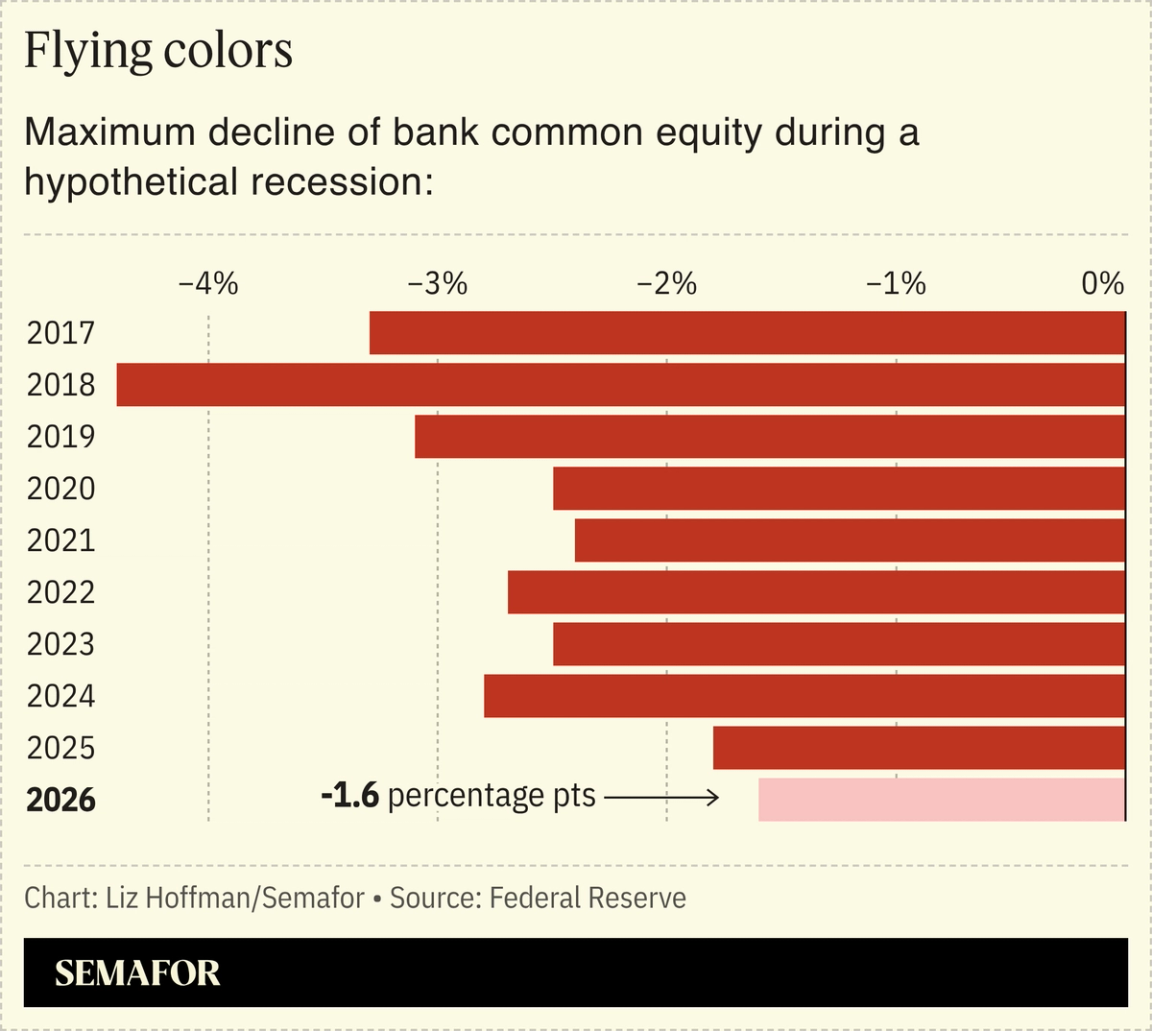 US banks sailed through their government stress tests, helped by advance knowledge of the hypothetical doomsday scenario they’d be put through. Big banks took the smallest hit to their capital, just 1.6 percentage points, since the 2019 exercise, and were also aided by the Federal Reserve releasing the outlines of the theoretical recession ahead of time. The results free banks up to boost their dividends and stock buybacks — many quickly did yesterday, after spending a record amount on buybacks in the first quarter — and could set the stage for a new wave of takeovers. Banks sitting on extra capital will have to find something to do with it, and demand for loans remains muted. (Competition from nonbank lenders has also challenged banks to put deposits to work profitably.) |
|
HPE’s CEO isn’t afraid of California |
 Caroline Brehman/Reuters Caroline Brehman/ReutersState officials are stepping into the void left by the Justice Department’s antitrust enforcers, and at least one CEO in their crosshairs is unimpressed. Hewlett Packard Enterprise CEO Antonio Neri dismissed a push from state attorneys general to unwind its acquisition of Juniper Networks in an interview with Semafor’s Andrew Edgecliffe-Johnson. Thirteen Democratic attorneys general are asking a federal court to find that HPE’s settlement with the DOJ, which allowed the merger to go through with few conditions, isn’t in the public interest. “The answer is absolutely yes,” it is, Neri said. “The rest is all, in my view, politics.” HPE acquired Juniper in a $14 billion deal that faced scrutiny from both Biden- and Trump-era antitrust enforcers. The computing giant — shares of which have surged 93% this year — turned to a set of Trump-connected fixers to sway the Justice Department, an unusual intervention that resulted in the departure of two DOJ officials and contributed to the eventual firing of the department’s antitrust chief, Gail Slater, by Trump top brass. |
|
Blue-chip dollars boost right-wing media |
 Ben Shapiro. Cheney Orr/Reuters. Ben Shapiro. Cheney Orr/Reuters.Conservative media outlet Daily Wire is raising money with an eye toward an IPO, as Semafor’s Max Tani scooped. Its pitch: If you want to influence MAGA, you have to advertise where they are. Its $750 million pitch to investors, viewed by Semafor, touts a conservative, “quality” audience that is attracting blue-chip advertisers: Oracle, Paramount, Meta, Netflix, and Chevron. All have big business in front of the White House — merger approvals, data centers, oil concessions, avoiding President Donald Trump’s missives about CNN — and may see conservative-media ad spending as a way to press their case. More broadly, the concerns that CMOs had about appearing next to conservative content in the wake of the Jan. 6 riots has all but disappeared; they are back in force on X, too. (There’s a reason Jamie Dimon went on Maria Bartiromo’s Fox show last year to send Trump a tariff warning; it works.) |
|
Raimondo: ‘Government stakes make me queasy’ |
 Gina Raimondo at Semafor World Economy. Annabelle Gordon/Reuters. Gina Raimondo at Semafor World Economy. Annabelle Gordon/Reuters.Former US Commerce Secretary Gina Raimondo said the idea of the US taking financial stakes in AI companies makes her “queasy,” in an interview with Semafor’s Morgan Chalfant. “The things that have made our economy the best, most dynamic, most resilient, most amazing in the world is actually private capital funding private enterprise with limited interference from government.” As part of a growing wave of state capitalism, Trump and his advisers have floated the idea of acquiring shares in frontier AI labs like OpenAI and Anthropic as a way to share the spoils with a public unsettled by the technology’s impact on jobs and communities. It follows stakes in other tech companies like Intel, as well as in quantum and rare-earth companies. “I don’t know a state-owned enterprise that is as efficient and well-run as it could be if it weren’t a state-owned enterprise,” said Raimondo, who oversaw a government grant to Intel that the Trump administration later converted into an equity stake. (Shares have risen sixfold since then.) “I worry a lot that, when you go down the slippery slope of government owning a means of production — I mean, what does that sound like to you? To me, it sounds like socialism. To me, it sounds like an invitation for corruption.” Raimondo sees another, privately funded way to address the collective angst accumulating over AI’s tectonic economic shifts. She and former Indiana governor Eric Holcomb are launching RAISE US, a project to help train US workers to adapt to the AI age, with financial backing from the OpenAI Foundation, Anthropic, Amazon, and Bank of America. |
|
 The story behind your money. Each Saturday, a reporter who spent a decade inside the investing world tells you what the week’s numbers mean, who benefits, and what the people in charge would rather you didn’t know. Start reading Quartz Markets. |
|
➚ BUY: Memory. Apple raised the prices of its laptops and tablets, as much as 25%, blaming the surging cost of memory chips. “This is a hundred-year flood,” Tim Cook, who’s made a career of pinching and pressuring suppliers, said last week. ➘ SELL: Retention. The AI talent war continues as Anthropic poaches two Google Gemini researchers. |
|
 Companies & Deals- Easy greens: Vail Resorts CEO Rob Katz is facing pressure from a major shareholder and an irate billionaire, but doesn’t seem worried. “Not something we’re spending any time on,” he said on his podcast in response to Semafor’s report that it’s in an activist’s crosshairs.
Watchdogs- Pocketbook pain: US inflation reached its highest level in nearly three years in May, pushed up primarily by the rise in energy prices.
- Tokyo shift: Japan’s prime minister announced a $2.3 trillion investment plan, promising to “break the cycle of excessive austerity” and get the world’s fourth-largest, but slow-growing, economy in gear. Sanae Takaichi continues to be a puzzle for Japan’s business community, which likes her growth agenda even if they can’t get her to answer the phone.
|
|
|


