
|
 |


You want to invest in companies with a wide moat.
But you know what’s even better? Finding a small company with a wide moat.
Let’s look at how you can do this via ETF investing.
 |
Moats Matter
Capitalism is brutal.
When a company starts making a lot of money, it usually attracts competition.
In most cases, it means margins and profits go down for everyone.
That’s called reversion to the mean.
But sometimes… This is not the case.
Reversion to the mean doesn’t take place when a company has a durable competitive advantage (moat).
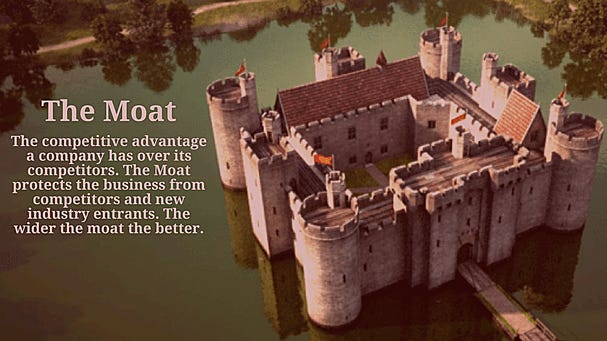 |
A moat puts a company in a superior business position.
This allows the business to maintain and increase its profit margin and market share.
It’s the most important thing if you’re going to be a long-term investor.
 |
Morningstar rates companies based on their economic moat.
There are 3 categories:
Wide moat: A durable competitive advantage expected to last 20 years or more
Narrow moat: A competitive advantage expected to last 10–20 years
No moat: Either no advantage or one that will be gone quickly
The wider the moat, the better.
Moat Sources
In general, there are 5 different moat sources:
Switching costs
What? It’s hard for a customer to switch to a competitor
Example? FICO scores. Banks have built their automated loan approval systems around them, and switching to a competitor means massive operational risk for no real advantage
Intangible assets
What? Brands, patents, or regulatory licenses that allow the company to charge more than competitors
Example? Hermès. A competitor can make a similar bag, but they’ll never have the prestige that allows Hermès to consistently raise prices without losing demand.
Network effects
What? As the business gets more customers, it becomes more valuable to everyone involved.
Example? Visa is a classic example. Consumers use Visa because every merchant accepts it. Merchants accept Visa because every consumer carries it.
Cost advantages
What? Allow a business to produce goods or deliver services at a lower cost than everyone else.