| | Oil prices fell to their lowest level since the US-Israel war with Iran, amid growing signs of a ten͏ ͏ ͏ ͏ ͏ ͏ |
| |  | Energy |  |
| |
|
 - Crude flood
- Europe’s missed opportunity
- War on coal
- Major renewables IPO
- Fuel shocks
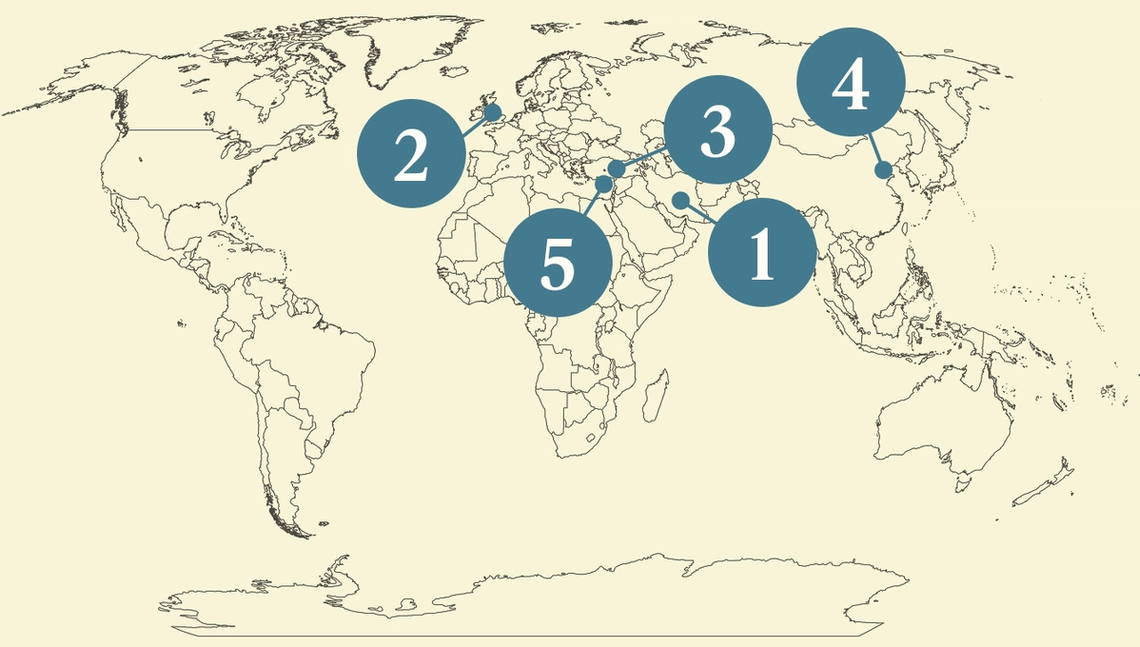
 A warning from the US on Europe’s methane rules, and a warning from China on fossil fuel reliance. |
|
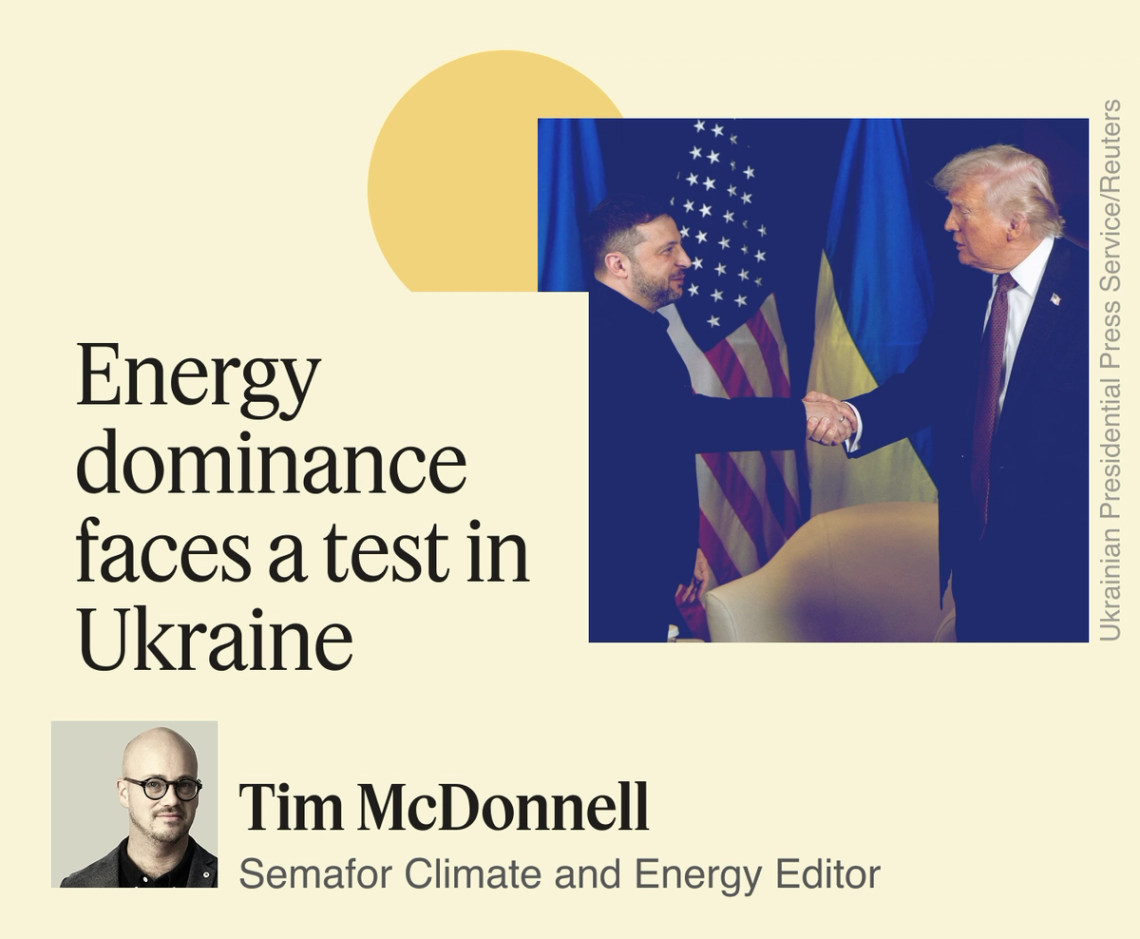 One essential facet of US President Donald Trump’s overseas energy dominance strategy is proving slow to materialize. At a major Ukraine recovery conference today in Poland, Kyiv’s allies announced more than €10 billion in new business deals and aid packages. But notably absent were any new project investments stemming from the “mineral deal” struck by the Trump administration nearly a year and a half ago, an indication that the US’ flagship initiative in support of Ukraine is losing time to produce results before the president leaves office. The concept behind the deal, which was one of Trump’s first big foreign policy forays after returning to the White House, was to sidestep thorny intra-Republican debates about whether and how the US should support Ukraine’s military effort against Russia, and instead create a new platform for government-backed business deals. Ukraine has a lot of critical minerals the US wants for batteries, chips, and other tech, and President Volodymyr Zelenskyy wanted new methods to keep Trump personally interested in Ukraine’s victory. Facilitating investment in Ukraine’s natural resources sector would put more minerals and gas under US influence, and leverage them to achieve the broader foreign policy objective of undermining Russia. The deal also represented an innovative use of the US International Development Finance Corporation, which invests taxpayer money in private-sector projects that serve US interests but need help to be financially viable. Trump has made the DFC a centerpiece of other energy dominance objectives, including to provide war-risk insurance for tankers passing the Strait of Hormuz. And under Trump, the DFC has expanded its mandate to cover activities that previous administrations, and equivalent institutions in Europe, have been unwilling to touch, such as military tech and fossil fuel production, Daniel Runde, a senior advisor at the Center for Strategic and International Studies who was one of the DFC’s original architects, told me. But the challenge with focusing on minerals is that mining projects are notoriously time-consuming to put together. Ukrainian officials said this year that at least three major initiatives should be due to receive the first tranche of funding from the deal in 2026. The first, and so far only, project was announced in March, and had nothing to do with minerals. Many observers were expecting more mining-related announcements this week in Poland. But spokespeople for the DFC and the fund confirmed to me that nothing like that is forthcoming for now. To the extent that a central purpose of the fund is to keep Trump engaged in Ukraine, it needs to deliver results while he remains in office, Runde said. That’s still within reach, for projects in areas like gas drilling and titanium mining that aren’t starting from scratch. But time is running short. Bigger-picture, it is unclear whether Trump’s transactional, DFC-centric approach toward supporting Ukraine can actually contribute to the country’s economic strength and success on the battlefield. And given the degree to which leaders in both Kyiv and Washington are prone to self-dealing, it also remains to be seen if the fund can support projects that are genuinely commercially viable — or it will become a backdoor for deals that mainly benefit investors close to either side’s inner circle. |
|
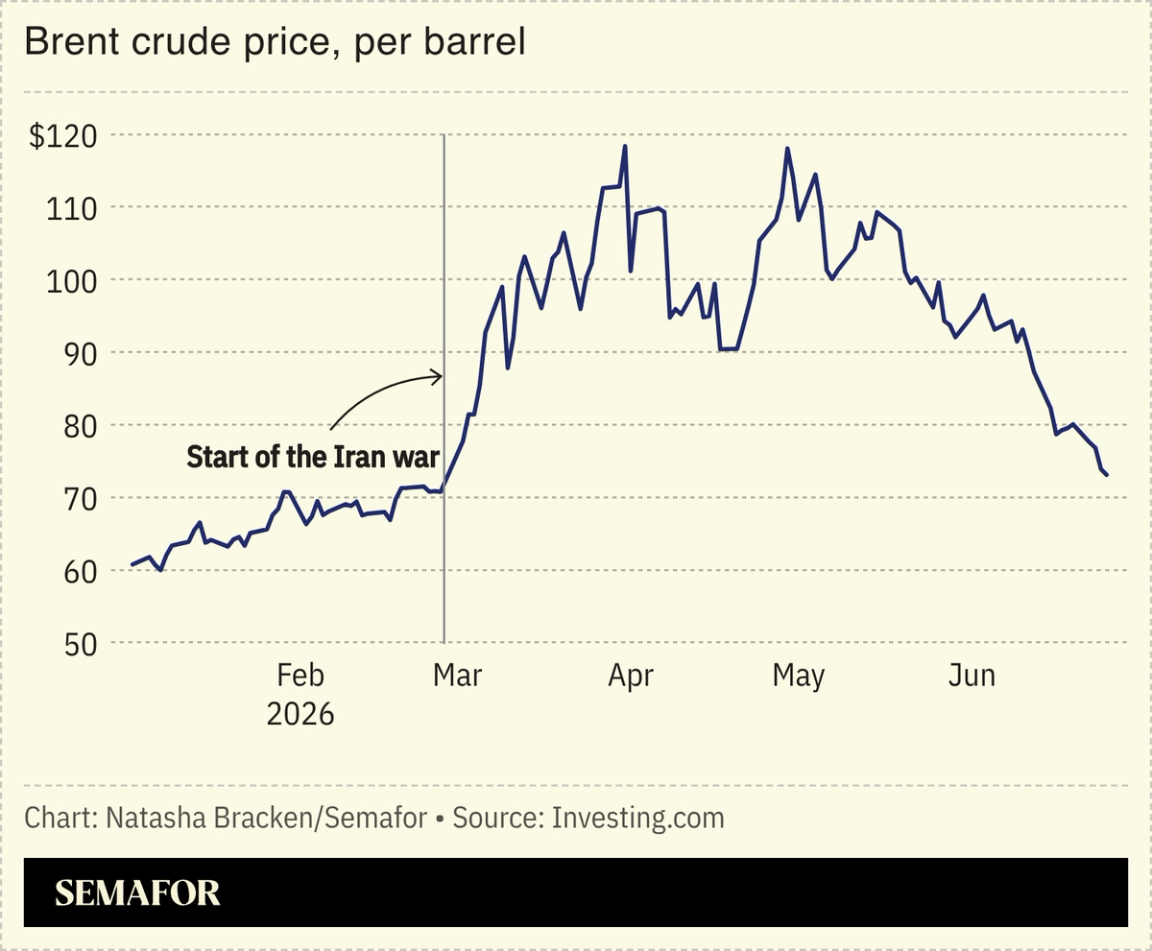 Oil prices fell to their lowest level since the US-Israel war with Iran, as growing signs of a tentative return to normality through the Strait of Hormuz soothed markets. Buyers of crude are “suddenly awash with supply,” Bloomberg said. Following the agreement of last week’s interim truce between Washington and Tehran, growing numbers of ships — many of which had in recent weeks “gone dark” in order to quietly traverse the strait — are now exiting the waterway with their transponders on in a sign of confidence, and maritime insurers are slashing their rates. Still, weeks of disruption are likely to leave their mark, Goldman Sachs economists warned: Stocks of refined products are lower than their recent average, with gasoline in particularly short supply. Gasoline prices always take longer to fall than crude oil prices, as refiners work through the products they made when crude prices were high and recoup business expenses they couldn’t cover when their profit margins were lower; in this case, refineries also focused on producing diesel and jet fuel due to fears of shortages, Goldman Sachs said. That didn’t stop Trump from accusing oil companies of “gouging” drivers — a familiar refrain from frustrated US presidents that has always failed to turn up evidence of wrongdoing. |
|
Europe’s missed opportunity |
 Chris J. Ratcliffe/Reuters Chris J. Ratcliffe/ReutersEU authorities risk curbing investments in the continent’s energy transition because of a combination of a failure to integrate its capital markets and regulatory shortcomings, multiple bankers said during London Climate Action Week. European and UK regulations are too prescriptive about favored technologies in the energy storage sector, and officials should seize an opportunity to play a greater coordinating role between entrepreneurs and financiers, senior Barclays executives Daniel Hanna and Damian Payiatakis said at a media roundtable. Elsewhere, multiple senior bankers at Western lenders argued that the continent’s fragmented financial markets undermined its financial might, at a cost to European startups in the tech and energy sectors that were consequently unable to compete for financing to the extent of US counterparts. — Prashant Rao |
|
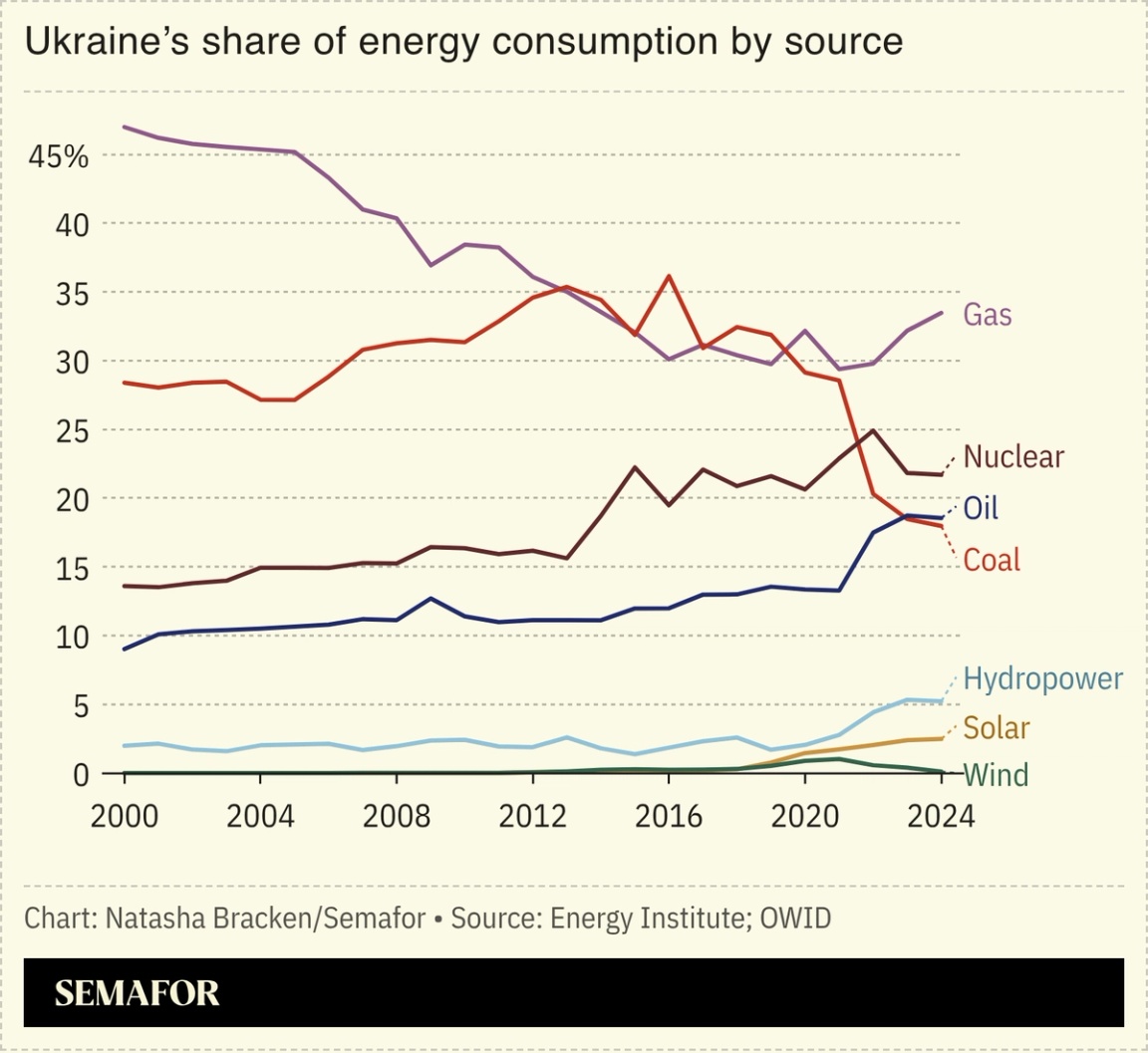 Ukraine’s biggest energy company is moving renewables to the forefront of its plan to rebuild a more secure grid after four years of devastating attacks. In DTEK’s first energy transition plan, published this week, the company committed to entirely closing down its fleet of coal-fired power plants and coal mines by 2035, and to boost its investment in wind, solar, batteries, and grids. Diversifying the company’s assets from large, centralized, Soviet-era power plants to a much broader network of distributed, low-carbon stations will both allow it to meet a goal of reducing its full-scope carbon footprint 90% below 2023 levels by 2050, and make the system more resilient to future attacks by Russia, Chief Sustainability Officer Jeff Oatham told Semafor: “Energy security and energy transition are not things that Ukraine has to choose between.” The challenge is finance: Grid modernization alone will require at least $7 billion over the next decade, he said, and at the moment it’s nearly impossible to draw investment into the country without guarantees from foreign governments. |
|
 Wind and solar power producer China Resources New Energy Holdings, the renewable energy arm of a state-backed power producer, is set to raise $3.6 billion in an initial public offering, in what would be the largest on record on the Shenzhen Stock Exchange. The move would also represent China’s biggest IPO in four years. The retail portion of the renewable producer’s shares received orders for 683 times more shares than were available, underscoring the financial market’s growing enthusiasm for green energy in China as Beijing pushes to advance the nation’s energy transition. |
|
 Alexander Ermochenko/Reuters Alexander Ermochenko/ReutersFuel prices at Russia’s airports have spiked 17% in June, as the country’s energy crisis deepens due to intensified Ukrainian strikes on Russian refineries. Gasoline production this month is 25% lower than a year ago, and several regions have announced fuel rationing. Moscow’s biggest refinery, damaged in Ukraine’s largest-ever attack on the capital, will not resume service until 2027, Reuters reported. And Russian-occupied Crimea’s biggest cities were left without power after Ukrainian strikes knocked out a huge major electricity substation. Despite Kyiv’s success in disrupting energy supplies under new drone tactics, Russia’s economy is “treading water, rather than contracting,” The Economist argued, thanks in part to heavy stimulus. Boosting energy ties with Southeast Asia has helped, too: ASEAN leaders’ recent visit to Russia, Foreign Policy wrote, illustrated how the Iran shock has “strengthened” the Kremlin’s diplomacy in a “fuel-hungry region.” |
|
 The world around us is changing, and technology is at the heart of the story. As artificial intelligence transforms how businesses operate and compete, Semafor Technology unpacks the ideas, innovations, and power shifts driving the AI revolution. Penned by Tech Editor Reed Albergotti, each edition delivers clarity on the forces reshaping industries, markets, and society. Subscribe for free. |
|
 New Energy- The Trump administration announced $17.5 billion in loans to help accelerate the development of 10 new large nuclear reactors in the face of surging power demand from data centers.
- China’s special envoy for climate change said that countries should view the impact of the Iran war on fossil fuel markets as a sign to accelerate their energy transitions, warning that the fallback on coal should only be a temporary solution.
Fossil Fuels- The volume of gas flared increased by 6% in 2025 to 167 billion cubic meters, roughly equivalent to half of Europe’s annual gas consumption.
- The US and Qatar, the world’s top LNG exporters, warned that they could not meet the EU’s draft regulation that would introduce monitoring and reporting standards across supply chains for methane.
- China’s coal-fired power generation is expected to rebound from its first decline in a decade, as renewable energy struggles to keep up with demand, especially amid El Niño and the Iran war.
Finance- Investors have been betting on AC stocks, as climate change causes a surge in heatwaves, and the spread of data centers drives a demand for industrial cooling systems.
Tech- As criticism of data centers intensifies, Microsoft is pushing back against worries that its data center expansion will drive up water use, pointing to a nearly 90% improvement in water efficiency since the early 2000s.
EVs |
|
|


