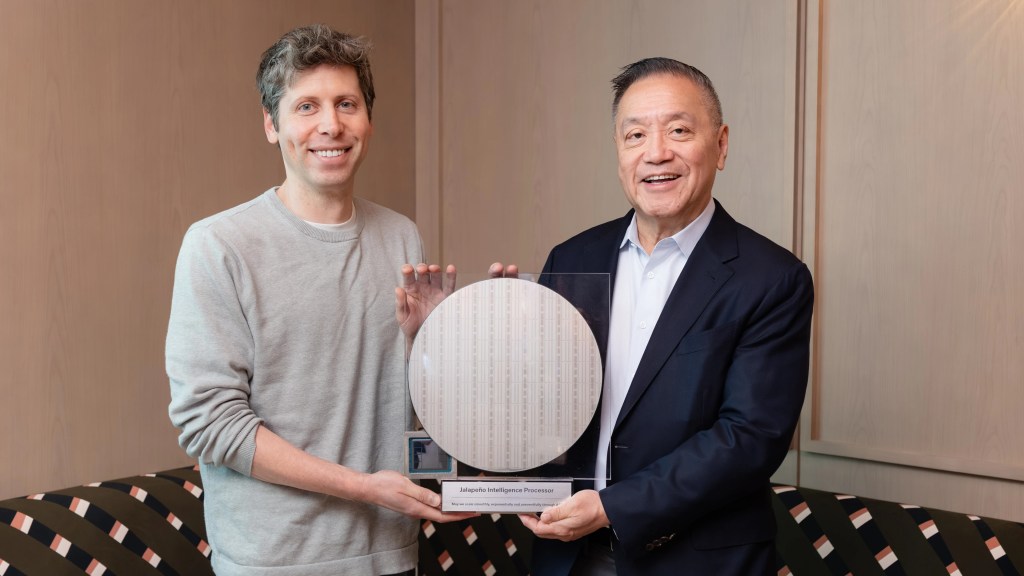
 OpenAI CEO Sam Altman (left) and Broadcom CEO Hock Tan holding their new AI chip, “Jalapeño.” OpenAI
It’s finally here. OpenAI and Broadcom
on Wednesday took the wraps off their long-gestating custom AI chip.
Dubbed “Jalapeño,” the silicon is designed for inference (as opposed to training) and is, according to Broadcom chief Hock Tan, as good as Nvidia’s Blackwell chips or Google’s TPUs in terms of speed and efficiency when working with large-language models.
The first chip is planned for deployment by the end of this year in custom servers made by Canada’s Celestica. Like its peers, this first Jalapeño chip marks what will be a multigenerational family of silicon. (Poblano? Serrano? The mind reels.)
“We optimized the architecture around the kernels, memory movement, networking, and serving patterns that matter most for frontier AI models,” said Richard Ho, who leads OpenAI’s hardware program, in a statement. “Based on early testing, Jalapeño will efficiently execute our most important workloads close to the hardware’s theoretical limits.”
OpenAI has not made it a secret that it believes the winner of the AI arms race will be the company that moves first to secure as much AI infrastructure as possible. The new Broadcom chip, designed in the span of nine months and manufactured by Taiwan’s TSMC, is part of that multifaceted effort.
It comes as no surprise that rival Anthropic is also reportedly exploring making its own AI chip in a bid to catch up with OpenAI—not to mention Amazon (Trainium), Google (TPU), Meta (MTIA), and Microsoft (Maia). All of them are working with seasoned partners like Broadcom and Marvell to help design the chips, after which they’re made by foundries such as TSMC, Samsung, and Intel.
—AN