
|
 |



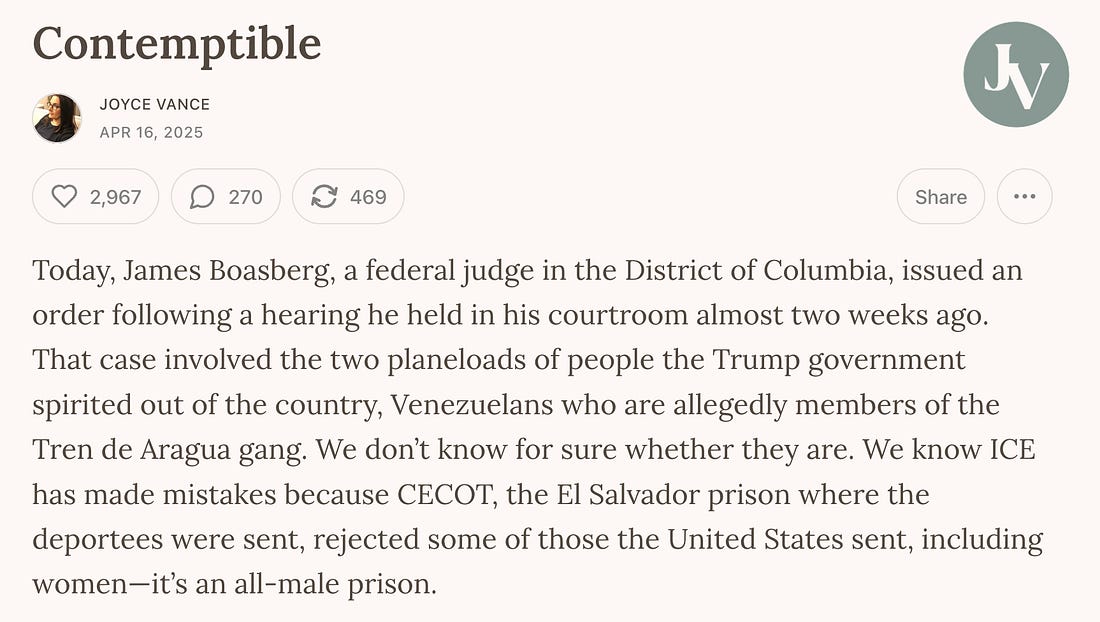
Last year, around this time, we were consumed by the Trump administration’s tightrope act. DOJ was trying to do Trump’s bidding while maintaining plausible deniability that it was violating court orders. Then, federal District Judge James Boasberg ordered the government to turn around planes filled with Venezuelans being deported to El Salvador’s notorious CECOT prison. The government didn’t.
 |
There has since been whistleblower testimony that DOJ political appointees, one of whom is now a judge on the Third Circuit, chose Trump over their oaths to uphold the law. According to a whistleblower complaint filed by Erez Reuveni, a former Department of Justice attorney, former DOJ political appointee Emil Bove suggested to subordinates during a meeting about a deportation case that the department might need to tell the courts “f**k you,” implying that it would ignore court orders to carry out Trump’s policy demands. Bove denied making the remark under oath during his Senate confirmation hearing.
Regardless of who said what, the flights remained on course after Judge Boasberg ordered them to turn around, and their passengers were ultimately transferred to El Salvadoran custody and imprisoned. The Judge subsequently opened a proceeding to determine who was responsible for the contempt that occurred. A divided panel of the D.C. Court of Appeals shut it down in April. But that may not be the last word.
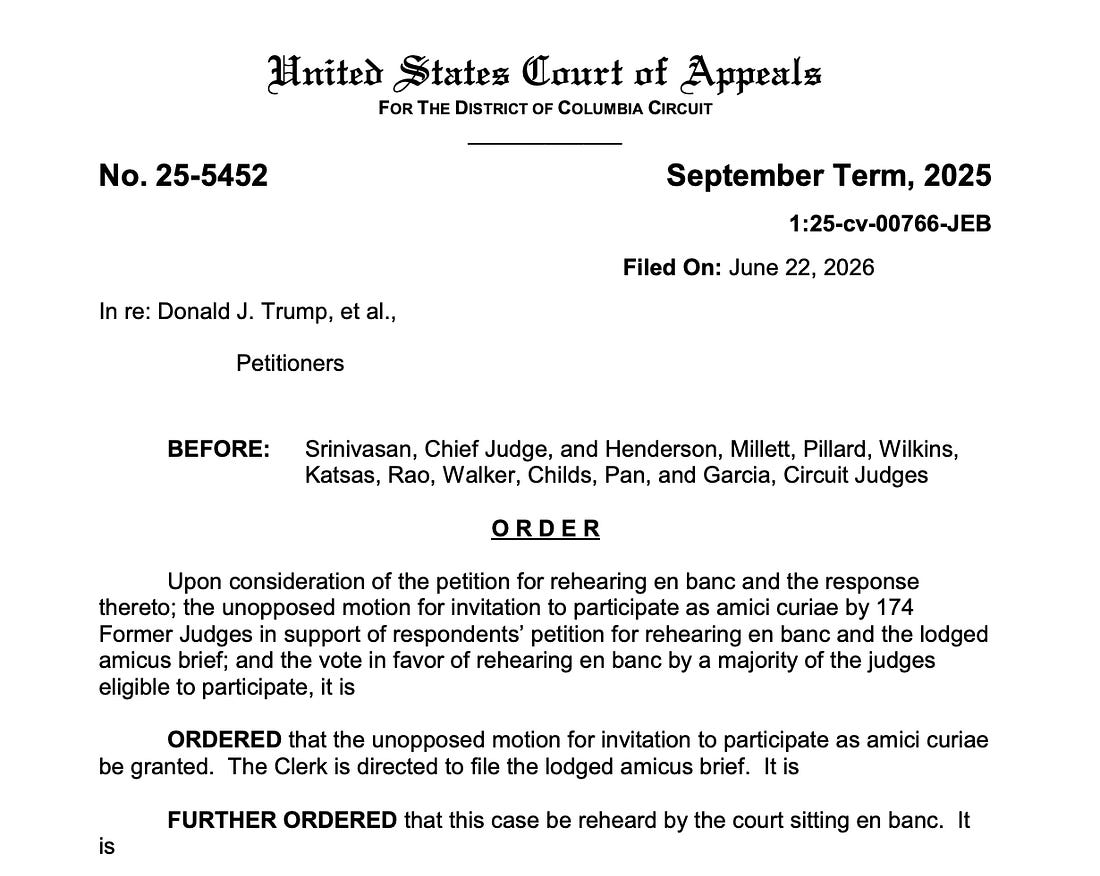
On Tuesday, the full court agreed to rehear the panel decision en banc in order to reconsider the split decision that prevented Judge Boasberg from moving forward. It won’t happen quickly. The briefs will trickle in over the course of the summer and oral argument is set for September 29.
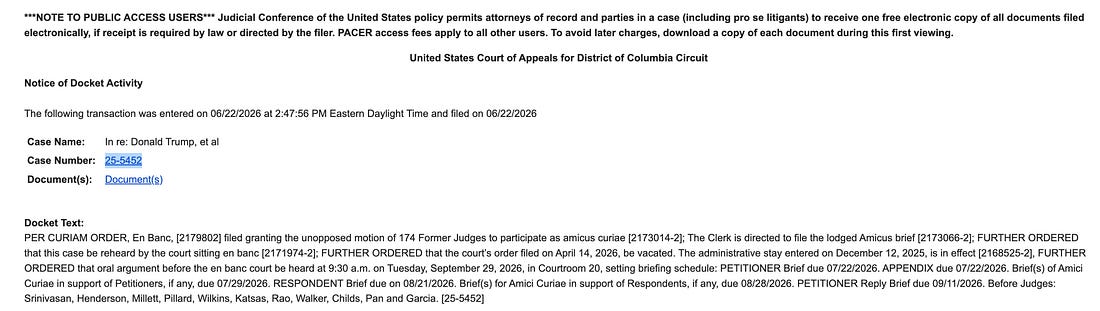 |
But a significant development, noted in the court’s docket yesterday, involves an amicus brief filed by 174 former judges in support of contempt proceedings. It begins by noting that “The most basic proposition of judicial authority is that courts must be able to enforce their own orders.” That’s what’s at stake here.
We’ve been talking a lot about amicus briefs lately. We’ve seen them in cases where there is an absence of true adversity between the parties, such as the Florida case over the release of Volume II of Special Counsel Jack Smith’s report and in Trump v. IRS, where Trump openly mused about how much he could award himself in damages, given that he controlled the IRS’s final decision in the matter. Amicus means “friend of the court,” and groups and individuals frequently seek leave to file such briefs, most often in appellate cases, when they believe they have special insight or expertise to offer that may aid the court’s decision. Amicus briefs from anyone other than the federal government require leave of the court or consent of all the parties.
 |
“A court that issues orders a litigant is free to disregard or circumvent is not a court in any meaningful sense; it is instead an advisory body, and its judgments are mere suggestions,” the amici judges’ brief explains. So an investigation into a possible contempt is something a federal judge must be permitted to conduct to protect the integrity of its proceedings. They argue that “The attempt by the Executive Branch in this case to interfere with that bedrock function—through an extraordinary writ of mandamus—should be rejected.” This is the case, they say, because “the panel’s ruling creates a means for the Government to defy an order, and then curtail court inquiry into the Government’s conduct on the basis of post-hoc justifications.” In other words, the government could come up with any sort of justification to rationalize its conduct after the facts are known and bootstrap it to shut down a contempt hearing. That is more or less what happened here.
The key principle in a situation like this is that if litigants don’t like a court’s order, they are free to appeal it at the appropriate time. They are not free to disobey it. Absent compliance with that bedrock legal principle, the entire system would fail.
Courts, including the Supreme Court, have repeatedly reaffirmed this principle, and the Supreme Court noted (in a 1967 case out of Birmingham, Alabama) that an injunction “must be obeyed…however erroneous the action of the court may be…It is for the court of first instance to determine the question of the validity of the law, and until its decision is reversed for error by orderly review…its orders based on a decision are to be respected, and disobedience of them is contempt of its lawful authority, to be punished.” In other words, the fact that a lower court’s order is subsequently reversed on appeal is not an excuse for disobeying it.
In Walker v. City of Birmingham, the Supreme Court upheld the contempt-of-court convictions of Martin Luther King Jr., Fred Shuttlesworth, and other civil rights leaders. They were jailed for defying a state judge’s ban on mass street parades and demonstrations without a permit. Birmingham’s ordinances required protesters to obtain parade permits from the city commission. That was never going to happen—the police commissioner had already told the group it would never receive a permit because of its views. But that didn’t matter. According to the Supreme Court, they still could not violate the injunction the court had entered with impunity.
Justice Potter Stewart, writing for the majority, made it clear that “respect for judicial process is a small price to pay for the obedience to law regulating official behavior.” Even though the city’s permit law was ultimately deemed unconstitutional and the injunction unenforceable, the Court held that “The way to challenge those provisions was by bringing a suit…not by violating the ordinance and the injunction.”
The law is clear: the government shouldn’t get a pass here, either. But it’s always hard to read the tea leaves when rehearing en banc is granted, and no matter how the circuit rules, there will almost certainly be an effort to get the Supreme Court to weigh in before Judge Boasberg is permitted to proceed with contempt proceedings. It could be months, perhaps longer, before we know the outcome, but regardless, the principle here is too important to set aside.
The amici judges write that if the panel opinion stands, it “undercuts an essential power of the judiciary to enforce its rulings and the rule of law” and that “That danger is heightened by doing so to aid an Executive Branch whose conduct in this case illustrates an intent to push the limits of compliance with court orders.” That is self-evident. In many ways, the administration is its own worst enemy in this matter. Instead of correcting course after the incident in Judge Boasberg’s case, it seemingly doubled down on its animus toward court decisions it disagrees with. It has pushed the issue of its disobedience so far that multiple judges have either questioned or declined to apply the longstanding presumption of regularity to this administration’s conduct. That presumption holds that public officials and government agencies are deemed to have properly discharged their duties and followed the appropriate legal procedures unless there is clear evidence to the contrary. If this were a one-off situation, the courts might, as the panel did, make excuses, confident that there w