| | In this edition, Democrats come to Jesus, Mamdani romps, and more unenthused Iran polling.͏ ͏ ͏ ͏ ͏ ͏ |
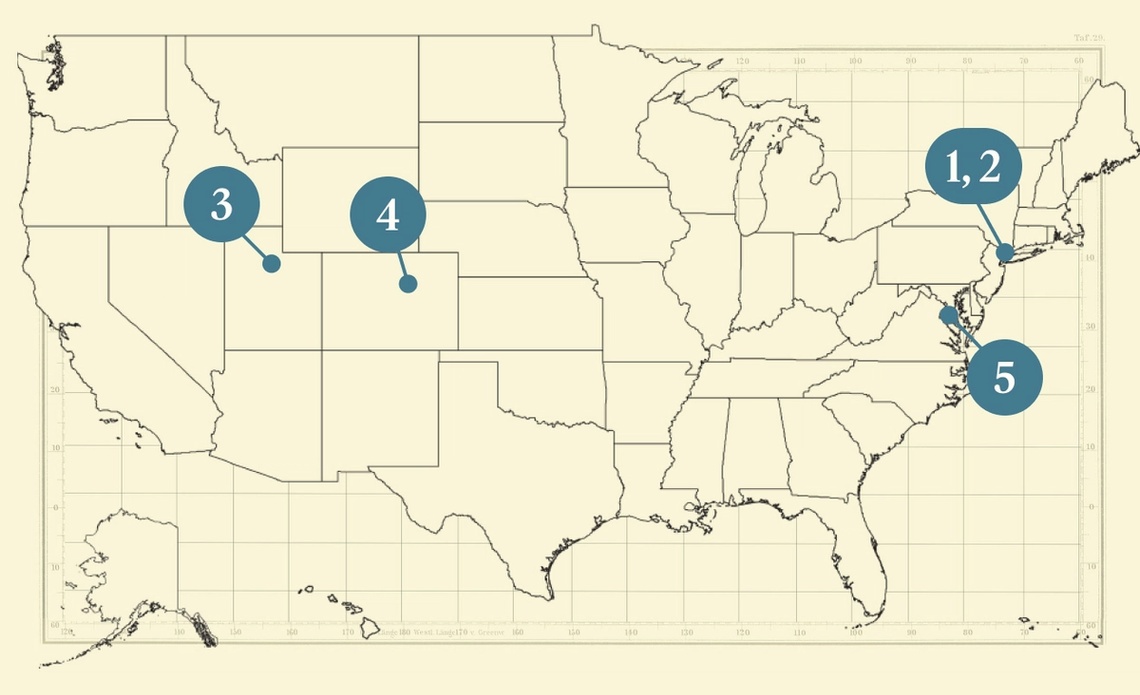
| |  SALT LAKE CITY, UT SALT LAKE CITY, UT |  DENVER, CO DENVER, CO | OSSINING, NY |
 | Americana |  |
| |
|
 - Dem leaders’ insurgent headache
- Mamdani calls his shots
- The other guys
- ‘Fighter’ club
- Fog of war
|
|
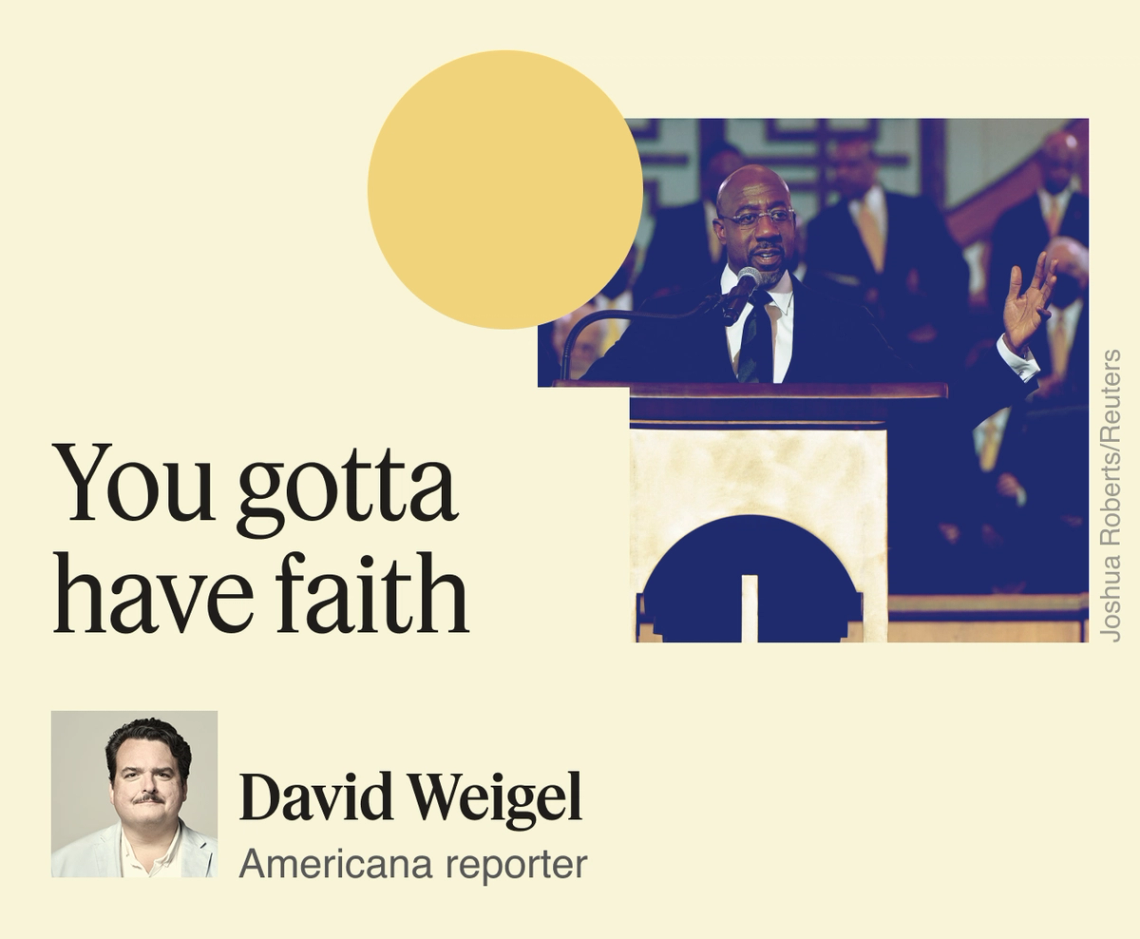 Raphael Warnock and Mike Johnson sat down one-on-one this month for a reason that was bigger than their stated topic. Publicly, the Republican House speaker was requesting time with the Georgia Democratic senator after Warnock questioned how Johnson, a devout Christian, could “say a prayer” then vote to cut $1 trillion from Medicaid. Privately, they ended up at a respectful impasse over how they saw their respective Christian faiths. Warnock, who talked with me about it this week, said Johnson sees the moral mandates for equitable treatment of the poor as individualistic, with no implications for government or systems. The only Democratic pastor in Congress had another view, drawn from the traditions of the “anti-slavery church.” Justice is a central theme of the scriptures; nations are judged based on their treatment of the poor. “It is an American church, literally born fighting for freedom,” Warnock told me. “Its mission is to bear witness against any idea that we can be in Christ, and divided.” A trio of other Democratic pastors and seminarians are trying to join Warnock on the Hill next year while campaigning on a similar comfort linking their Christianity with their politics: James Talarico in Texas, Sarah Trone Garriott in Iowa, and Adam Hamilton in Kansas. Their willingness to ground progressive beliefs in faith is a mirror image of the longtime ease with which conservative Republicans have tied their Christianity to their politics. That hasn’t stopped the GOP from mocking their faith as faddishly liberal, so concerned with social justice that it has nothing to say to true believers. It’s an argument designed to appeal to more conventional Christian voters in their red states, particularly evangelicals, rather than the increasingly secular electorate overall. Progressive Christian Democrats are betting it won’t work, that the GOP is making a mistake by dismissing open-minded faiths in a less conservative country. “If the Republican Party wants to return to their self-righteous and morally condescending position of 20 years ago, be my guest,” said Rep. Sarah McBride, D-Del. Talarico’s opponents, for example, have portrayed his progressive church — and his seminary-trained readiness to defend LGBTQ+ rights and abortion on Biblical grounds — as ungodly. “I’ve never seen so much blasphemy from anyone running for office,” Texas Lt. Gov. Dan Patrick said at this month’s state GOP convention. Patrick added that he would “pray for that guy,” because Talarico would be “going to hell for sure” based on his campaigning. Read more about these Democrats’ godly pitch. → |
|
|
Insurgent left becomes Democratic leaders’ next headache |
 Eduardo Munoz/Reuters Eduardo Munoz/ReutersDemocratic angst is spiking after Zohran Mamdani-backed challengers toppled establishment-backed candidates in three New York City primaries. The progressives’ next move could be upending the lives of the party’s congressional leaders. The victories of Brad Lander, Claire Valdez, and Darializa Avila Chevalier show the growing power of a progressive bloc that risks stealing the party’s megaphone during a campaign that Democrats had hoped to center on affordability, not aid to Israel. There’s already concern in the party, and glee among Republicans, that the trio will use their new clout to spotlight issues that divide Democrats, like abolishing ICE. Top House Democrats are brushing off the results. But the party’s leaders don’t have to look far to reckon with their increasingly left-wing electorate — both Jeffries and Senate Majority Leader Chuck Schumer live in New York City. Some Democrats are worried their party is growing more vulnerable to GOP attacks after redistricting shrank the House battlefield. The GOP has “got a f*ckton of money, more than us and more than they did in 2018,” one Democratic strategist working on swing-district races told Semafor. “And the far-left primary wins do help the Republicans portray all Democrats as unacceptable.” Read more from our Nicholas Wu, Lauren Morganbesser, and me. → |
|
|
 Eduardo Munoz/Reuters Eduardo Munoz/ReutersNEW YORK — Mamdani led his “team” of left-wing candidates to victory with a hefty amount of personal involvement, banking on his city’s 14,000-odd Democratic Socialists of America members to out-organize the party’s rickety machines. His bet extended downballot, too; he backed DSA candidates for the state legislature. The result after Tuesday night was more power for a left-wing faction that plenty of local Democrats saw as a foreign, gentrifying force. Socialists won all the way down the ballot, aided by Mamdani’s popularity in the city, and strengthened by an anti-establishment, pro-peace message. Avila Chevalier summed up their agenda as “babies, not bombs,” funding domestic needs by cutting US aid to Israel. “Last June was not an anomaly,” Mamdani said, introducing Avila Chevalier at her party in Harlem. “It was not the end; it was a beginning.” |
|
Moderate Democrats prevail elsewhere on primary night |
 Cait Conley. Frank Becerra Jr./The Journal News/USA TODAY NETWORK via Imagn Images/Reuters Cait Conley. Frank Becerra Jr./The Journal News/USA TODAY NETWORK via Imagn Images/ReutersModerate Democrats, it turns out, had a pretty good Tuesday night outside of New York City. In Utah, former Rep. Ben McAdams won the nomination for a redrawn, safely Democratic district in Salt Lake City. In Maryland, state legislator Adrian Boafo fended off more than a dozen candidates in the primary race to succeed his mentor, Rep. Steny Hoyer. AIPAC’s United Democracy PAC spent heavily for Boafo; other candidates tried, and failed, to make that into a weakness for his campaign. In the Hudson River Valley, where Rep. Mike Lawler is defending one of the only GOP districts won by Kamala Harris in 2024, Democrats nominated veteran Cait Conley over more progressive candidates. That was a defeat for GOP PACs that attempted to weaken Conley by attacking her work in the defense industry, a bet that Democratic voters would recoil at connections to ICE and Palantir. There were no surprises in Republican primaries. Utah Rep. Blake Moore, a member of House GOP leadership, held off a conservative primary challenger who blamed him for the redrawn McAdams district (stemming from a state supreme court ruling) and for his openness to data centers. Read Nicholas on the data center backlash that Moore survived. → |
|
|
Colorado’s Democratic primaries spotlight incumbent salesmanship |
 Diana DeGette/YouTube Diana DeGette/YouTubeNext week’s Democratic primaries in Colorado will give the party’s left flank two more changes to replace older, less radical incumbents. Sen. John Hickenlooper and Rep. Diana DeGette got a preview of the action when their respective challengers, Julie Gonzales and Milat Kiros, dominated at local delegate meetings. How do the senator and the congresswoman convince voters they’ve still got it? Well, both are running ads titled “Fighter.” In hers, DeGette cites her experience as a manager of Trump’s second impeachment, saying she “led the effort to hold Trump accountable.” In his, Hickenlooper splices together clips saying he’s “pissed off” about healthcare cuts and won’t give “another f*cking penny” to ICE to demonstrate just how angry he is. Kiros, who’s half DeGette’s age, narrates her own ad, recreating a town hall meeting where she explains that the incumbent is backed by “corporations” that “profit from genocide.” |
|
Partisan split over Iran war blurred by lack of enthusiasm |
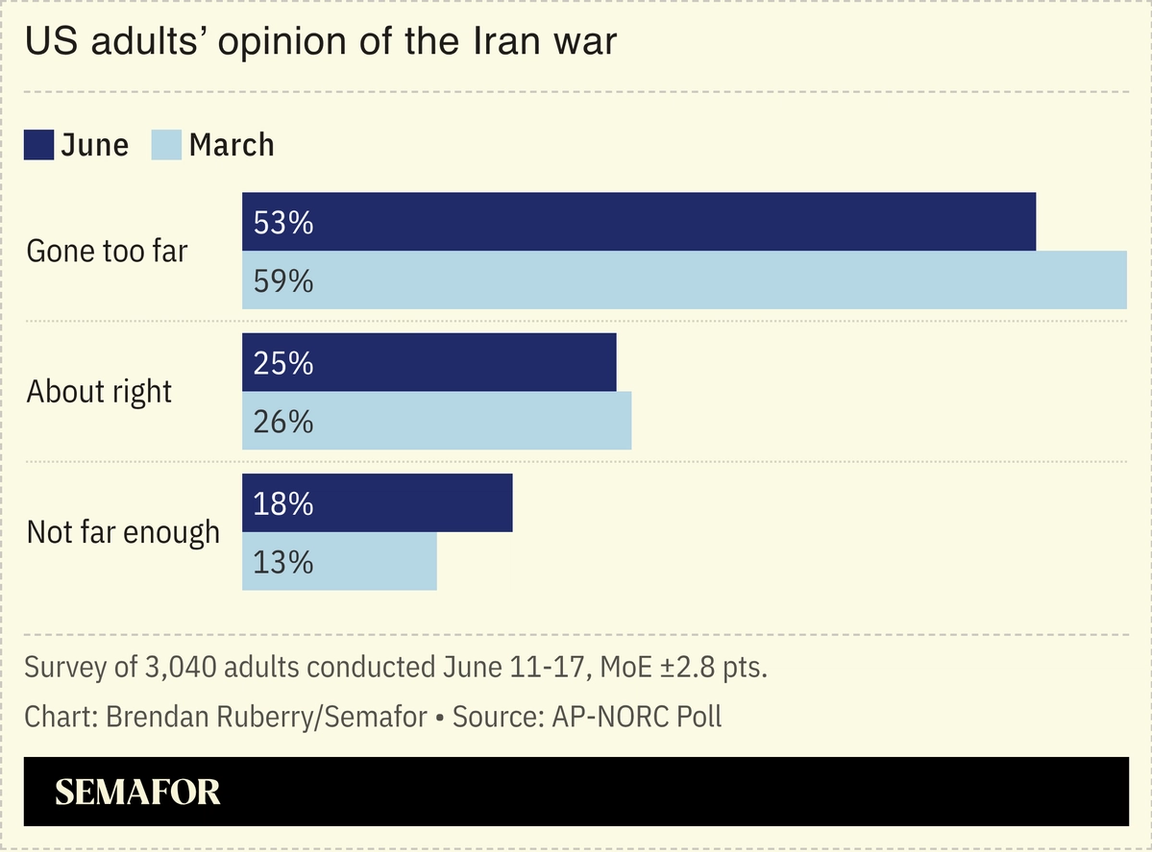 Not that many people seem happy about the ostensible conclusion of the Iran war. Republicans are trying to get there, but they’d rather be celebrating a clearer victory. In the three months since the AP first asked about the war, the share of Republicans who said that the US wasn’t going “far enough” to win nearly doubled, from 20% to 37%. But as the topline numbers show, Independents and Democrats didn’t move toward that position. Instead, a small share of them moved from outright opposition to saying that the war effort was “about right.” Public opinion since Trump signed the memorandum of understanding with Iran has remained unenthused. This will have ramifications for the year’s next congressional fight: A Pentagon request for extra funding to pay for the war, which Democrats face no internal pressure to vote for. |
|
 The insider guide to the energy transition’s new order. Penned by Climate and Energy Editor Tim McDonnell, Semafor Energy delivers sharp reporting and analysis on the policies, people, and power struggles driving the energy transition. As the world reshapes how it produces, distributes, and consumes energy, each edition helps readers understand how the energy transformation is defining the new world economy. |
|
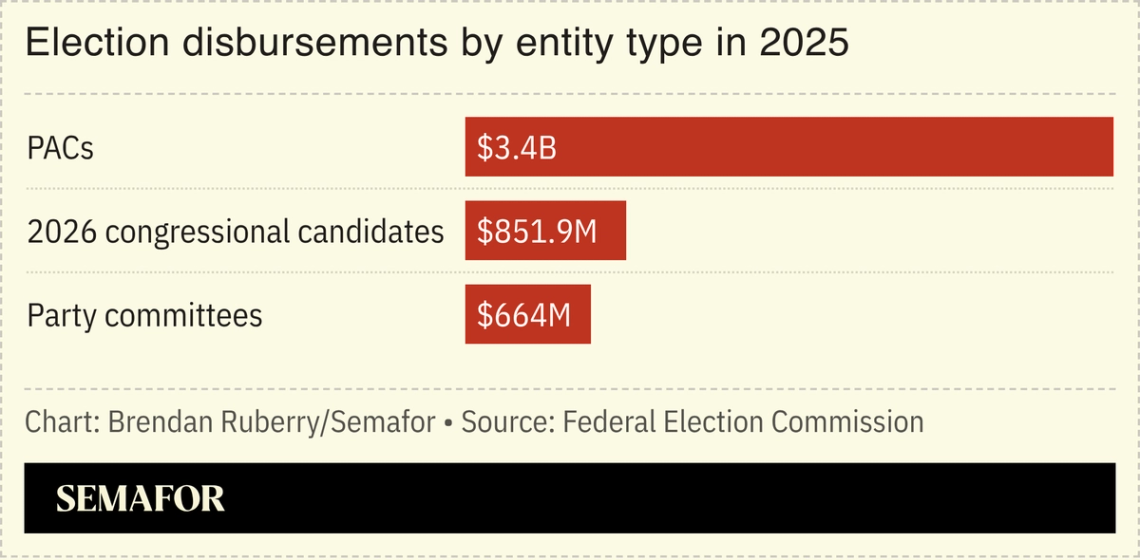 Super PACs have towered over this year’s campaign, sending more mail and buying more ads with less and less disclosure. Politico’s Jessica Piper was the first reporter to pull post-primary filings and confirm that two PACs that assisted left-wing Democratic House candidates (Lead Left and Real Change) were in fact funded by the Conservative Americans PAC, itself financed by the American Prosperity Alliance. In The American Prospect, David Dayen got fresh, nervous insights from Democrats — progressives who otherwise feel confident — about how to blunt the PACs’ impact in primaries. |
|
 My favorite summer read so far, away from the news cycle, has been Julian Jackson’s De Gaulle, published in the UK as A Certain Idea of France. De Gaulle’s own memoirs are probably enough for most people, which he could have predicted. (Jackson quotes de Gaulle favorably comparing his style to Winston Churchill, “who has never written a properly composed book, just interesting observations and |
|
|


