|
Good morning from a scorching Brussels. I’m Mared Gwyn.
Just in: Belarus’s opposition leader Sviatlana Tsikhanouskaya has told Euronews that “democratic Belarus is with Ukraine” and that President Aliaksandr Lukashenka is willing to sacrifice Belarus’s “independence and sovereignty to stay in power”. Watch.
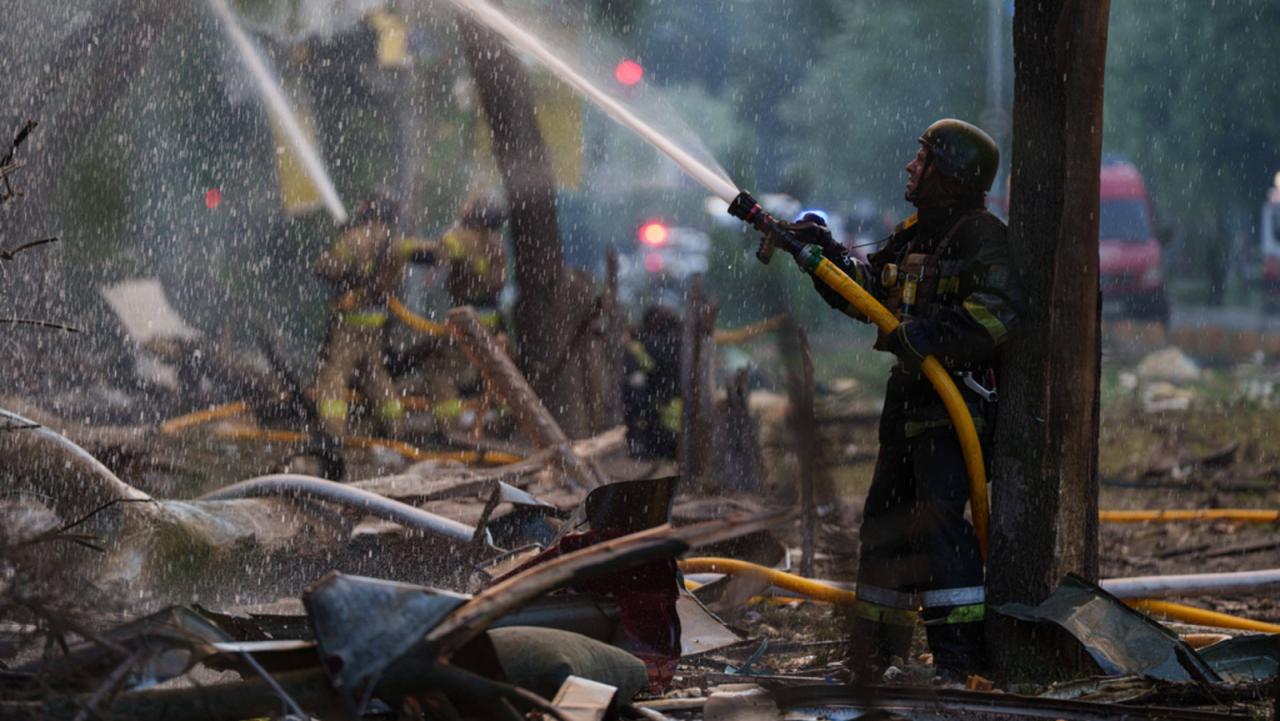
Tsikhanouskaya spoke from Kyiv, which over the weekend was targeted by an Oreshnik missile in what was one of Russia’s biggest attacks in the war to date. More on that below.
But we start today with the drone crisis rocking the Baltic nations – with European Commission boss Ursula von der Leyen and defence chief Andrius Kubilius in Lithuania today for talks with the Lithuanian and Estonian Presidents after vowing a strong and united response to a series of recent drone incursions.
Last Wednesday, a drone alert ground Lithuania’s capital, Vilnius, to a halt and saw people rush for shelter in bunkers. It was the fourth such incursion on Europe’s eastern flank in two weeks, with a NATO jet shooting down a drone over Estonia days earlier.
The drones are believed to be Ukrainian in origin but diverted off course by Russia and sent into European airspace. According to drone experts and security officials, drones knocked off course by electronic jamming are significantly more difficult to intercept and pose a bigger risk to the civilian population.
But beyond the security, economic and social risks of this uptick in incursions, the drone crisis is also threatening the political stability of these nations. Latvia’s government collapsed earlier this month when Prime Minister Evika Silina fired her defence minister over repeated failures in air defence systems.
The Baltic nations say Russia is sowing chaos and threatening to undermine support for Ukraine in countries which have long been Kyiv’s staunchest allies. It’s also piling pressure on Brussels to step up to the plate.
The Commission’s chief spokesperson said today’s visit aims to “stress” EU support for strengthening the Baltics’ defences and ensuring “closer cooperation” in response to threats. But, three months after the Commission unveiled an action plan to support countries to beef up counter-drone security, the continued entry of stray drones into European skies is raising questions about the efficiency and speed of the initiatives.
Also today, EU affairs ministers are gathering in Brussels to discuss the next EU budget, relations with the United Kingdom and preparations for the June summit of leaders, which is shaping up to be consequential, Jorge Liboreiro writes in.
Ahead of the meeting, 16 countries known as the “Friends of Cohesion” have called for an ambitious long-term budget which puts an emphasis on the EU’s regional and agricultural funding programmes.
Another topic on the agenda will be enlargement. Cyprus, the current EU Council presidency, hopes to open the first cluster of negotiation with Ukraine and Moldova before it passes the baton to Ireland on 1 July. The step, as you know, is still under Hungary’s veto. But hopes are rising after the new government in Budapest launched formal talks with Kyiv to discuss the issue of the Hungarian minority in western Ukraine. “We’re working very hard,” said a senior official. “We really want to have the first cluster open, yesterday if we could.”
Meanwhile, other candidate countries continue to march ahead. At the end of Tuesday’s meeting, an accession conference with Albania will take place to confirm its progress under the first cluster, known as Fundamentals. Albania is, after Montenegro, considered the most advanced candidate.
And finally, a look ahead to the rest of this week, with European Commissioners set to gather to brainstorm ideas on how to deal with China’s aggressive trade policies on Friday.
France, Italy, Spain, the Netherlands and Lithuania are pushing Brussels to toughen its trade defences against partners “imposing new trade barriers or contributing to systemic and structural industrial overcapacity”, according to a non-paper seen by Euronews.
The document called for safeguards — including tariffs and quotas — to tackle “sector-wide trade disruptions”, as well as investigations into unfair practices such as dumping and unfair subsidies targeting specific products. It also urges the European Commission to strengthen its trade-defence teams – which currently employs around 140 officials – and to integrate economic security considerations into the assessment of the Union’s interest within the trade-defence toolbox.
But divisions remain within the bloc. Germany did not endorse the document and over the weekend, Spain toned down its participation in the French-led initiative. “We support a balanced approach based on added value, economic openness and the guarantee of secure, diversified and resilient supply chains,” a Spanish government official said. |