This week in religion

ADVERTISEMENT

View in Browser | APNews

Policy changes, but facts endure. AP delivers accurate, fact-based journalism to keep the world informed in every administration. Support independent reporting today. Donate.

By Holly Meyer and David Crary

May 08, 2026

By Holly Meyer and David Crary

May 08, 2026


Hello, World of Faith readers.  


This week, we mark Pope Leo XIV’s one-year anniversary with an in-depth analysis of what he’s tried to achieve – and what’s complicated those efforts. We look at what the founding fathers’ beliefs can tell us about today’s debate over the religious underpinnings of the United States’ beginnings. And we explore the ethical ramifications behind the booming interest in cosmetic surgery.  


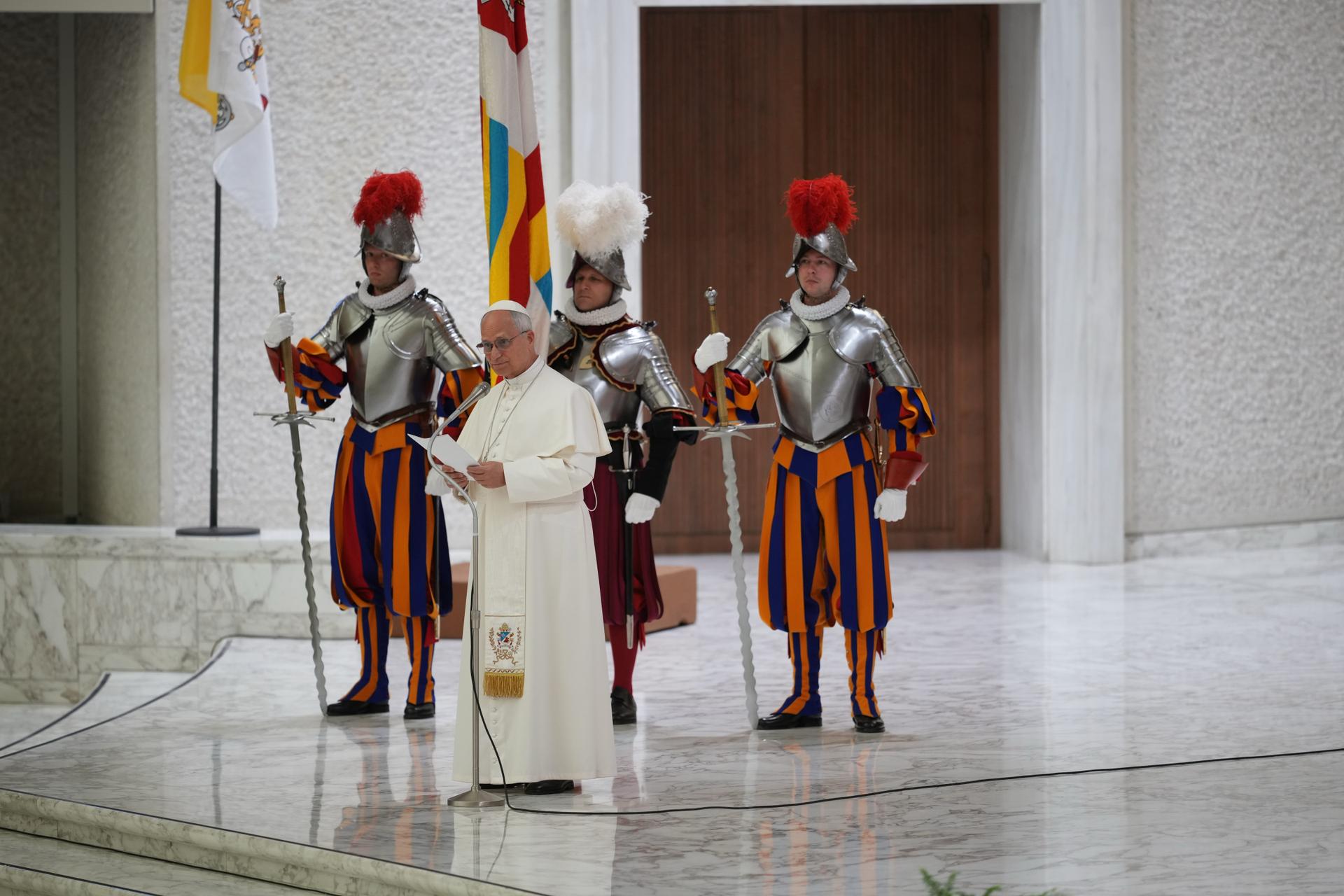
Pope Leo XIV attends the swearing-in ceremony for 28 new Pontifical Swiss Guards in the Paul VI Hall at the Vatican. (AP Photo/Andrew Medichini)

PAPAL ANNIVERSARY

Pope Leo XIV sought a pastoral role in his first year, but verbal sparring with Trump intervened

Pope Leo had tried during his first year as pontiff to insist that his essential role was that of a pastor accompanying his flock. President Donald Trump’s continuing criticisms – and Leo’s increasingly bold retorts – complicated the effort and overshadowed the May 8 anniversary of Leo’s election. Leo met the previous day with U.S. Secretary of State Marco Rubio, who had come to the Vatican on a fence-mending visit. Trump’s repeated broadsides against history’s first U.S. pope created an unprecedented back-and-forth on issues of the Iran war and peace that strained U.S.-Holy See relations. Read more.

Why this matters:

  • By the end of Rubio’s visit, the Vatican and the State Department stressed their strong bilateral ties. But the episode nevertheless pushed Leo to make zingers like this one, after Trump's latest misrepresentation of his views: “If someone wants to criticize me for announcing the Gospel, let him do it with the truth.” 

  • It’s all a bit out of character for Leo who --  the world has come to learn -- is at heart a mild-mannered, 70-year-old Midwestern missionary priest, and a reserved one at that. He likes to play the solitary game of tennis, quotes the 5th century philosopher St. Augustine from memory and insists he is merely quoting the Bible when he calls for peace.

  • The Trump-Leo feud aside, the former Robert Prevost seems driven not by the dramatic gesture or headline-grabbing tensions that often fueled  Pope Francis. Rather, Leo seems inspired by the calm, persistent zeal to preach the Gospel and – thanks to his Augustinian spirituality – emphasize community and harmony. 

RELATED COVERAGE ➤

  • A year in, what's on Pope Leo XIV's to-do list? And what has he done so far? 
  • Pope will inaugurate Barcelona's Sagrada Familia tower and meet migrants in June trip to Spain 
  • Pope encourages wealthy US Catholics to keep donating 
  • Highlights of Pope Leo XIV's trip to Africa
  • The American pope: Pope Leo XIV’s first year in photos
 

FOUNDING FATHERS  

Did the founders create a Christian nation? No, but religion did shape their thinking 

There’s long been debate over the intentions of America’s founders about the role of religion in politics and public life. The debate has been turbocharged with the approaching 250th anniversary of the Declaration of Independence on July Fourth. Read more. 

Key points:

  • Some Christian activists are redoubling claims that the United States had a Christian founding. But scholars note that there’s no established religion in the Constitution and some of the most influential founders weren't Christian.  

  • Yet these founders weren’t anti-religious skeptics; they believed in prayer and that God was helping the revolutionary cause. Scholars say they created a sort of free market in which American religion has thrived to this day.

  • There is no reference to any specific religion in the Constitution beyond the date -- “in the year of our Lord” 1787.  The First Amendment of the Bill of Rights guarantees religious freedom and forbids “establishment” of a national religion. 

RELATED COVERAGE ➤

  • Trump administration agencies post Easter messages celebrating Christ’s resurrection 
  • What does it mean to claim the US is a Christian nation, and what does the Constitution say? 
  • Trump task force report alleges anti-Christian discrimination under Biden administration
 

BEAUTY AND ETHICS

Cosmetic interventions are booming. Many say ethical conversations are lagging 

Technological advancements have made cosmetic procedures more accessible but have also led many to grapple with the philosophical and ethical implications. Some religious views discourage vanity while others see cosmetic surgery as a personal choice. There are multiple factors to consider, including personal autonomy, social pressures and the medical profession’s role. Read more. 

Key points:

  • There has been little in the way of official guidance or explicit prohibitions from major religions. But a growing chorus of theologians, philosophers and bioethicists are calling for more conversations surrounding these procedures and treatments. 

  • In March, the Vatican released a document on Christian anthropology decrying the “cult of the body.” “Once modified, often with relentless frenzy, the body becomes a body-object in which the person-subject mirrors themselves, creating a relationship in which the person is no longer his or her body but ‘owns’ a body,” it said.

  • Demand for cosmetic surgery in the U.S. has increased in recent years across all age demographics and ethnic backgrounds, says Dr. C. Bob Basu, president of the American Society of Plastic Surgeons. One of the biggest changes he’s seen is more young people opting for interventions. 

RELATED COVERAGE ➤

  • Trump pardons Nevada politician who paid for cosmetic surgery with funds to honor a slain officer 
  • Seattle plastic surgery provider accused of posting fake positive reviews must pay $5M 
  • Cosmetic surgery prices in US vs. Mexico