| | In this edition: South Africa’s top court revives Ramaphosa impeachment probe, Dangote plans a Londo͏ ͏ ͏ ͏ ͏ ͏ |
| |  | Africa |  |
| |
|
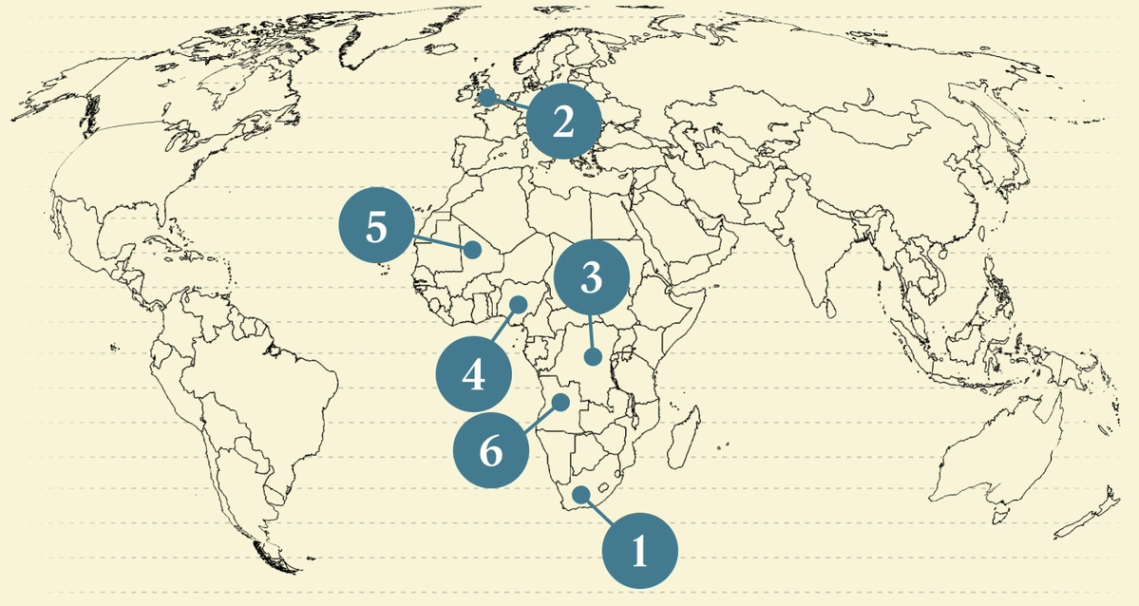 - Landmark Phala Phala ruling
- Dangote plans London listing
- DRC leader eyes new term
- Jumia leans on China imports
- Mali unrest raises concerns
- Global economy trends
 Weekend Reads, and how malaria impacted early human migration. |
|
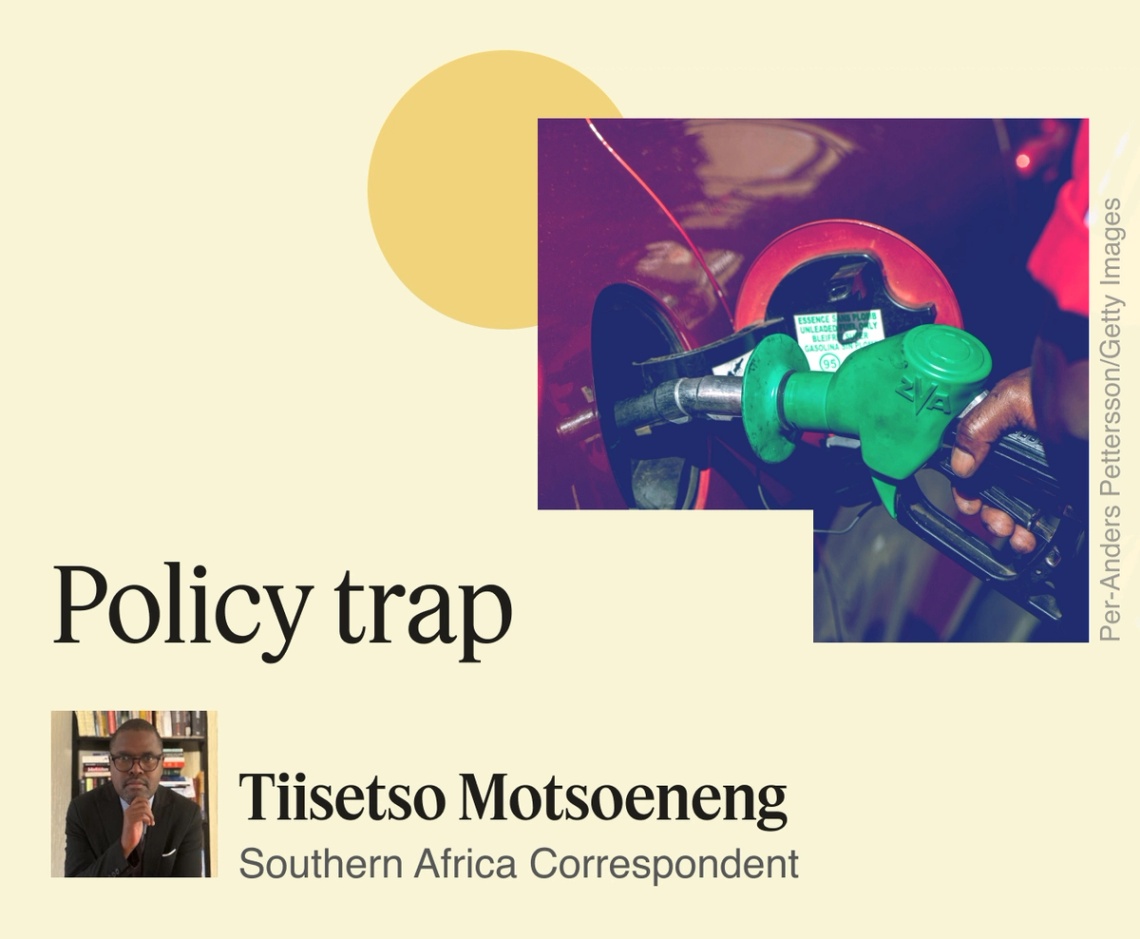 South Africa has stumbled into a classic policy trap. The government last month slashed the fuel tax levy. On paper, it’s a self-correcting fiscal intervention that will cost 17 billion rand ($1 billion), ostensibly a temporary measure, designed to halve in June and vanish completely by July. But here in South Africa, there is nothing quite so permanent as a temporary government relief measure. Once you subsidize survival, you cannot simply turn off the tap, and expect nobody to notice. To understand the trap the state has just walked into, look at the Social Relief of Distress grant authorities instituted in 2020 as a fleeting, six-month pandemic stopgap. It has since morphed into an immovable 200-billion rand ($12-billion) pillar of the national social wage, equivalent to more than a third of what the state spends on education in a single year. South Africa couldn’t revoke the payout because the underlying disease — an economy that has hardly grown for more than a decade alongside unemployment at more than 30% — was never cured. Instead, the grant became the cornerstone of the African National Congress’ survival strategy leading into the highly contested 2024 national elections, and remains vital now within the coalition government of which the ANC is the biggest party. The fuel levy suspension is hurtling toward the exact same political brick wall. Sure, mechanically speaking, letting the suspension expire is easier than taking cash out of the hands of 8.2 million COVID-era grant beneficiaries. But the economic shock of a sudden price jump at the pumps in July will be brutal. South African wages have barely grown in real terms over the last five years, and the typical low-income commuter already surrenders up to 40% of their monthly income to the minibus tax, while increases to the price of diesel will cascade into road freight and farm production. The idea that fragile multiparty coalition partners will willingly orchestrate record high fuel and food prices just months before voters head to the polls in local elections is fiscal fantasy. |
|
S. Africa court revives impeachment probe |
| |  | Tiisetso Motsoeneng |
| |
 South Africa’s President Cyril Ramaphosa. Sharon Seretlo/Gallo Images via Getty Images. South Africa’s President Cyril Ramaphosa. Sharon Seretlo/Gallo Images via Getty Images.South Africa’s top court ordered parliament to restart an impeachment inquiry into President Cyril Ramaphosa, ruling that lawmakers acted unlawfully when they blocked the process in 2022. The majority ruling, which casts a shadow over Ramaphosa’s future, injects fresh uncertainty into the coalition government and marks the first time in post-apartheid South Africa that a sitting president will be forced into a formal inquiry of this scale. The judgment ordered lawmakers to revive scrutiny of Ramaphosa’s handling of the 2020 theft of foreign currency from his Phala Phala game farm, a scandal that triggered allegations of a cover-up and money laundering. Ramaphosa has denied wrongdoing. The ruling and what follows will be watched closely by investors and business leaders in Africa’s biggest economy: Standard Bank CEO Sim Tshabalala, speaking at Semafor World Economy last month, warned that the country’s anemic growth is rooted in the state’s basic inability to uphold the rule of law. |
|
Dangote Cement plans London listing |
 Aliko Dangote. Tasos Katopodis/Getty Images for Semafor World Economy Aliko Dangote. Tasos Katopodis/Getty Images for Semafor World EconomyAfrica’s richest man Aliko Dangote plans to list shares of his cement subsidiary in London, taking advantage of revised requirements by UK regulators who are pursuing more initial public offers by African companies, the Financial Times reported. About 10% per cent of the cement company’s shares would be sold in the process, Dangote told the outlet. Dangote Cement is Africa’s largest cement producer. More than half of its output comes from plants in Nigeria but it operates in 10 other African countries, including Côte d’Ivoire, Ethiopia, and South Africa. Dangote’s 650,000 barrel-a-day refinery in Lagos state — which he plans to list on multiple exchanges in Africa — has become the most high-profile business in his conglomerate as governments seek alternative suppliers of fuels amid the Iran war. But cement remains a strong performer in the group: The unit’s profit after tax rose 53.5% year-on-year in the first quarter of 2026, and its $13 billion capitalization on Nigeria’s stock market makes it one of the country’s most valuable companies. |
|
DR Congo president looks to third term |
 President of DR Congo Félix Tshisekedi. Kevin Lamarque/Reuters. President of DR Congo Félix Tshisekedi. Kevin Lamarque/Reuters.DR Congo President Félix Tshisekedi opened the door to seeking a third presidential term — ostensibly blocked by his country’s constitution — saying during a nationally televised press conference on Wednesday that he would stay available for office if the Congolese people demanded it. Tshisekedi, first elected in 2019, is due to complete his second and final term in 2028. His remarks come amid mounting opposition concerns that proposed constitutional changes could weaken presidential term limits. Tshisekedi also used the press conference to back recent US sanctions against former President Joseph Kabila, saying Washington had validated his government’s longstanding claims that Kabila supported destabilizing M23 forces in eastern Congo. The move has reinforced perceptions that Tshisekedi has become central to the Trump administration’s Africa strategy, particularly as Washington seeks preferential access to cobalt, copper, and other critical minerals vital to energy transition technologies. — Yinka Adegoke and Ruben Nyanguila |
|
Jumia leans on Chinese imports |
| |  | Alexander Onukwue |
| |
 Issouf Sanogo/AFP via Getty Images Issouf Sanogo/AFP via Getty ImagesAfrican e-commerce company Jumia plans to maintain a strategy that has ramped up inventory supply from Chinese vendors in order to achieve profitability at the end of next year, CEO Francis Dufay told Semafor. The company started importing goods from Chinese vendors two years ago to make up for a dearth of suppliers in Africa who can deliver a wide variety of large orders at scale with favorable prices, Dufay said. But it was also a strategy to counter the rise of Chinese online retailers on the continent, he said. Jumia’s revenue in the first quarter rose 39% year-over-year, though it is facing rising fuel prices as a result of the Iran war. “We can’t really charge customers for it because their willingness to pay is limited,” said Dufay. Still, the war’s effects will not significantly change the company’s midterm financial goals, he added. |
|
Mali unrest sparks US security concerns |
| |  | Adrian Elimian |
| |
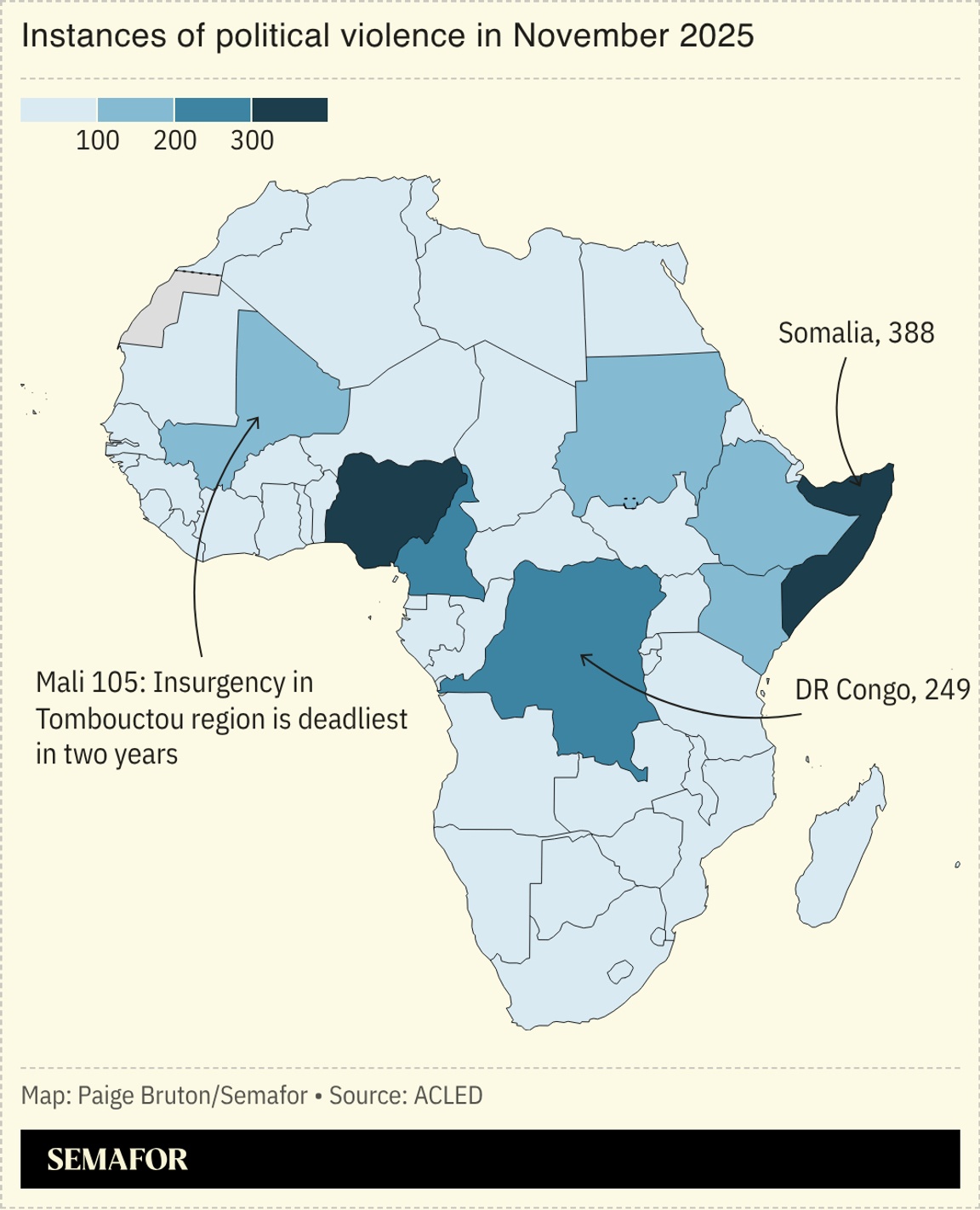 A sweeping jihadist offensive across Mali is raising concerns in Washington about the security of the US embassy in Bamako and the safety of Americans in the West African nation. The scale and coordination of the attacks has sparked urgent questions on Capitol Hill about the future of the military junta that has governed Mali since 2021, plans for US embassy operations, and American strategy in the country, US officials told Semafor. Mali is under a “Do Not Travel” advisory — the State Department’s highest warning. US officials are also working to free Kevin Rideout, an American believed to be held hostage somewhere in Mali or Niger. The growing unrest lands at a delicate moment for US policy in the Sahel: The Trump administration has been quietly rebuilding ties with Mali’s junta as part of a broader effort to warm relations with military-led governments across the region. |
|
Drivers of the global economy |
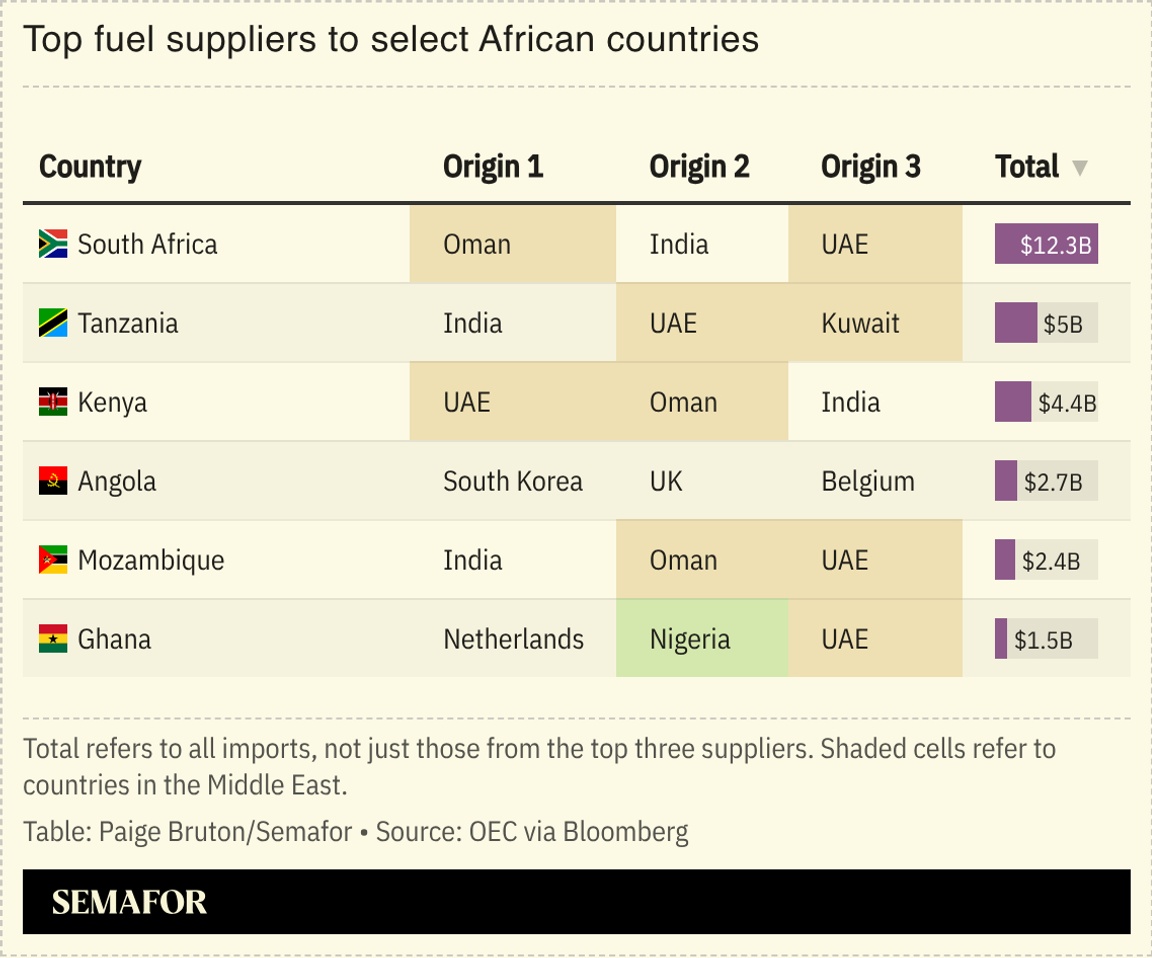 The global economy will be driven by the fallout from the Iran war as well as the buildout of AI-related infrastructure, according to an analysis of more than 300 interviews with top business and political leaders at Semafor World Economy — factors that are unlikely to benefit sub-Saharan African economies. Semafor Intelligence, a new report based on a proprietary AI tool, parsed onstage interviews across five days and ranked nearly 5,000 distinct claims from last month’s gathering in Washington, DC. It found that among the top consensus were arguments that global trade would likely be reconfigured to rely on longer routes that ultimately increase the cost of commerce and that markets are broadly underpricing the fallout from the Iran war. There was also widespread consensus that countries and companies were increasingly focusing on building out energy infrastructure for the AI race, potentially limiting investments in the power needed for other economic priorities. |
|
 - The destabilization of the Sahel’s military juntas in Burkina Faso, Mali, and Niger will trigger more than rising insecurity and migration pressures, columnist Howard French argues for Foreign Policy. As Africa’s population and economic power grow, widespread state failure will reshape the future global economic order and undermine shared prosperity, he says. Pointing to Mali — once a democratic bellwether — as an example, French makes the case for greater Western investment. “The West can choose to engage seriously with Africa’s development now, or it can pay a far higher price later,” he writes.
- Piracy off Somalia’s coast has surged in recent weeks, with some analysts linking the rise in crime to the Iran war. At least three vessels were targeted in the first week of May alone, Al Jazeera reports. Surging fuel prices are considered to be a driving factor — one of the ships had been carrying around 18,000 barrels of oil — and also the recent diversion of anti-piracy efforts to the Red Sea to help counter Houthi attacks. Somalia has long faced piracy troubles, with ransoms demanded between 2005 and 2011 totaling as much as $413 million.
- In December 1982, South African Rodney Wilkinson planted four bombs at the Koeberg nuclear power station where he worked, pulled the pins, had drinks with his colleagues, and then left on a bicycle. The next morning, each of the bombs detonated, causing half a billion dollars in damage. Koeberg was the crown infrastructure jewel of the apartheid regime, and yet Wilkinson was able to blow it up and then disappear into oblivion. Deca
|
|
|


