| | The US and Iran trade fire, Trump and Lula bolster ties, relations between South Africa and the US i͏ ͏ ͏ ͏ ͏ ͏ |
| |  | Flagship |  |
| |
|
The World Today | 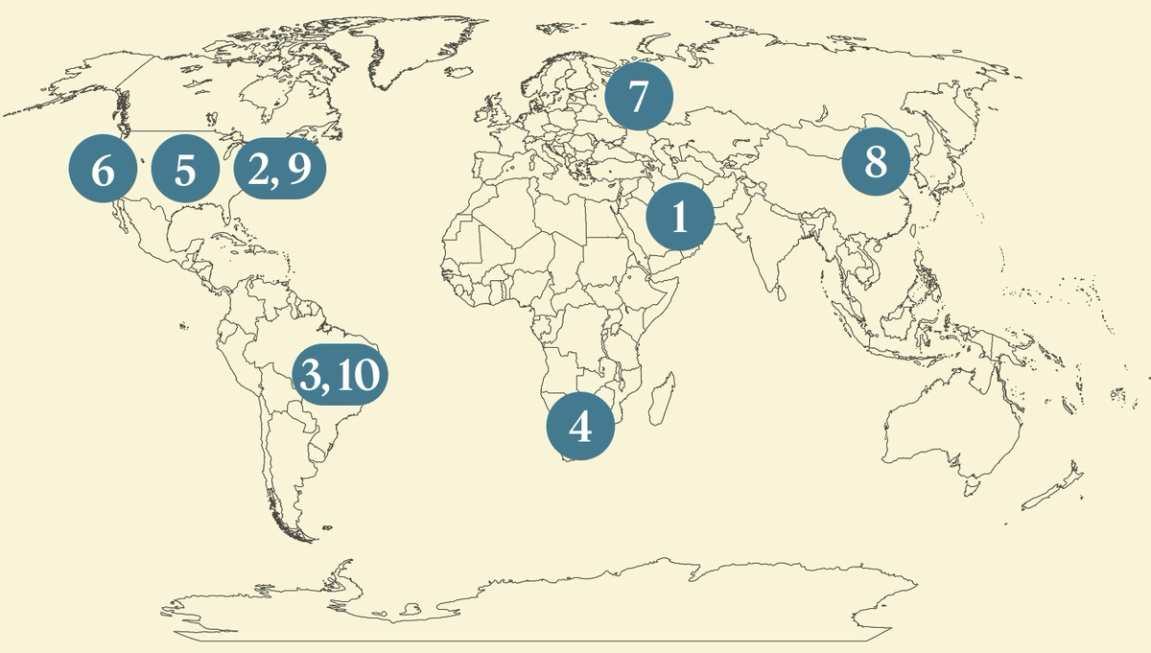 - Iran, US exchange fire
- Court blocks Trump tariffs
- Lula hails Trump meeting
- US-S. Africa trade talks
- Hackers paralyze schools
- AI steps up AI R&D
- Russia’s muted Victory Day
- Corruption in China…
- …and in the US
- Brazil’s new long weekend
 A classic David Attenborough work on the occasion of the great man’s 100th birthday. |
|
Trump’s latest tariff setback |
 Kylie Cooper/Reuters Kylie Cooper/ReutersA US federal court overruled President Donald Trump’s latest effort to impose new global tariffs. Trump had tried to circumvent February’s Supreme Court block on his “Liberation Day” duties, but judges said his justification was inadequate. He remains keen to use levies as a tool of international diplomacy — he threatened the EU with “much higher” tariffs if it did not implement a previously agreed US trade deal, while extending the deadline to do so until July 4. Brussels is weighing striking back by restricting American access to EU public procurement unless the US opens up its own economy. The tit-for-tat measures risk “a cycle of restrictions that leaves all countries worse off,” the WTO chief wrote in the Financial Times. |
|
Lula, Trump ties ‘stabilized’ |
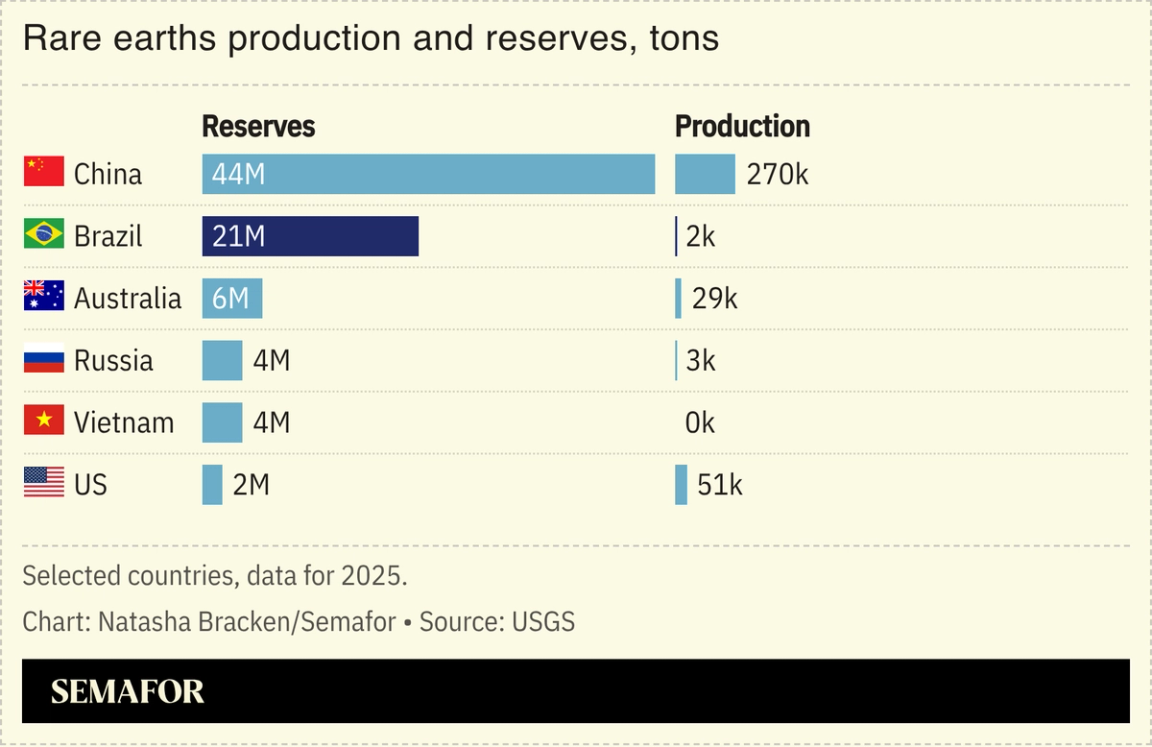 Brazilian President Luiz Inácio Lula da Silva said after a three-hour meeting with US President Donald Trump that ties had been “stabilized,” raising hopes of improved relations between two leaders who have clashed repeatedly. The US imposed onerous levies on Brazilian imports over Brasília’s prosecution of a former, Trump-aligned president, while Lula has criticized Washington for its foreign policy and trade practices. However ties have improved recently as the White House looks to reassert US regional supremacy and increase its access to rare earths. Lula’s visit can only be understood “as part of a global story,” a prominent expert on Latin America wrote: “The US need for rare earths … is acute and perhaps far more urgent than [the] public knows.” |
|
Trade talks between US, South Africa |
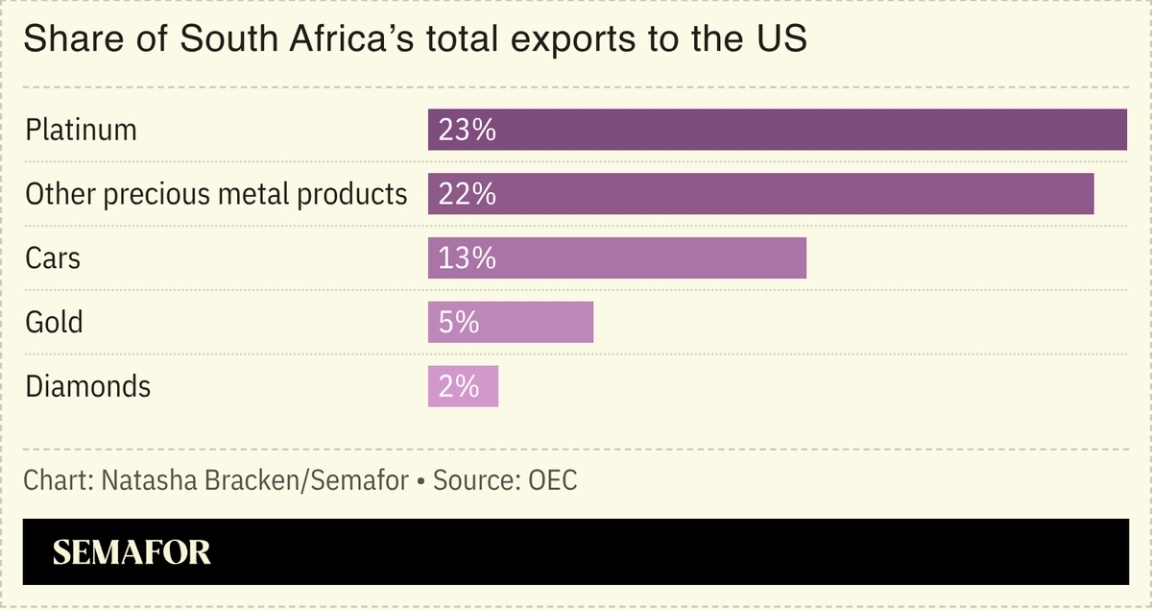 The US and South Africa held bilateral trade talks, a sign that ties may be improving after months of tension. Relations between Washington and Africa’s biggest economy have eroded since the start of US President Donald Trump’s second term, with the American leader accusing South Africa of carrying out a “genocide” of its white population. Though the claims have been dismissed by experts, they have nonetheless prompted Washington to impose significant levies on Pretoria, pushing the country closer to China’s sphere of influence. However the White House’s recent drive to increase its access to African mineral resources has raised hopes of closer trade relations. |
|
 Semafor today launched Semafor Intelligence, a new AI-enabled editorial insight product that transforms the full onstage record of Semafor’s global convenings into evidence-backed analysis — capturing the views of the world’s most consequential decision-makers, the debates shaping their thinking, and forward-looking signals. The first edition draws on Semafor World Economy 2026, where more than 500 CEOs, policymakers, and G20 leaders gathered in Washington, DC to discuss the forces shaping the new world economy. To produce it, Semafor developed a proprietary AI tool that analyzes the full onstage record of each convening, identifying key claims, topics, stances, and supporting evidence, then linking each finding back to the relevant speaker, session, transcript, and video moment. Semafor’s editorial team then distilled the strongest patterns into the sharpest insights. Each published theme combines transcript-backed analysis, speaker moments, citations, and a journalist’s view on why the signal matters. Semafor Intelligence findings from Semafor World Economy 2026 tell the story of The Chokepoint Economy — the consensus among leaders that the promise of globalization has given way to concentrated power and risk, and that resilience is now the organizing principle of the new world economy. Across nine themes, the report surfaces where consensus is forming, where it is fracturing, and where the prevailing views may be dangerously wrong. |
|
AI automating AI development |
 OpenAI CEO Sam Altman. Kylie Cooper/Reuters OpenAI CEO Sam Altman. Kylie Cooper/ReutersAI labs are close to automating their R&D cycle and creating positive feedback loops. In 1966, a computing pioneer predicted an “intelligence explosion” when “an ultraintelligent machine could design even better machines.” This “recursive self-improvement” may already be underway: AI has been used in AI design for years, and new coding models can debug themselves and optimize their architectures. For now, humans are still in the loop, but design cycles are getting shorter, and true self-improving systems are “right around the corner,” a researcher told IEEE Spectrum. In a survey last year, all but two of 25 AI experts said automating AI research could lead to an intelligence explosion and 20 rated it a “severe and urgent” risk. |
|
Russia’s muted Victory Day |
 Stringer/Reuters Stringer/ReutersRussia’s annual Victory Day celebrations look unlikely to be victorious or celebratory. Tomorrow’s event marks Russia’s defeat of Nazi Germany, and usually involves months of rehearsals and a huge military parade. This year, there will be neither rehearsals nor military hardware. Security concerns mean President Vladimir Putin will spend less time in public view on Red Square. “Putin’s magic is fading,” a Carnegie Endowment scholar wrote, while another analyst said rumors of a coup were spreading. Even official polling finds his approval rating at its lowest level since the war began, and high-profile Russians are being unusually outspoken: One former supporter called him a “war criminal” in March, yet, surprisingly, is not behind bars. |
|
 The headlines cover the story. The data explains the why. Gallup’s Front Page is a free weekly newsletter offering rigorous, nonpartisan insight from researchers who have been measuring the world for decades. It provides the context and evidence needed to understand the forces shaping the world — and the implications behind them. Subscribe to stay informed. |
|
China sentences defense ministers |
 Greg Baker/Pool via Reuters. Greg Baker/Pool via Reuters.China sentenced two former defense ministers to suspended death sentences, the most senior officials to be punished in a wide-ranging military anti-corruption push. The pair are among around 100 top officers to be dismissed or disappeared, according to a recent assessment, raising questions over the true capabilities of China’s military amid a purported push to be ready to invade Taiwan by 2027 and fears among Asian leaders over what they see as a more aggressive Beijing. Chinese leader Xi Jinping, meanwhile, risks creating deep shortcomings by pursuing what two Asia Society researchers dubbed a “forever purge” — “bureaucratic paralysis, a depleted elite, and the possibility that a highly centralized discipline system will prove untenable once Xi himself is gone.” |
|
|


