
| Forwarded this email? Subscribe for more |



 |
| By Beverly Gage | PREVIEW |
America is turning 250, and The Free Press is marking the occasion with a yearlong series of events, conversations, and stories celebrating our country’s history. Today, we’re taking a journey with historian Beverly Gage to Southern California. Beverly traded the archives for the open road for her new book, This Land is Your Land: A Road Trip Through U.S. History. We’re proud to publish an excerpt, on the theme park that shaped American politics—and the presidents who loved it. —The Editors
 |
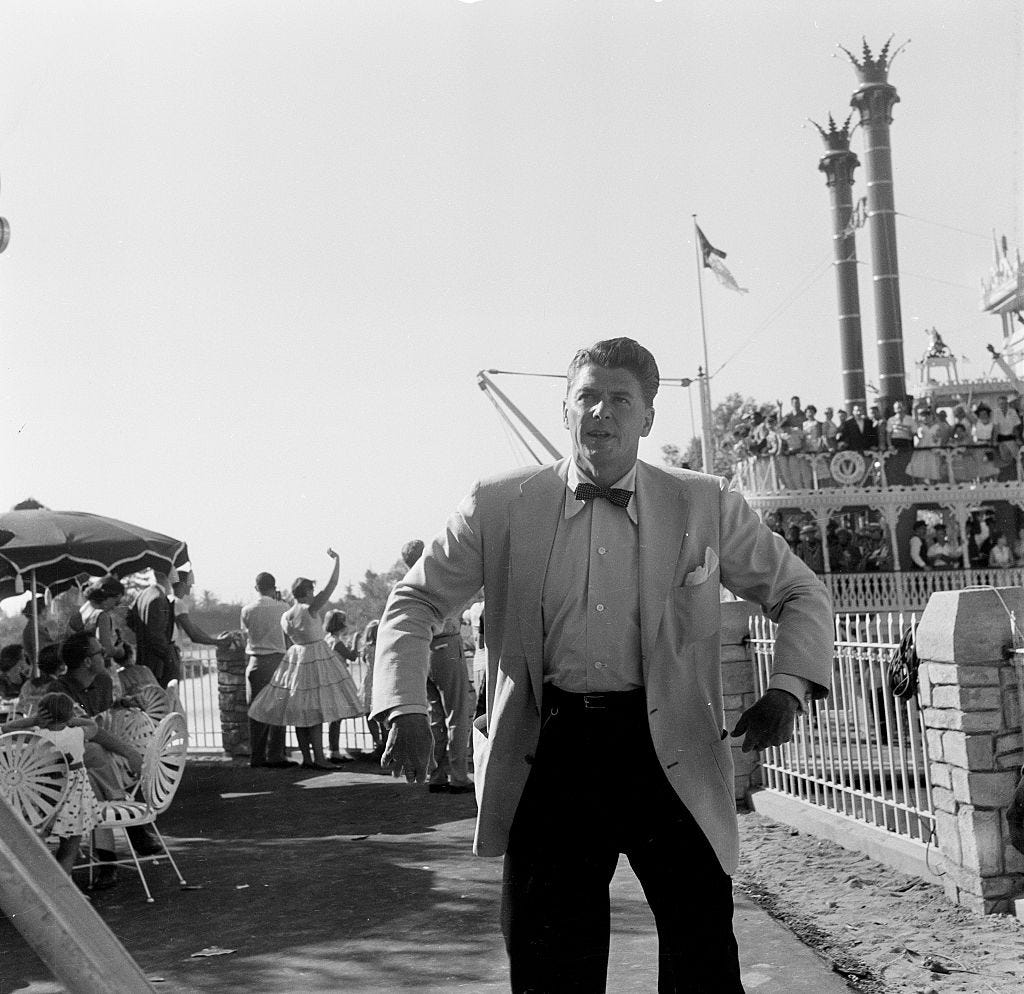
On July 17, 1955, Ronald Reagan stood near a mocked-up wood-plank town in Anaheim, California, where a 13-star flag flew incongruously over an “Old West” landscape, and introduced the world to Disneyland. He had been invited by Walt Disney himself to co-host the park’s live ABC broadcast, alongside Art Linkletter and Bob Cummings—three Hollywood actors who seemed to embody a wholesome, all-American ethos. From the imagined past of Frontierland, the show leaped ahead to Tomorrowland, set in the far-off year of 1986, emphasizing the technical marvels yet to come: nuclear energy harnessed for civilian purposes, human beings riding rocket ships into space. Disney foretold great things for a 1980s in which the United States would serve as “a source of joy and inspiration to all the world.” But even he could not predict the most important political fact of the age: that his genial co-host would become president.
Southern California was a strange place to build a park about the past, because the region at the time was all about newness and abundance and growth. For a lot of its history, Orange County had been Southern California’s version of flyover country: a vast agricultural expanse between two desirable places, Los Angeles and San Diego. But Disneyland was changing that. Before long, 50 miles south of deep-blue Hollywood, Orange County would become a region famed for its right-wing politics—but also for its mythmaking skills. Those two things, it turned out, went naturally together.
| ADVERTISEMENT | |||
|

The two presidents Southern California gave America both understood this instinctively. Richard Nixon and Reagan each built a national career on invoking a version of the American past in which the specificities of historical context mattered less than the big picture. For Nixon, progress meant proclaiming a “New American Revolution” on the eve of America’s bicentennial while dismantling the federal programs that had built the postwar middle class. For Reagan, it meant recapturing a lost optimism and an old-fashioned faith in America as an exceptional nation. Both men were less interested in history as it actually happened than in history as it felt—and Orange County, a place that had built itself almost entirely from scratch, turned out to be exactly where the myth of America’s future was getting made.
I’m a historian—and historians tend to be myth-busters. With the country’s 250th birthday on the horizon, I figured it was a good time to step out of the ivory tower and check in with the past as it exists here and now, at the museums and monuments and roadside attractions where Americans go to learn about their history. After all my travels—to Davy Crockett’s Tennessee and Texas, to the real Erie Canal, to the birthplace of the American automobile and the actual Old West—I couldn’t miss out on Disneyland, the single most influential historic attraction in U.S. history...
Continue reading 'How Disneyland Remade American Politics' | |||||||||||||||||||||||||||
Or | |||||||||||||||||||||||||||
|


