
|
 |
| ||

Open Tab: Emily Sundberg
Building a media business from scratch, why she’s tired of being asked how much she makes, and where Feed Me is going next
|


| ||||||||||||


For our inaugural episode of Open Tab, we knew we wanted to speak with Emily Sundberg. Emily’s the founder and daily writer of Feed Me, a business, tech, and culture newsletter that’s been described as “must-read (and much-read).” She publishes almost every weekday— something like 250 sends a year—covering everything from DTC darlings and media industry churn to New York hospitality and new world etiquette. In the process, she has been profiled by the New York Times and Air Mail, becoming known as a “media it girl” and “one of the most talked-about writers in business and culture journalism.”
Emily has worked in media and tech but built her current audience of over 10,000 paid subscribers natively on Substack, post by post. She told us she sees Feed Me as a studio, with extensions like a podcast, job board, and thriving subscriber comments section where she’s “never scared that anything bad is happening.”
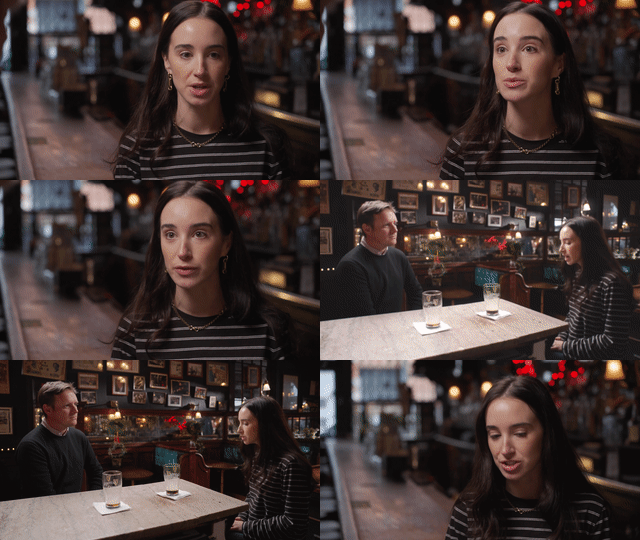
Substack co-founder Hamish McKenzie sat down with Emily at Old Town Bar in Manhattan’s Flatiron district to talk about building her independent media business from scratch and the glimmers of hope she sees for media on Substack and beyond.
Location: Old Town Bar, Flatiron, NYC. Order: 1 Guinness each
FEED ME
Founded: 2021
Format: Daily newsletter
Subscribers: 10,000+ paid (purple checkmark bestseller)
Extensions and verticals: Merch, events, podcast Expense Account (hosted by J Lee). Interview series Guest Lecture (where her paid subscribers have submitted questions for everyone from Lena Dunham to Lina Khan). Recent West Coast and London editions of the newsletter, a job board, and more.
Conversation Excerpts
Hamish: A lot of Feed Me is about money, power, and status. How does that influence how you do [your] job?
Emily: Well, I’ve had a lot of jobs, which has opened me up to a lot of different networks of people. So I’m not coming out of journalism school and writing about the DTC world, or about the hospitality world, or about newsrooms that I’ve never been in. I’ve worked in newsrooms, I’ve worked in venture-backed companies, I’ve worked at Facebook, so I can write about all these things—I don’t want to say “with authority”—but with experience. I know what the chairs feel like in the Meta offices at Hudson Yards.
Hamish: What do they feel like?
Emily: Bouncy, like very adjustable. Everything is like, bring it up, bring it down. I know what the New York Magazine office—
Hamish: What are those chairs like compared to Facebook’s?
Emily: That was the only job that I had a proper cubicle at. It was at the old Varick Street office when Adam Moss was the editor. I loved that job so much. Olivia Nuzzi was one of the first women to ever come up to my desk and be like, do you want to go smoke a cigarette? That happened to me. I’m not writing about her from over here. I hung out with her. You build up your own sources. You’re not blind-calling anyone, because you’ve been around a bit. I think that has given me a lot of perspective when I write about work.
A big thing when I started Feed Me in its current form is that I like to write about the way that people spend money and what that says about them. And I think that’s changed a bit. It’s a little bit more like New York news, and it’s probably a little bit less judgy about how people literally spend money. I think I was probably forcing myself into that narrative a bit.
Hamish: You used to be more judgy?
Emily: I didn’t have an audience. I could hit so hard. I have so many people watching me now, it’s hard. I also don’t really have a team, so if I have a bad day, there’s nobody I’m really looking at [who’s] being like, “It’s fine.”
~^~^~^~^~^~^~^~^~^~^~^~
Emily: I worked at Meta, and during Covid I started writing on Substack. I started writing short horror fiction that was super informed by my time working in social media and the sort of consumer moment that was happening. Matt Levine from Bloomberg linked to one of those stories in his newsletter, and a bunch of my friends sent me photos of their terminals. They were like, “Levine put you in Money Stuff.” And I was like, wait, you’re reading newsletters for pleasure, and there’s cross-promotion in newsletters? It opened my eyes to the traffic potential but also the pleasure potential of reading newsletters. Because in the past, it was like this chore that you gave to somebody on the audience team, like “Aggregate a bunch of stuff and put it in the newsletter.” It has to happen, nobody wants to do it, but we have to send it.
Hamish: The newsletters were used to try and drive traffic to the stories of the property.
Emily: Right, right. To check off a box. And the best-case scenario was that somebody wouldn’t [flag] it [as] spam or unsubscribe. And I was freelance