
|
 |



Commerce Secretary Howard Lutnick was back in the hot seat yesterday, giving closed-door testimony to the House Oversight Committee over his contradictory statements about his past relationship with Jeffrey Epstein.
Ahead of Lutnick’s appearance, Oversight Republicans weren’t exactly rallying to his defense: “I haven’t seen wrongdoing in the email correspondence,” Chair James Comer told reporters. “But he wasn’t 100 percent truthful with whether or not he had been on the island.”
And afterward, Democrats were scathing in their assessment of his performance: “After what we have seen so far, I feel very comfortable in saying Howard Lutnick is a pathological liar who is enabling the most egregious coverup in American history,” Rep. Yassamin Ansari said. Happy Thursday.
 |
No Kings. No Ballroom.
by William Kristol
Donald Trump’s ballroom isn’t just an architectural monstrosity and a blunderbuss of bad taste. It is an assault on American republicanism.
On Saturday, October 18, 2025, somewhere between 5 and 7 million Americans demonstrated under the banner of No Kings.
Ahead of the rallies, House Speaker Mike Johnson claimed the demonstrators would be anti-American and that the message of the rallies would be “Hate America.” He even predicted, “Let’s see who shows up for that. I bet you see pro-Hamas supporters. I bet you see Antifa types. I bet you see the Marxists in full display, the people who don’t want to stand and defend the foundational truths of this republic.”
Johnson lost his bet. The protests were very American. Indeed, one could say that they were animated by “the foundational truths of this republic.” Their spirit and energy followed from the assertion of the Declaration of Independence that governments derive “their just powers from the consent of the governed.” Their propriety and legality followed from the Constitution’s guarantee of “the right of the people peacefully to assemble, and to petition the Government for a redress of grievances.”
And so after that Saturday’s peaceful and patriotic protests, all that was left for most of the No Kings haters was a retreat into sullen silence.
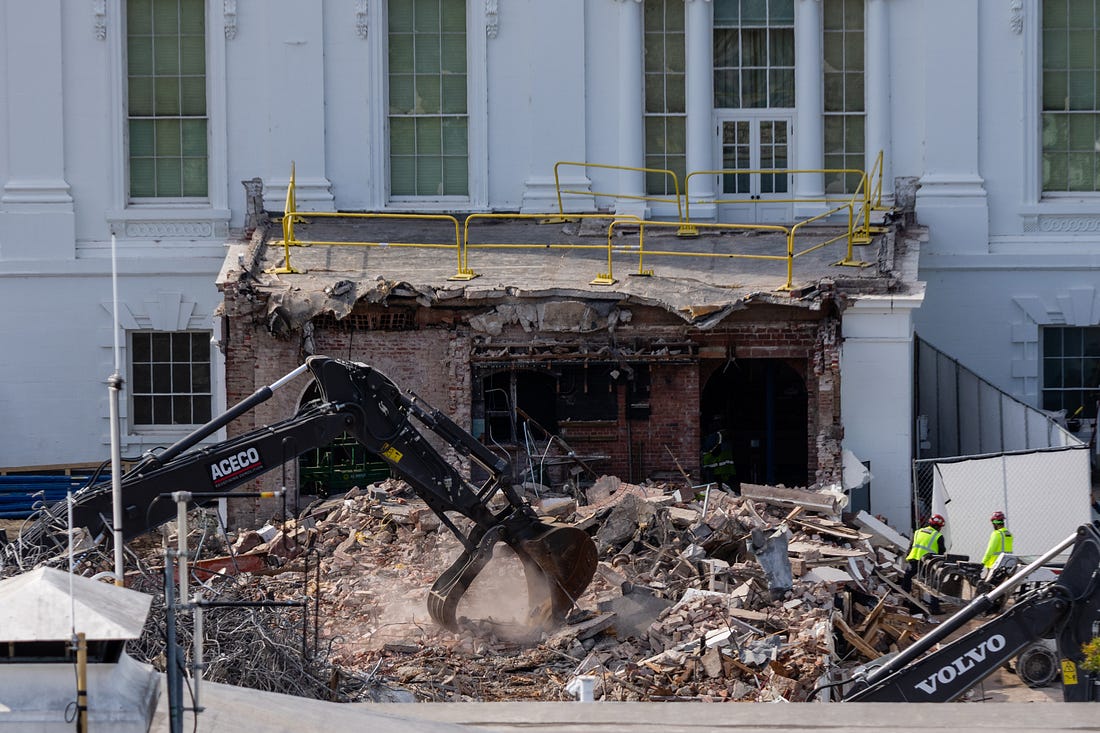
But Trump had a response. Two days later, on October 20, bulldozers suddenly appeared on the White House grounds to begin demolishing the East Wing in order to make way for Trump’s ballroom. There had been no consultation with Congress, or with organizations entrusted with the task of historical preservation, or with the public. Trump couldn’t stop or even discredit citizens rallying on town squares across America. But he was going to show that the White House was not the people’s house but his house. He could and would reshape it unilaterally as he alone decided.
Trump’s action was anti-democratic and anti-republican in spirit. It also comported with his psychological needs. As Timothy Devinney explained recently, the gilded ballroom was one of Trump’s projects that
share a common psychological origin in what might be called an “edifice complex,” which emerges when individuals in positions of authority, uncertain of their place in history, attempt to pre-empt posterity’s judgment with grandiose construction projects. It reflects insecurity and egomania in equal measure.
This is surely why the ballroom—like the planned Triumphal Arch and the renaming of the Kennedy Center—has had such outsized importance to Trump personally. But the destruction of the old East Wing, the transformation of a people’s house into an emperor’s palace, also symbolizes his broader effort to replace the old republican regime with an imperial one. It’s fair to point out that there had already been, for quite a long time, too many imperial encroachments on our old republicanism. But this was a new and dramatic step in the direction of imperial grandiosity replacing republican simplicity.
On August 22, 1864, one of Donald Trump’s predecessors in the presidency, Abraham Lincoln, addressed soldiers returning home during the Civil War from the White House balcony:
I almost always feel inclined, when I say anything to soldiers, to impress upon them, in a few brief remarks, the importance of success in this contest. It is not merely for the day, but for all time to come, that we should perpetuate for our children’s children that great and free government which we have enjoyed all our lives. I beg you to remember this, not merely for my sake, but for yours. I happen, temporarily, to occupy this big White House. I am a living witness that any one of your children may look to come here as my father’s child has.
Our presidents have understood themselves to be temporary occupants of “this big White House.” Trump thinks of himself as the constructor of a permanent Donald J. Trump Ballroom that will dwarf the old, republican White House.
The new Republican party’s budget reconciliation bill, unveiled this week, includes $1 billion for Trump’s ballroom. After last month’s assassination attempt, the rationale for the appropriation is dressed up as presidential and national security. But that was never Trump’s original justification. He wanted a grand edifice built by him and named after him.
In fact, it’s telling that Trump tried to undercut public resistance by stressing that it would be paid for by private donations. But leaving aside all the corruption that this entails, it does bring home that this is a private and imperial project, not a public and republican one.
There a