May 7, 2026
admin-ajax
Morning Rounds Writer and Reporter

Good morning. I was charmed by this profile of tween life in America, both as a former tween girl and as a reporter. I laughed out loud at one tween asking her friend, the main subject of the story: “You’re still getting interviewed?”

a stat examination

What the FDA has lost

Richard Pazdur sits on a couch at his home, lips pursed

Alex Hogan/STAT

Last year, health secretary Robert F. Kennedy Jr. fired about 3,500 workers from the FDA. Now he’s aiming to hire more than 3,200, including reviewers and investigators. But it will not be easy to replace many of those people who were lost, some of whom worked at the agency for decades across multiple political administrations.

STAT’s Lizzy Lawrence spoke with six of these former officials, who recounted their most challenging responsibilities and experiences at the agency. “I didn’t leave the FDA,” said longtime oncology regulator Richard Pazdur, pictured above. “The FDA left me.”

Read Lizzy’s story, which intimately illustrates how much expertise the agency has lost. In addition to Pazdur, she spoke with former regulators including AI policy expert Tala Fakhouri, drug safety expert Mary Ross Southworth, and former biologics and vaccines center leader Julie Tierney.


data points

1 in 10

That’s the number of LGBTQ+ young people who attempted suicide in the past year, according to the Trevor Project’s seventh annual survey, which included more than 16,000 LGBTQ+ people in the U.S. ages 13 to 24. Young queer people have long faced higher risks for mental health struggles, but as the Trump administration continues to pursue restrictions on gender-affirming care, the survey showed that transgender and nonbinary respondents who weren’t able to access hormones were nearly twice as likely to attempt suicide as those who could.

Since President Trump issued his executive order on “gender ideology” attempting to define biological sex as binary, gender identity data has been essentially erased from federal surveillance efforts, including the CDC’s Youth Risk Behavior Surveillance System. That makes the Trevor Project one of few organizations continuing to collect data on young trans people.

If you or someone you know may be considering suicide, contact the 988 Suicide & Crisis Lifeline: Call or text 988 or chat 988lifeline.org. For TTY users: Use your preferred relay service or dial 711 then 988.


first opinion

Remembering ‘the father of modern cardiology’

For Larry Altman, a physician and former medical reporter, it’s difficult to overstate the influence of Eugene Braunwald, a cardiologist who died last month at the age of 96. Altman frequently referenced medical literature edited by Braunwald, and always found him helpful in interviews. In a new First Opinion essay, Altman writes movingly about how Braunwald changed the practice of modern medicine, even as a scandal engulfed his laboratory. 

Early in his career, Braunwald told Altman he had two major visions for the future. First, he wanted to find real ways to help prevent a heart attack and to minimize heart muscle damage after an attack began. He also dreamed of expanding Harvard’s medical campus here in Boston, where in the early 80s, heart transplants weren’t even being performed yet. Read more on Braunwald’s enormous legacy.


graph it

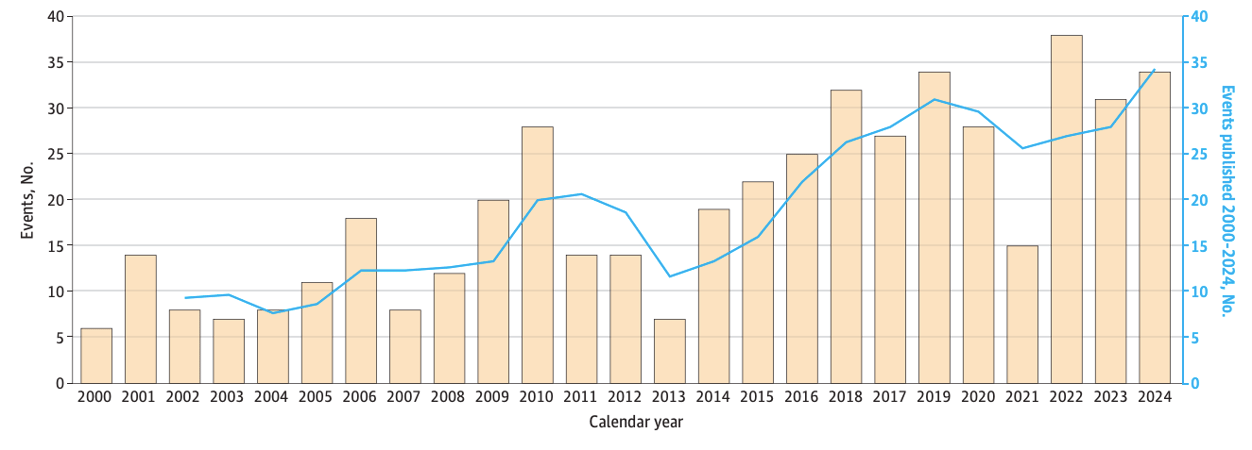
Hospital shootings steadily increased since 2000
Screenshot 2026-05-06 at 1.12.06 PM

JAMA Network Open 

Shootings at hospitals have increased over the years, but nearly a third were preventable with weapons screening, according to an analysis of more than 300 news stories published this week in JAMA Network Open. Large hospitals, those in urban settings, and those in the south saw the most incidents.

As the graph above shows, shootings increased from about 6 per year in 2000 to 34 in 2024. Hospitals have largely struggled to adapt to increasing threats of violence, and the researchers particularly focused on screening as a potential solution. A separate survey of hospital security leaders found that 48% used metal detectors at some hospital entrances, with comprehensive use much less common.


infectious disease

Why hantavirus isn’t the next pandemic

You’ve probably seen a lot of media coverage on the hantavirus outbreak on a cruise ship moored off the western coast of Africa, including here in this newsletter. It makes sense why the situation — people trapped on a ship where a deadly disease might be spreading — triggers flashbacks to the early days of the Covid pandemic. But as STAT’s Helen Branswell reassured some STAT staffers, this isn’t the Diamond Princess revisited.

Still, scientists and public health experts are watching the situation. There’s a lot to be learned about how hantavirus is spread. But the scientific and public health significance does not equate to widespread risk. Read more from STAT’s Helen Branswell on how the experts are thinking about the outbreak.


science

What a discovery of ‘dark proteins’ could mean

Since ribosome profiling was invented in 2009, scientists have used the method to understand the inner workings of model organisms like bacteria, yeast, and mice. Over the years, many of them encountered never-before-seen mini-proteins that could be traced back to parts of the genome that weren’t thought to produce proteins. Scientists generally wrote off these “dark proteins” as cellular noise. But a couple researchers using the method on human tissue samples had a hunch that there was something more there.

One of those researchers, systems biologist Sebastiaan van Heesch, is now part of a team that has found thousands of the mini-proteins and begun to decipher what it is they actually do. In a paper published yesterday, his team reports that some are involved in critical roles like cell division and DNA repair, while several others are unique to cancer cells that they display on their surfaces. Read more from STAT’s Megan Molteni on the discovery’s potential.


More around STAT
Check out more exclusive coverage with a STAT+ subscription
Read premium in-depth biotech, pharma, policy, and life science coverage and analysis with all of our STAT+ articles.

What we're reading

  • In a milestone for ALS, a treatment helps some patients improve, New York Times

  • Trump administration’s drug strategy is at odds with recent actions on funding, policy, STAT
  • RFK Jr. clears path for minors' use of tanning beds, much to the dismay of dermatologists, Los Angeles Times
  • Why the FDA is authorizing fruit-flavored vapes, STAT