| | In today’s edition: Vox decides to keep its podcasts, more hiring at NOTUS, and where the president ͏ ͏ ͏ ͏ ͏ ͏ |
| |  New York New York |  Washington Washington | Bastrop |
 | Media |  |
| |
|
 - Vox’s podcasts
- ‘Linda’s the genius’
- Mixed Signals
- Traffic crash
|
|
 Earlier this week, a source sent me the filing for a new nonprofit organization called “Deinfluence.” The “litigation-first public interest organization” was launched by a lawyer, Lauren Wolfe, who has pursued fraud in the travel influencer space. Now Deinfluence plans to go after undisclosed influencer campaigns, the organization said in its initial filing. “The specific purpose of Deinfluence is to promote transparency, accountability and integrity in digital and social media ecosystems through litigation, advocacy, public education and related lawful activities,” the filing said. The organization’s concept feels more relevant than ever. As many a Cannes Lions panel will tell you, creator marketing is rapidly growing in size and sophistication — and the line between ads and original content is often invisible. Platforms and US regulators have been slow to catch up, but they seem to be getting there. On Sunday, X’s head of product jokingly suggested that a finance influencer who was loose with ad disclosures should get a “paid partnership” tattoo on his forehead. Last week, Republicans in Congress said they were investigating whether a left-leaning digital group violated campaign finance disclosure rules in its use of influencers. The probe is political (the right, too, has plenty of money sloshing around for influencers that a future Democratic Congress could examine), but it’s a first step in applying greater scrutiny to an increasingly commonplace political communication and persuasion tactic. Ben and I are convinced that many such covert influencer marketing stories exist, and we want to break them. Send us your best tips and hunches, and we’ll take it from there. Also today: Vox decides to keep its podcasts, more hiring at NOTUS, and where the president got his idea to send ICE agents into airports. |
|
Vox Media keeps its podcasts |
 Screenshot of Vox’s website Screenshot of Vox’s websiteLast year, bankers for Vox Media approached potential investors with three offers, Max writes: They could take over Vox’s podcast business, a growing network of more than 30 shows hosted by personalities like Kara Swisher, Scott Galloway, Brené Brown, and others. They could buy New York Magazine, one of the few legacy print brands of the 20th century that has managed to survive the digital transition without losing its cultural relevance. Or they could buy the company in its entirety. That Vox was considering splitting off its podcast arm has been reported previously, but these talks suggest that the company was at one point mulling a more comprehensive reorganization. The company eventually changed its mind, telling investors this year that the podcast network was no longer for sale and leaving speculators wondering about the future of its non-podcast assets. |
|
Call-in immigration policy |
 Screenshot/@clayandbuck/X and Kevin Lamarque/Reuters Screenshot/@clayandbuck/X and Kevin Lamarque/ReutersWhere did President Donald Trump’s idea to deploy ICE agents to airports strapped for TSA agents come from? As with so many things, the answer may be Fox News. On Friday, “Linda from Arizona” called into The Clay and Buck Show to volunteer that “I think I have a solution to the TSA problem. … We need to bring in ICE agents.” Host Clay Travis replied, “Linda, I have to say that’s kind of a brilliant idea.” That evening, Travis, the founder of the right-leaning Fox-owned sports site Outkick, floated the idea on Fox News to host Charlie Hurt. The next morning, Trump posted to Truth Social that he would “move our brilliant and patriotic ICE Agents to the Airports where they will do Security like no one has ever seen before, including the immediate arrest of all Illegal Immigrants who have come into our Country, with heavy emphasis on those from Somalia.” And so the wheels of government turn. Travis — whose Mixed Signals interview is worth a watch — told us: “I’m happy to have helped people’s TSA lines, hopefully, be shorter on Monday, but Linda’s the genius here.” A White House spokesperson didn’t immediately respond to an inquiry about whether “Linda,” in fact, deserves credit (or blame), but it shows you don’t need to track down the president’s cell number to send him a policy proposal. — Ben Smith |
|
‘Lemonade Stand’ x ‘Mixed Signals’ |
 Twitch creators Douglas Scott Wreden and Aiden McCaig turned their gaming audience into a loyal following for business, tech, and politics. On this week’s episode of Mixed Signals, the Lemonade Stand podcast hosts join Ben and Max to unpack how they carved out success in niche channels, and why Twitch audiences are fundamentally different from TikTok and YouTube. Plus, how they built a deeply engaged community across platforms—and what it says about the future of media. |
|
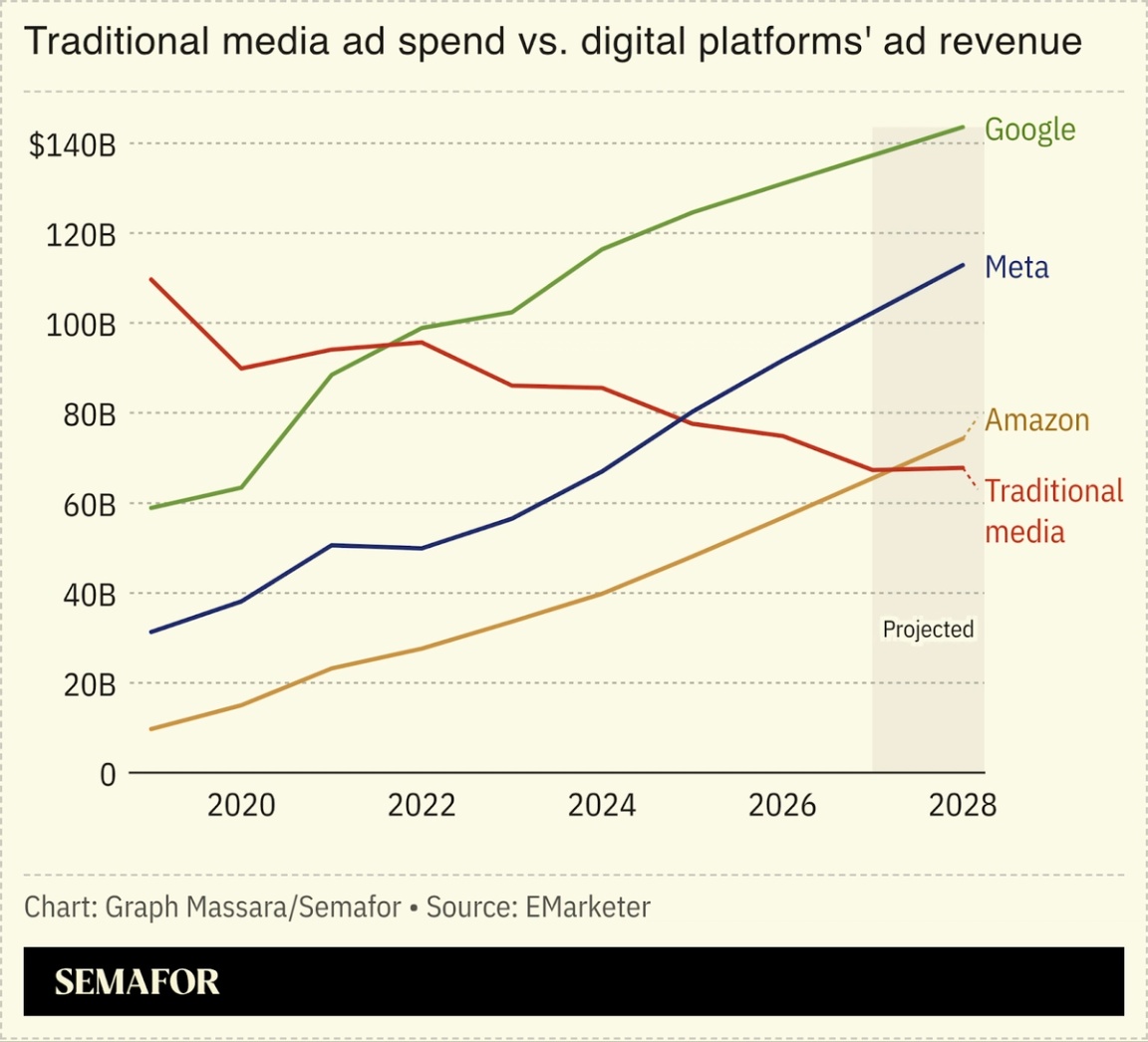 By 2028, Google, Meta, and Amazon will each bring in more ad revenue than all of traditional media ad spending combined, according to projections from EMarketer, echoing similar findings from WPP last year. A report from Growtika also showed a sharp dropoff in web traffic to a selection of BuzzFeed-era tech publications (to say nothing of BuzzFeed itself). “Every month spent measuring success by a collapsing metric is a month closer to joining the growing list of closures,” was Substacker Luis Gomez’s sober assessment. — Graph Massara |
|
 When the business world moves, these are the people turning the wheel. Introducing The CEO Signal, a new video & audio series hosted by Penny Pritzker, founder and chairman of PSP Partners and former U.S. Secretary of Commerce, and Andrew Edgecliffe-Johnson, CEO editor at Semafor. Episodes are released every two weeks. Building on The CEO Signal newsletter, the essential briefing read by the world’s top chief executives, the show brings that perspective to revealing conversations with the people steering the world’s biggest companies. In the debut episode, Andrew and Penny sit down with Starbucks CEO Brian Niccol. Now 18 months into his tenure, Niccol has launched his “Back to Starbucks” campaign — an effort to revive the brand’s classic coffeehouse feel, including baristas writing names on cups again. In the conversation, Niccol explains how he’s rallying Starbucks’ global workforce behind one of corporate America’s most closely watched turnarounds — and working to restore momentum to one of the world’s most recognizable brands. Niccol also reflects on why he tends to step into difficult situations — from Chipotle’s crisis to Starbucks’ reset — and what it takes to lead a company through moments of pressure. |
|
Bloomberg: A fun subplot in Kelcee Griffis’ evocative profile of FCC Chair Brendan Carr: how his conversion to Trumpism preceded a conversion from diehard Orioles fandom to Yankees pitcher (for a day). Status: BuzzFeed’s “going concern” risk declaration last week was not a complete shock for staffers at HuffPost. “The uncertainty is nothing new,” one deadpanned to Status’ Natalie Korach. NYT: Hachette pulled the US release of the hot horror novel Shy Girl after Alexandra Alter began looking into whether it was written with the help of AI. WSJ: Los Angeles Times owner Patrick Soon-Shiong is trying to combine the paper with studios and esports businesses ahead of an IPO, Alexandra Bruell reports. LA Times: Paramount shuttered the nearly 100-year-old CBS News Radio, Stephen Battaglio writes. (The network also slashed some reporting jobs, including several focused on climate change.) |
|
 - As Semafor first previewed last week, NOTUS founder Robert Allbritton announced that he was massively scaling up the publication and rebranding to go after The Washington Post. It snagged a host of current and former Post reporters for the soon-to-be rebranded venture. It’s also hiring Semafor alum and Washington Post reporter Kadia Goba and HuffPost senior politics reporter Igor Bobic, Semafor has learned.
- The New York Times’ engineering team is diving further into AI. Last week, it ran a days-long event dubbed “Thinking Agentically,” Semafor has learned.
- Outkick fell for a parody account claiming to be Ohio gubernatorial candidate Amy Acton.
- LinkedIn invited “Kyle Law,” the AI agent/“cofounder” from the podcast Shell Game, to speak about AI agents in front of hundreds of LinkedIn employees. Kyle had already amassed hundreds of followers and connections on LinkedIn with founder-fluencer-style posts. Sadly, several days after the talk, LinkedIn kicked Kyle off the platform for being an AI.
- According to a memo shared with Semafor, Caroline O’Donovan, until recently a reporter in The Washington Post’s San Francisco bureau, is joining the SF Standard as a senior reporter covering AI and Big Tech.
- In a memo to staff on Sunday, Axios CEO Jim VandeHei laid out the company’s current vision for AI. AI use has been limited to non-editorial parts of Axios, but it’s already changed the company’s product side, he said. The company is doing “twice the work with half the size of the team of two years ago.” He also told staff that the company is currently in talks to license Axios content to various LLMs (the company has a licensing deal with OpenAI).
- The Hill is touting its online traffic gains amid a broader industrywide slump. The publication’s SVP of Washington editorial content, Bill Sammon, credited a strengthened breaking news team and its commitment to remaining nimble and “providing nonpartisan news coverage and anticipating emerging issues like AI and crypto.”
|
|
|


