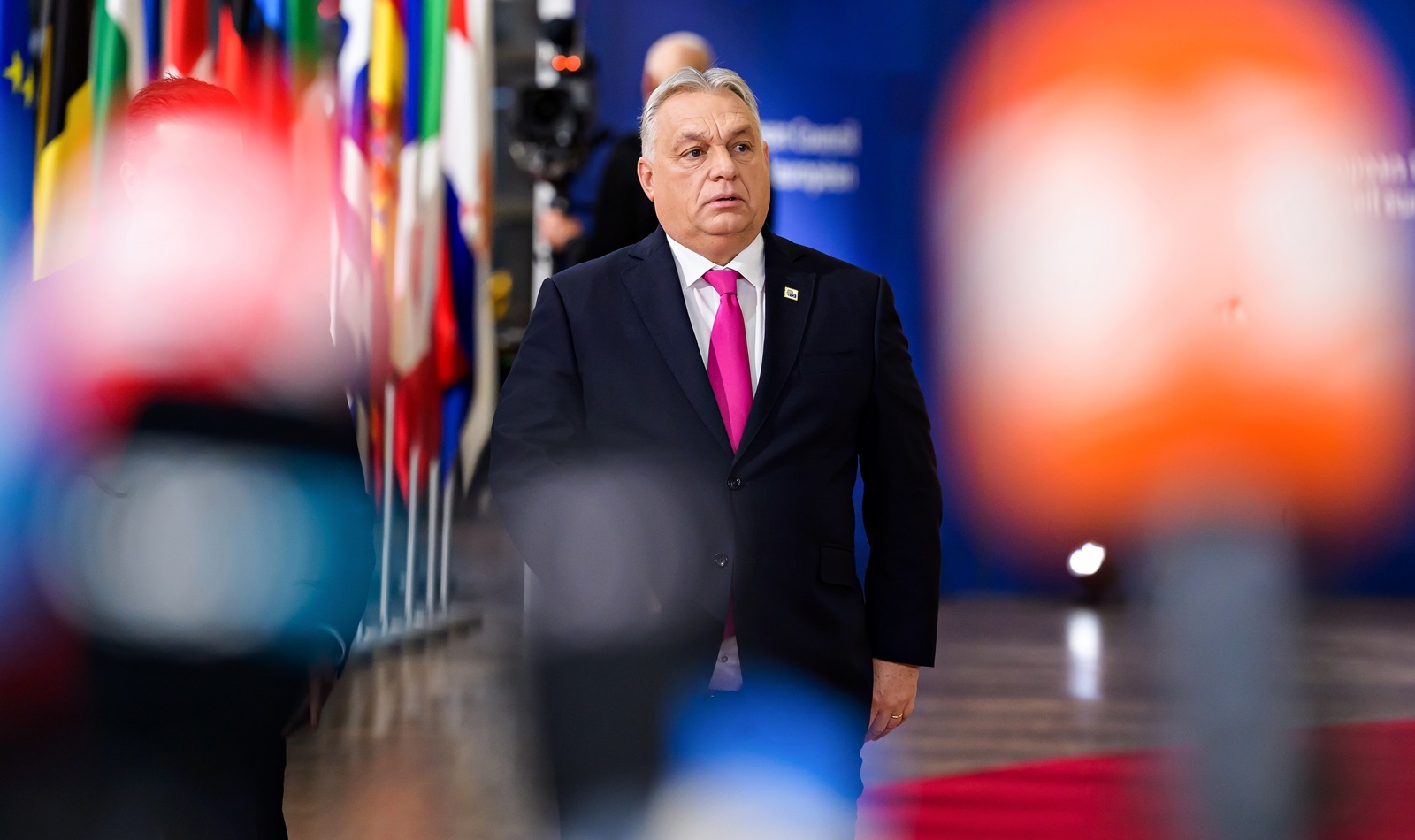
By Jorge Liboreiro
It is fair to say that Brussels, much to its chagrin, has grown accustomed to dealing with Hungarian vetoes now and then. Prime Minister Viktor Orbán has turned the principle of unanimity into a political weapon to be wielded at his sole discretion, raising eyebrows and ruffling feathers along the way.
But there has never been a veto like this one.
In the lead-up to the grim fourth anniversary of Russia’s full-scale invasion of Ukraine, Orbán jolted the system by announcing a veto on the €90 billion loan that the European Union had prepared to meet Kyiv’s financial and military needs for at least two years.
Orbán blamed Kyiv for the interruption of oil supplies through the Soviet-era Druzhba pipeline, severely damaged in late January in an attack attributed to Russia.
“This is an unprovoked act of hostility that undermines the energy security of Hungary,” Orbán said, claiming “political considerations” behind the interruption.
What made this veto particularly explosive was the fact that EU leaders had personally agreed the €90 billion loan at a high-stakes summit in December. The consensus was only possible after Hungary, Slovakia and the Czech Republic secured a tailor-made exemption as a condition for amending the EU budget rules. It was a delicate quid pro quo that did the trick.
Orbán has now stopped the loan in its tracks just as it was about to reach the very final stage of the legislative process. It is extremely rare for a prime minister to backpedal after heads of state and government have put their word in writing.
“When leaders reach a consensus, they are bound by their decision,” António Costa, the president of the European Council, told Orbán in a curt letter. “Any breach of this commitment constitutes a violation of the principle of sincere cooperation.”
Adding fuel to the fire, Orbán has drawn a direct link between the dispute over the Druzhba pipeline and the upcoming general election on 12 April, portraying Ukrainian President Volodymyr Zelensky as an agent of interference. The Hungarian premier is currently facing the most formidable challenge of his career against opposition leader Péter Magyar, lagging in opinion polls by double digits.
“We see that you, Brussels, and the Hungarian opposition are coordinating efforts to bring a pro-Ukraine government to power in Hungary,” Orbán said, addressing Zelenskyy.
The European Commission, which was ready to go to the markets and raise debt as soon as the €90 billion loan was approved, is trying to put on a brave face.
“We will deliver on the loan one way or the other,” Ursula von der Leyen said in Kyiv, speaking next to Zelenskyy and Costa. “Let me be very clear: we have different options, and we will use them.”
Asked to spell out these options, a Commission spokesperson declined to provide details. Privately, EU officials admit the exercise is still in very early stages.
Diplomats, meanwhile, say that there is neither time nor appetite for exploring out-of-the-box shortcuts to bypass Orbán’s veto. The legal texts of the €90 billion loan have already been negotiated by ambassadors and approved by the European Parliament, which means starting the process from scratch is unfeasible. Looming over is the fact that Ukraine needs a fresh injection of assistance as early as April due to the complete withdrawal of American support.
The precarious situation has brought Zelenskyy under the spotlight.
EU officials and diplomats agree that the Ukrainian president, whose relationship with Orbán has sharply deteriorated, needs to “make a move” and that “something has to give” to diffuse the crisis. The most logical move, they say, is fixing the Druzhba pipeline.
Von der Leyen and Costa conveyed the message to Zelenskyy during their joint visit to Kyiv, asking for the repair works to be “accelerated”, a noteworthy message to be delivered publicly.
Zelenskyy heeded the call but warned that the intervention cannot happen “that fast” because of relentless Russian bombardment. “They advise us to repair it, but they know that there have already been attacks on Druzhba,” Zelenskyy said the day after the visit of von der Leyen and Costa. “Our people were injured so that it would work.”
With no clarity on the repairs, Brussels is promoting the Adria pipeline, which carries seaborne oil through Croatia, as an alternative route to fulfil the annual oil needs of both Hungary (5.75 million tons) and Slovakia (4.66 million tons). But the two landlocked countries insist on their right to receive the significantly cheaper Russian crude they have contracted.
The seeds of a potential solution were planted on Thursday, when Orbán, in a new letter to Costa that had a noticeably softer tone, proposed a “fact-finding mission” to inspect the damaged section of the Druzhba pipeline, promising to abide by the conclusions.
“I am fully aware of the political difficulties created by the delay in the implementation of the European Council conclusions on the financial support for Ukraine,” Orbán wrote.
“My initiative also aims at facilitating the timely resolution of this issue.”
|