|



As we speak, today, April 4, 2026, Anthropic ended something that was never supposed to exist in the first place.
Starting at noon Pacific time, Claude Pro and Max subscribers can no longer use their flat-rate subscriptions to power third-party agentic harnesses — OpenClaw first, then every other external agent tool shortly after.
The community reacted with predictable fury. Twitter threads, Hacker News posts, accusations of open-source betrayal, Steinberger calling it a Friday-night bury job.
Boris Cherny from Anthropic offered refunds and tried to soften the landing with credit bundles. OpenClaw’s own documentation was updated within hours to route users toward OpenAI’s Codex subscription as the default alternative.
The drama is real. The outrage is understandable. And it is also almost entirely beside the point.
What actually happened here is not a policy decision. It is a structural correction — the moment when the physics of compute economics finally caught up with an unsustainable arrangement that should never have been allowed to compound as long as it did.
Understanding it properly requires stepping back from the community narrative and reading the mechanics underneath.
 |
The Subsidized Commons Trap
 |
Every subscription model is, at its core, a bet on average consumption. You price the subscription at the average expected cost, add a margin, and rely on the distribution of usage patterns across your user base to make the economics work.
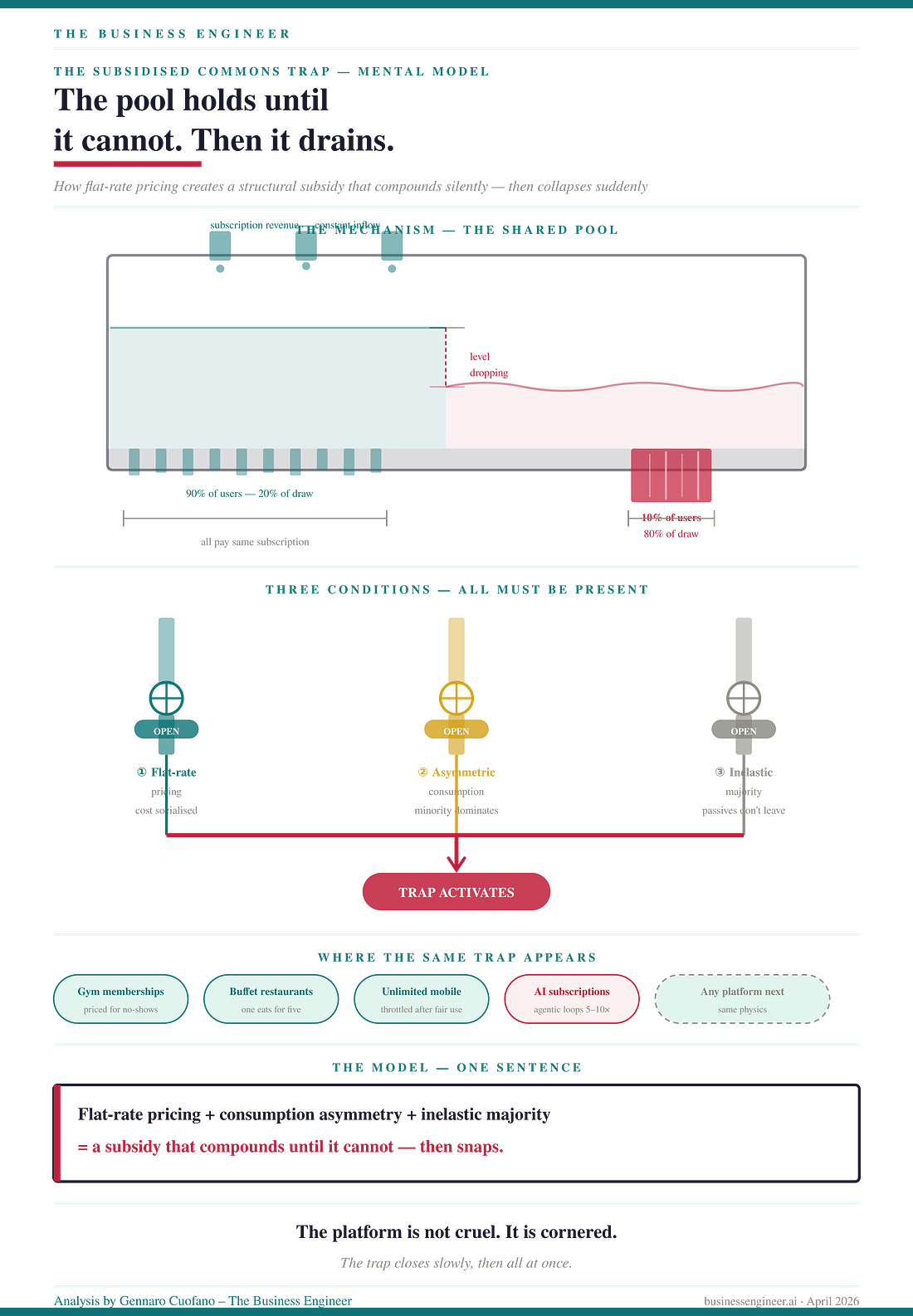
Heavy users are subsidised by light users. The casual Claude.ai subscriber who sends twenty messages a day is paying for the infrastructure consumed by the power user running agentic loops at 2 AM. This is normal and expected — it is how every SaaS business in history has worked.
What broke the model here is the nature of agentic usage.
An OpenClaw instance running continuous multi-step workflows does not generate normal usage patterns. It generates something closer to a small API customer using the system programmatically — except it does so at consumer subscription pricing, which is designed for humans typing messages.
The numbers are stark:
Third-party tools were achieving compute access at 5–10× lower cost than direct pay-as-you-go API rates
Every developer running OpenClaw on a $20–200 subscription was effectively extracting thousands of dollars of compute value per month
That value was being cross-subsidised by every other subscriber on the platform
Over 135,000 OpenClaw instances were running — many of them without any authentication layer at all
That is not a pricing quirk. That is a structural arbitrage. Given the usage patterns Anthropic is currently experiencing and the growth rate they are running, this is not a manageable edge case. It is a growing structural hole in the unit economics that compounds with every new agentic user who discovers the loophole.
The mechanism is what we call the Subsidized Commons Trap: flat-rate pricing socializes computing cost across a diverse user population. Agentic loops privatize the surplus — concentrating consumption in a small minority while spreading the cost across everyone else.
Eventually, the concentration exceeds the cross-subsidy's capacity to absorb it. The only resolution is repricing. Anthropic just repriced.
What is striking is how long it took. The loophole was technically visible since OpenClaw’s launch in November 2025. Anthropic updated their terms in February 2026 to formally prohibit OAuth token use in third-party tools. The actual enforcement only landed in April.
That is five months of documented, known arbitrage that Anthropic tolerated — likely because the goodwill generated by the developer community was worth the short-term compute cost. Until it wasn’t.
The Developer Derangement Problem
 |
This is the part that deserves the most direct treatment, because the community response has been almost perfectly calibrated to prove the point.
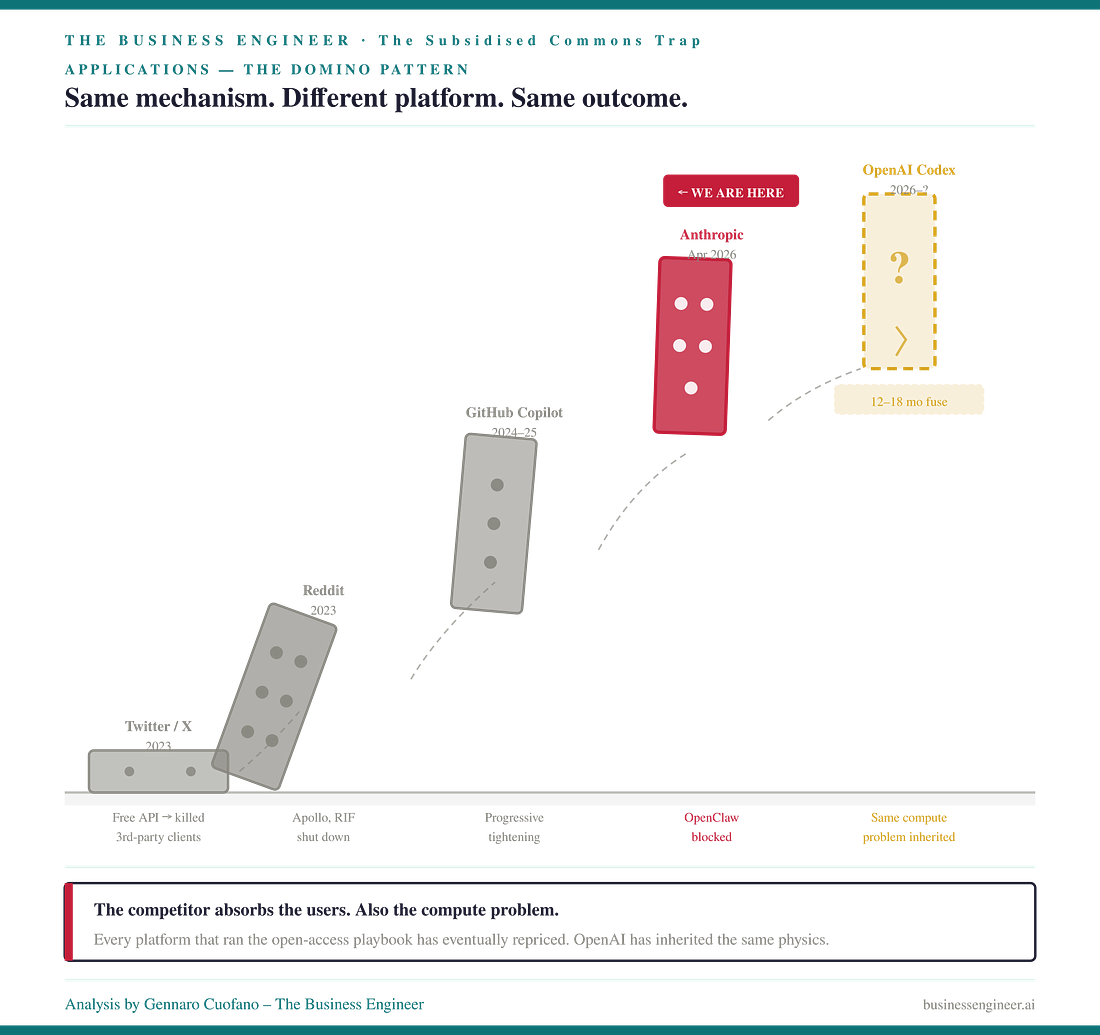
Within hours of the announcement, OpenClaw’s documentation had updated its default recommendation from Anthropic’s API to OpenAI’s Codex subscription.
Peter Steinberger — who joined OpenAI in February — tweeted that he and Dave Morin had tried to talk sense into Anthropic, but only managed a one-week delay. OpenAI’s Thibault Sottiaux endorsed Codex subscriptions for third-party harnesses within the same news cycle. The migration narrative was fully constructed and ready to ship before the policy was even live.
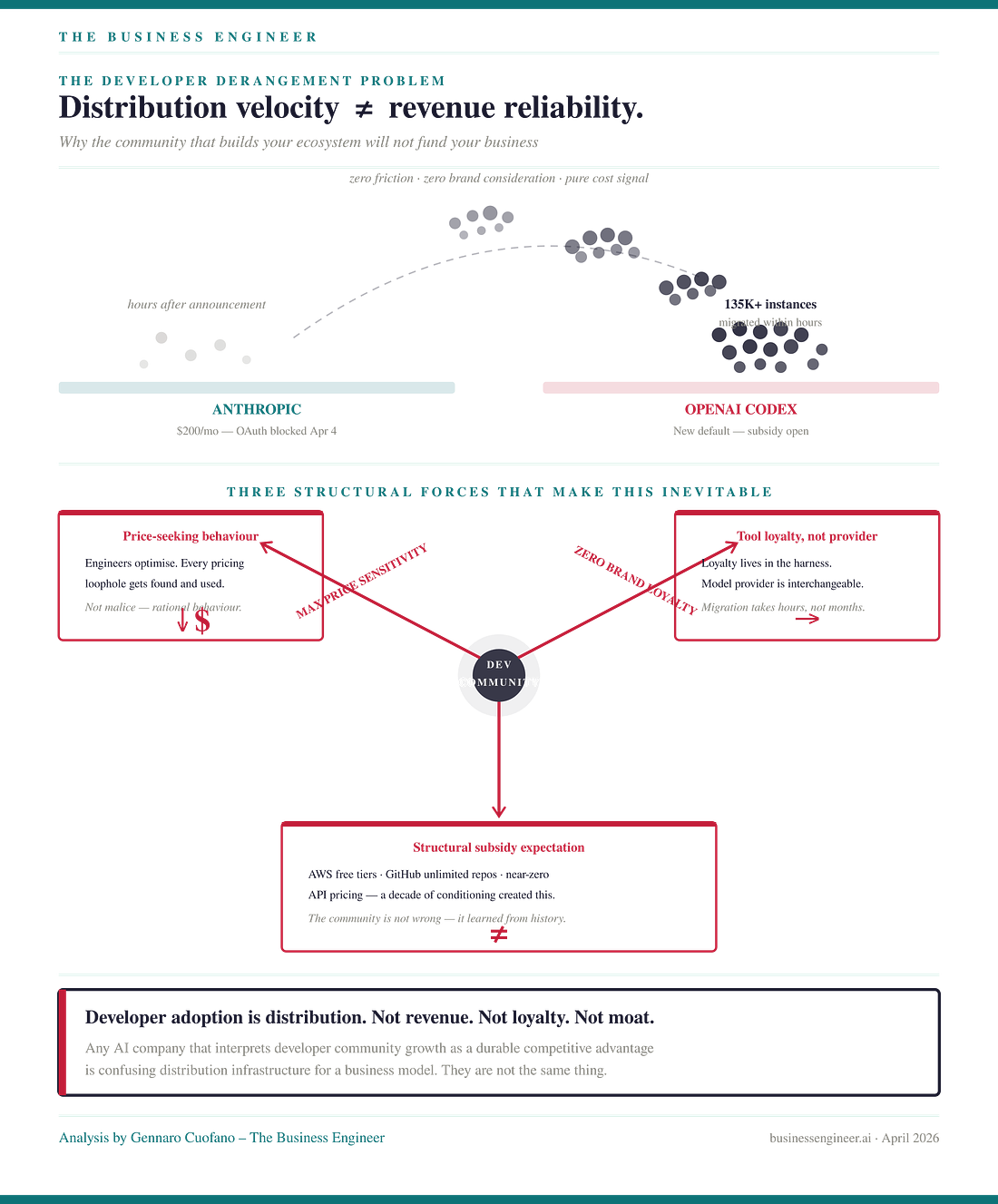
This is the Developer Community Paradox in its purest form. Developer communities offer extraordinary distribution velocity — they build on your platform, create integrations, generate word-of-mouth, extend your surface area faster than any marketing team could. That is real and genuinely valuable. But they come with three structural properties that make them fundamentally unreliable as a revenue base:
Maximum price sensitivity. Developers will systematically identify and exploit every available pricing loophole. Not out of malice — this is rational behaviour. Engineers optimise. Give them an arbitrage and they will use it. The OpenClaw OAuth loophole was not an ethical failure by the community; it was a predictable response to an economic incentive. Anthropic’s error was allowing the incentive to persist long enough to build a user base around it.
Zero brand loyalty to providers. The loyalty is to the tool, not the underlying model. Within hours of the announcement, OpenClaw pivoted its entire onboarding to a different foundation model and the community followed without hesitation. This is not unique to this situation — it is a consistent historical pattern. Developer communities switch providers based on cost and API convenience, not relationships. Any AI company that interprets developer adoption as a moat is misreading the evidence.
Structural expectation of subsidy. The entire history of developer platform economics — from AWS free tiers to GitHub’s unlimited private repositories to every API that launched at near-zero pricing to capture market share — has trained developers to expect that infrastructure cost will be subsidised during the adoption phase. The community’s outrage at Anthropic is not irrational given this conditioning. The error is assuming the same subsidy logic applies when the underlying infrastructure cost is orders of magnitude higher than web hosting or database compute.
Training a developer community on subsidised access and then repricing is genuinely disruptive. But the alternative — maintaining the subsidy indefinitely at the compute costs involved in frontier model inference — is not a business strategy. It is a slow-motion capital destruction event.
Anthropic knows that you cannot build a sustainable business solely on the developer community at current infrastructure economics. The enterprise customer paying for a structured contract, with defined use cases and manageable consumption patterns, is the actual business. The developer community is distribution infrastructure, not revenue infrastructure. Conflating the two is the derangement at the heart of this particular cycle of outrage.