|



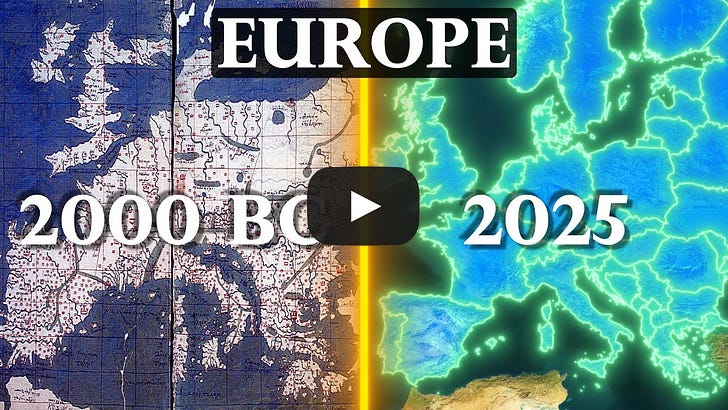
Now available on YouTube. Full video coming soon on Substack and Spotify.
CHECK OUT OUR MAP STORE HERE: https://www.redbubble.com/people/MapStory/shop
WATCH THIS AND ALL OUR VIDEOS OVER ON SPOTIFY:
This Is History This Is History |


The first early European modern humans appear in the fossil record about 48,000 years ago, during the Palaeolithic era. Settled agriculture marked the Neolithic era, which spread slowly across Europe from southeast to the north and west. The later Neolithic period saw the introduction of early metallurgy and the use of copper-based tools and weapons, and the building of megalithic structures, as exemplified by Stonehenge. During the Indo-European migrations, Europe saw migrations from the east and southeast. The period known as classical antiquity began with the emergence of the city-states of ancient Greece. Later, the Roman Empire came to dominate the entire Mediterranean Basin. The Migration Period of the Germanic people began in the late 4th century AD.
The fall of the Western Roman Empire in AD 476 traditionally marks the start of the Middle Ages. While the Eastern Roman Empire would continue for another 1000 years, the former lands of the Western Empire would be fragmented into a number of states. The first great empire of the Middle Ages was the Frankish Empire of Charlemagne, while the Islamic conquest of Iberia established Al-Andalus. The Viking Age saw a second great migration of Norse peoples. Attempts to retake the Levant from the Muslim states that occupied it made the High Middle Ages the age of the Crusades, while the political system of feudalism reached its height. The Late Middle Ages were marked by a large population decline, as Europe faced the bubonic plague, as well as invasions by the Mongol peoples from the Eurasian Steppe. At the end of the Middle Ages, there was a transitional period, known as the Renaissance.
Early modern Europe is usually dated to the end of the 15th century. Technological changes such as gunpowder and the printing press changed how warfare was conducted and how knowledge was preserved and disseminated. The Reformation saw the fragmentation of religious thought, leading to religious wars. The Age of Discovery led to colonization, and the exploitation of the people and resources of colonies brought resources and wealth to Western Europe. After 1800, the Industrial Revolution brought capital accumulation and rapid urbanization to Western Europe, while several countries transitioned away from absolutist rule to parliamentary regimes. The Age of Revolution saw long-established political systems overturned. In the 20th century, World War I led to a remaking of the map of Europe as the large empires were broken up into nation states. Lingering political issues would lead to the rise of Nazi Germany and the outbreak of WW2. The subsequent Cold War saw Europe divided by the Iron Curtain into capitalist and communist states, led by the United States and the Soviet Union respectively, and the creation of NATO and the Warsaw Pact. The West's remaining colonial empires were dismantled. The last decades saw the fall of remaining dictatorships in Western Europe and a gradual political integration, which led to the European Community, later the European Union. After the Revolutions of 1989, all European communist states transitioned to capitalism, and in 1991 the Soviet Union came to an end. The 21st century began with most of the former communist states gradually joining the EU. In recent times, Europe has faced the Great Recession, the European migrant crisis, and the Russian invasion of Ukraine.
You're currently a free subscriber to This Is History’s Substack. For the full experience, upgrade your subscription.
|