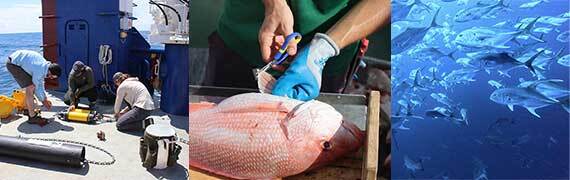
The NOAA RESTORE Science Program is excited to announce $17.2M in awards from the program’s 2025 funding competition focused on long-term trends in the Gulf of America ecosystem. Five projects will receive funding for five years to conduct long-term collaborative research that informs natural resource management. High-performing projects will have the opportunity to apply for an additional five years of funding.
Collectively, these projects will track long term trends in fish spawning aggregations, changes in fisheries habitat use, seagrass health, Rice’s Whale recovery, and age and growth of commercially important fisheries in the Gulf region. These awards will support teams of researchers and resource managers from across 15 institutions with project teams including representatives from universities, government agencies, non-governmental organizations, and the private sector.
Click on each Project Title to learn more about individual projects.
Title: Cooperative Research and Management for Fish Spawning Aggregations in the Gulf of America
Lead Investigator: Rebecca G. Asch
Lead Institution: East Carolina University
Award Amount: $3,558,344
Project Description: This project will verify, characterize, monitor, and model multi-species fish spawning aggregations (FSAs) in the Gulf and evaluate the long-term habitat suitability of FSAs. The project will co-produce information with resource managers at the Flower Garden Banks National Marine Sanctuary and the Gulf Council as well as fishers and scientists to facilitate FSA management and conservation.
Title: Fisheries on the move
Lead Investigator: Debra Murie
Lead Institution: University of Florida
Award Amount: $3,499,949
Project Description: This project will model historical, contemporary, and future trends in the targeting and distribution of select fisheries along the extensive latitudinal gradient of Florida’s west coast in relation to changing ocean conditions. The project will co-produce activities, including selection of study species, with fisheries agencies and angler groups. The products will inform fisheries managers about changes in distribution and size at sexual maturity to assist in determining minimum length regulations.
Title: Understanding drivers of change in seagrass ecosystems to inform management of critical habitats in the Gulf Islands National Seashore
Lead Investigator: M. Zachary Darnell
Lead Institution: University of Southern Mississippi
Award Amount: $3,059,252
Project Description: This project will identify drivers of change in Gulf Islands National Seashore seagrass communities by monitoring water quality, mapping seagrass extent, characterizing soundscapes and nekton communities, and developing ecosystem models to examine linkages between these variables. The goal is to provide managers with an improved understanding of ecological baselines, and co-develop a framework that allows for detection of changes in ecosystem structure and function over time.
Title: Long-term Assessments of Rice’s Whales for Endangered Species Recovery Planning
Lead Investigator: Melissa Soldevilla
Lead Institution: NOAA NMFS Southeast Fisheries Science Center
Award Amount: $3,572,490
Project Description: This project will use passive acoustic monitoring, physical oceanographic data, and acoustic tracking arrays to quantify relationships between trends in relative Rice’s whale density, oceanographic factors, and ambient noise. The project will co-produce products for use by the Bureau of Ocean Energy Management, NOAA NMFS, and a Mexican marine protected area to enhance understanding of the whale’s ecology.
Title: Fish Gene Tools: A Co-Production Project to Incorporate Fisheries Genomic Tools into Next-generation Stock Assessment
Lead Investigator: David S Portnoy
Lead Institution: Texas A&M University- Corpus Christi
Award Amount: $3,560,800
Project Description: This project will develop cutting-edge species specific epigenetic aging methods for 16 managed Gulf fishes using fin clip samples, replacing expensive and time consuming traditional otolith aging methods. The goal is to provide the Gulf Council with operationalized data collection and the use of genomic techniques to improve time series analysis of Gulf fishes via stock assessment.
The projects were selected following a rigorous and competitive process that included review by a panel of outside experts. Review criteria included the importance and applicability of the project, technical and scientific merit, overall qualifications of applicants, project costs and project team integration and practices.
This funding is provided through the RESTORE Act, also known as the Resources and Ecosystems Sustainability, Tourist Opportunities, and Revived Economies of the Gulf Coast States Act. RESTORE was created following the Deepwater Horizon oil spill.
The mission of the NOAA RESTORE Science Program is to carry out research, observation, and monitoring to support the long-term sustainability of the Gulf ecosystem, including its fisheries.
|